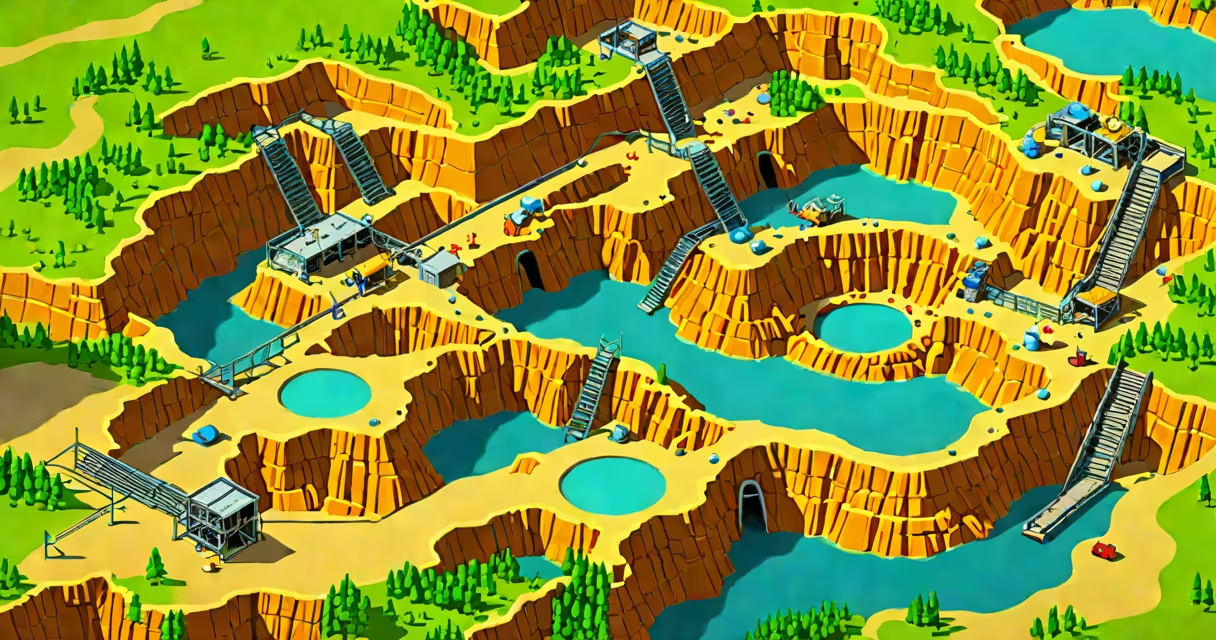
The environmental impact of mining refers to the measurable harm caused by extracting minerals and fossil fuels from the Earth, including deforestation, water pollution, soil erosion, and biodiversity loss. These effects occur during exploration, extraction, processing, and waste disposal stages.
Mining operations disrupt natural landscapes through excavation and removal of overburden-rock and soil covering valuable deposits. This process alters drainage patterns, increases sediment runoff into rivers, and degrades adjacent ecosystems. For example, the Mount Polley mine disaster in British Columbia released 25 million cubic meters of mine waste into nearby lakes and rivers in 2014, killing fish and contaminating drinking water supplies.
According to the U.S. Environmental Protection Agency (EPA), acid mine drainage-formed when sulfide minerals in rock react with air and water-can lower pH levels in streams to below 4.0, making water toxic to aquatic life. This condition persists for decades after mining ends, requiring long-term remediation efforts.
Environmental damage begins at the site selection phase. Large-scale mining projects often target remote or ecologically sensitive areas, such as tropical forests or high-altitude wetlands. Once operational, mining consumes vast amounts of water and energy, contributing to local resource depletion.
Processing ores requires chemicals like cyanide and mercury, especially in gold mining. The World Bank reports that artisanal and small-scale gold mining accounts for nearly 30% of global mercury emissions, primarily due to informal refining practices. In Ghana and Indonesia, unregulated miners use mercury to extract gold, leading to contaminated soil and water near villages.
Waste rock and tailings-byproducts left after mineral separation-are stored in impoundments. Failures in these structures cause catastrophic spills. The 2015 Brumadinho dam collapse in Brazil killed 270 people and released 12 million cubic meters of toxic sludge, destroying downstream habitats and polluting the Paraopeba River.
Environmental impacts fall into four main categories: physical disturbance, chemical contamination, climate change contribution, and biodiversity disruption.
| Type | Primary Cause | Example | Source |
|---|---|---|---|
| Land degradation | Open-pit excavation, spoil pile accumulation | Mountaintop removal in Appalachia removed 500+ mountains since 1970 | National Geographic |
| Water pollution | Acid mine drainage, heavy metal leaching | Peru's Yanacocha mine discharged 12 tons of arsenic into rivers annually (2010-2015) | UNEP report, 2016 |
| Greenhouse gas emissions | Energy-intensive processing, diesel-powered equipment | Copper mining emits ~15 kg CO₂ per kg of copper produced | International Energy Agency, 2022 |
| Biodiversity loss | Habitat fragmentation, noise and light pollution | Gold mining reduced orangutan habitat in Borneo by 40% between 2000-2015 | WWF, 2017 |
A lesser-known consequence is the creation of "ghost mines"-abandoned sites with ongoing pollution. The EPA identifies over 500,000 abandoned mines in the U.S. alone, many still leaking pollutants into groundwater systems. Remediation costs average $1.2 million per site, according to the Government Accountability Office.
Many assume that all mining is equally damaging. In reality, impact varies by scale, method, and regulation. Large industrial mines in countries with strict environmental laws-like Sweden or Canada-often implement closed-loop water systems and reclamation plans that minimize long-term harm.
Another misconception is that recycling metals eliminates the need for mining. While recycling reduces demand, it cannot meet current global needs. The International Energy Agency estimates that clean energy technologies will require 3x more lithium, 5x more cobalt, and 10x more nickel by 2050 compared to 2020 levels. This surge will increase mining pressure unless circular economy models are scaled rapidly.
Some confuse mining with quarrying. Quarrying extracts stone, sand, or gravel for construction and typically causes less chemical pollution than metal or coal mining. However, both degrade land and contribute to dust emissions. A study in India found that 68% of quarries failed to comply with dust control standards, affecting respiratory health in nearby communities.
The Ok Tedi mine operated from 1984 to 2002 and discharged over 100,000 tonnes of waste into the Ok Tedi River daily. This led to widespread siltation, which smothered aquatic life and destroyed fish populations important to local subsistence fishing.
By 2000, downstream communities reported a 70% decline in fish catch and increased rates of skin rashes and gastrointestinal illness. The PNG government later estimated cleanup costs at $1.3 billion-equivalent to 10% of the country's annual GDP at the time.
This case illustrates how environmental damage extends beyond immediate site boundaries. The river system spans over 1,000 km, affecting 200,000 people living along its banks. Legal action against the mining company took 15 years to resolve, highlighting the difficulty of holding corporations accountable for transboundary harm.
Nations have adopted frameworks to limit environmental harm. The European Union's Critical Raw Materials Act (2023) mandates that all new mining projects undergo lifecycle assessments and public consultation. Projects must demonstrate net-positive environmental outcomes or face rejection.
In Canada, the Canadian Environmental Assessment Act requires that mining proposals include reclamation plans showing how land will be restored post-closure. The Red Chris mine in British Columbia was temporarily shut down in 2014 after a spill of 4.5 million liters of acidic wastewater into the Aiyansh River. The incident prompted stricter monitoring protocols and mandatory emergency response drills.
Despite these measures, enforcement remains inconsistent. A 2021 audit by Transparency International found that 60% of mining companies in Latin America failed to publish environmental performance data. Without transparency, communities cannot verify compliance or hold operators accountable.
On-site mitigation strategies include phytoremediation-using plants to absorb heavy metals-and bioremediation using bacteria to break down toxins. At the former Iron Mountain Mine in California, researchers introduced sulfate-reducing bacteria to neutralize acid drainage. After five years, pH levels rose from 2.1 to 6.8, restoring aquatic life in the creek.
I visited a reclaimed coal mine site in West Virginia in 2022. The area had been converted into a solar farm with native grasses planted over compacted spoil piles. During a site tour, a biologist pointed out that bird diversity had increased by 45% since reclamation began in 2010. However, soil samples still showed elevated levels of selenium-a byproduct of coal combustion-indicating that full recovery may take centuries.
This experience confirmed that restoration is possible but slow. Even with active reclamation, legacy pollution persists. Long-term monitoring is essential to track progress and adjust management plans.
Understanding the environmental impact of mining is critical for evaluating trade-offs in energy, technology, and infrastructure development. As demand grows for materials used in batteries, semiconductors, and green tech, responsible sourcing becomes more urgent. Consumers and policymakers must consider not just the function of a product, but the cost of obtaining its raw ingredients.