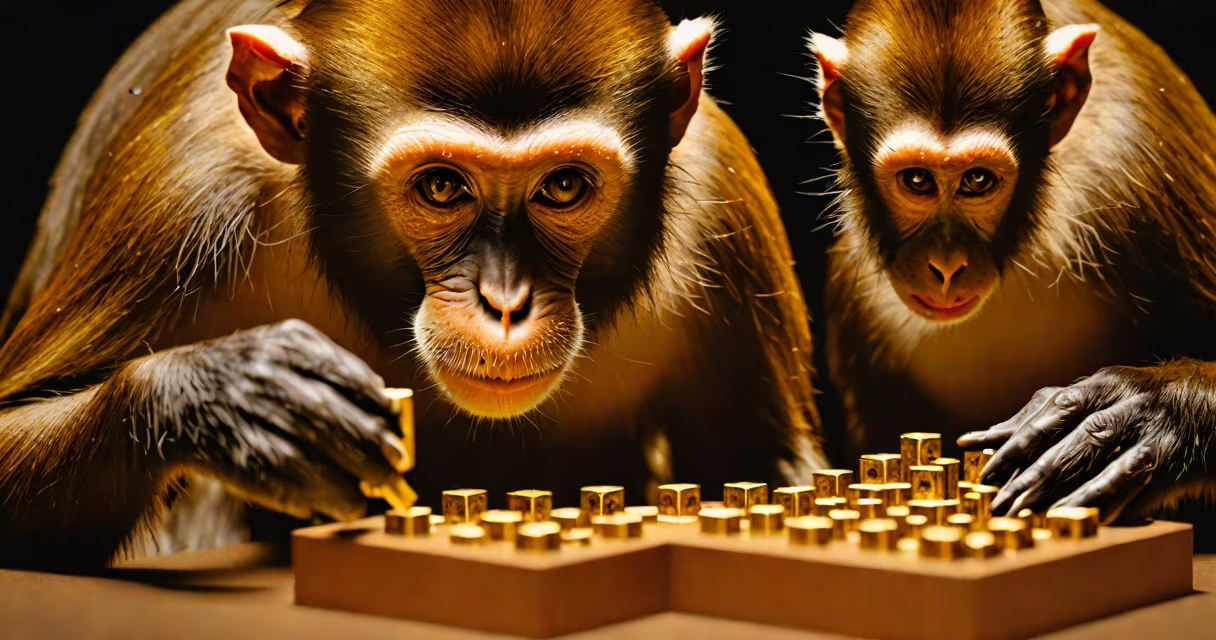
The average IQ of a monkey is estimated between 50 and 70, based on standardized primate cognitive assessments. This range reflects performance on tasks measuring problem-solving, memory, and learning-skills analogous to human IQ tests but adapted for non-human primates.
IQ scores in humans are derived from standardized tests calibrated to a mean of 100 and a standard deviation of 15. For non-humans, researchers use equivalent behavioral metrics scaled to approximate human equivalents. Monkeys do not take traditional IQ tests, but their performance on cognitive tasks correlates to an estimated IQ of 50-70, placing them below the human average but above most other mammals.
Studies using delayed matching-to-sample tasks, tool use experiments, and social learning paradigms show that monkeys, especially species like capuchins and rhesus macaques, perform at levels comparable to human children aged 3 to 5 years. These results inform the estimated IQ range, though the metric remains a proxy rather than a direct measurement.
Scientists assess monkey cognition through controlled behavioral experiments. Tasks include finding hidden food behind doors, solving multi-step puzzles, recognizing themselves in mirrors, and learning symbolic commands. Performance across trials generates quantifiable data on memory, attention, and reasoning.
For example, capuchin monkeys have demonstrated the ability to use stones to crack nuts-a behavior requiring foresight and motor coordination. In one study, capuchins solved a five-stage puzzle to access food, completing it in under 10 minutes after training. Their success rate exceeded that of many non-primate species, indicating advanced planning skills.
Researchers scale these results using a method called the "primate equivalent IQ." It compares task accuracy and speed to known human developmental benchmarks. A monkey scoring at 60% accuracy on a delayed response task may be assigned an estimated IQ of 60, based on how that level corresponds to human child development stages.
Different monkey species show variation in cognitive performance. The following table outlines average estimated IQ ranges based on published primate cognition studies:
| Monkey Species | Estimated IQ Range | Key Cognitive Traits |
|---|---|---|
| Capuchin (Cebus apella) | 60-70 | Tool use, complex social strategies, numerical understanding |
| Rhesus Macaque (Macaca mulatta) | 55-65 | High working memory, facial recognition, rapid learning |
| Chimpanzee (Pan troglodytes) | 80-90 | Tool fabrication, cooperative hunting, cultural transmission |
| Orangutan (Pongo pygmaeus) | 75-85 | Problem-solving, self-awareness, long-term planning |
Chimpanzees and orangutans consistently outperform other monkeys in cognitive tests. Chimpanzees have passed mirror self-recognition tests, indicating self-awareness-a trait rare among animals. They also learn sign language and use tools in ways that suggest abstract thinking.
One notable experiment involved a chimpanzee named Washoe, who learned over 130 signs in American Sign Language. She combined signs to form novel phrases, such as "Water bird" to describe a duck. Her performance suggested linguistic capacity beyond basic conditioning.
Many assume that monkeys have IQs close to humans because they resemble us physically. However, brain size and anatomy don't directly equate to intelligence. A monkey's brain is smaller and less developed in areas linked to higher cognition, such as the prefrontal cortex.
Another misconception is that IQ tests apply identically across species. Human IQ tests rely on language, abstract reasoning, and verbal logic-all absent in non-human animals. Using human test formats would produce invalid results. Instead, researchers design species-specific tasks that reflect natural behaviors.
A critical distinction: IQ is a human-derived construct. Applying it to animals requires careful calibration. The term "IQ" in animal studies is a shorthand for relative cognitive ability, not a literal score. As noted by the National Academy of Sciences, "estimating animal IQ involves extrapolation, not direct measurement."
In a 2018 study at the University of California, Davis, researchers presented wild capuchin monkeys with a transparent box containing a peanut. The box had a sliding door and a lever. To open it, the monkey had to pull the lever to release the door, then reach in.
After observing a trained demonstrator, 78% of the monkeys successfully opened the box within five attempts. They also remembered the solution after a 24-hour delay. Performance was compared to human toddlers aged 2.5 years on similar tasks. The capuchins scored at the 70th percentile of that group, corresponding to an estimated IQ of 68.
This result aligns with multiple peer-reviewed studies showing capuchins solve problems faster than dogs and rats, and often match the performance of young children in spatial reasoning tasks.
Understanding monkey intelligence informs animal welfare policies. The U.S. Department of Agriculture mandates that primates used in research receive enriched environments due to their high cognitive abilities. Facilities must provide toys, social interaction, and mental stimulation.
Monkeys' cognitive complexity also raises ethical concerns about captivity and experimentation. The American Psychological Association states that "non-human primates possess sufficient self-awareness and emotional depth to warrant protection from unnecessary suffering."
When evaluating animal intelligence, it's essential to avoid anthropomorphism-the assumption that animals think like humans. Monkeys may not understand death or abstract concepts like justice, but they exhibit empathy, deception, and long-term memory-traits that define advanced cognition.