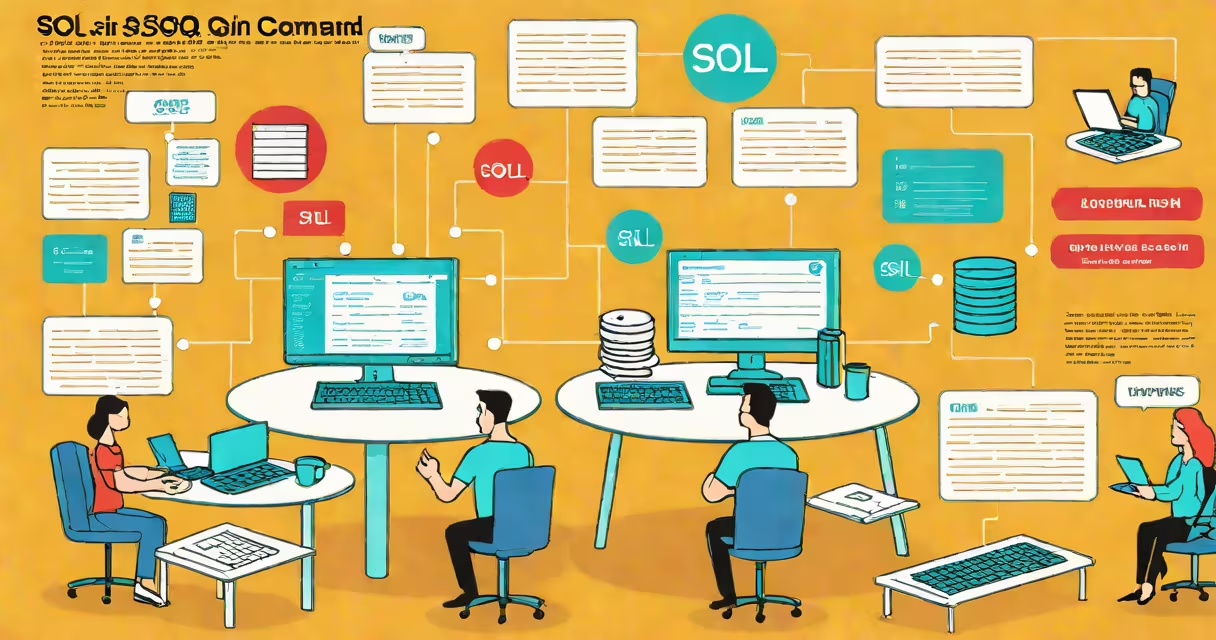
SQL (Structured Query Language) is a standard language used to store, retrieve, and manage data in relational databases. It lets users ask specific questions of data systems, such as "Show me all customers who bought something last month."
Every time you search for something online, check your bank balance, or browse products on a website, SQL is likely working behind the scenes to pull the right data quickly and accurately.
Think of SQL as a set of instructions you give to a database, like telling a librarian which books to find based on author, title, or subject. The database understands these instructions and returns the correct results.
SQL operates on tables-organized collections of data with rows and columns. Each row represents a single record, like one customer or one product. Columns define the type of data stored, such as name, price, or date.
To get data, you write a query using SQL syntax. For example, SELECT name FROM customers WHERE city = 'New York' tells the database: "Find the names of all customers whose city is New York."
Databases process these commands instantly, returning results in milliseconds-even when handling millions of records. This speed makes SQL essential for websites, apps, and business systems.
SQL uses a small set of core commands. Here's what each does:
| Command | Purpose | Example |
|---|---|---|
SELECT |
Retrieve data from a table | SELECT * FROM orders WHERE status = 'shipped'; |
INSERT |
Add new data | INSERT INTO employees (name, role) VALUES ('Anna', 'Manager'); |
UPDATE |
Change existing data | UPDATE products SET price = 19.99 WHERE id = 101; |
DELETE |
Remove data | DELETE FROM users WHERE last_login < '2023-01-01'; |
These commands form the foundation of almost every database interaction. You don't need to memorize them-just understand their purpose.
SQL powers most modern applications. Online stores use it to track inventory and orders. Banks rely on it to verify account balances and transaction history. Social media platforms use it to show your friends' recent posts.
For example, when you log into Facebook, the system runs a SQL query like SELECT * FROM users WHERE email = '[email protected]' AND password_hash = 'abc123...'; to confirm your identity.
Major companies like Google, Amazon, and Netflix use SQL-based systems internally. Even smaller businesses use SQL through tools like MySQL, PostgreSQL, or SQLite to run their websites and manage customer data.
SQL is not a programming language in the traditional sense like Python or JavaScript. It doesn't control hardware, animate graphics, or build user interfaces. Instead, it focuses solely on data manipulation.
It's also not a standalone tool. You can't run SQL directly on a computer without a database management system (DBMS), such as MySQL Server, Microsoft SQL Server, or Oracle Database. These systems interpret SQL and execute the requested actions.
A common mistake is thinking SQL is only for developers. In reality, anyone who works with spreadsheets, reports, or business analytics may use SQL daily. Data analysts often write SQL queries to extract insights from large datasets.
Suppose a small coffee shop tracks daily sales in a database with a table called sales. The table has columns: date, product, quantity, and revenue.
To find out how much money the shop made on June 15, 2024, the owner runs this SQL command:
SELECT SUM(revenue) AS total_revenue
FROM sales
WHERE date = '2024-06-15';
The database returns total_revenue = 432.50. That's $432.50 in sales for that day.
This simple query replaces hours of manual spreadsheet work. With SQL, the owner can analyze trends over weeks or months, compare performance between products, or spot slow days.
SQL is standardized by the International Organization for Standardization (ISO) and the American National Standards Institute (ANSI). But despite this, different database systems implement SQL slightly differently.
For example, MySQL uses LIKE '%text%' for partial text searches, while PostgreSQL supports advanced pattern matching with regular expressions. A query that works in one system may fail in another unless adjusted.
This variation means SQL isn't perfectly portable. A query written for SQLite won't always run unchanged in Oracle or Microsoft SQL Server. Developers must learn the quirks of each system they use.
I once helped a local nonprofit track donations. Their records were scattered across Excel files and emails. I created a simple SQL database with a donations table and wrote queries monthly totals, identify top donors, and flag incomplete entries.
Within two hours, we had a dashboard showing donation trends over six months. The team used the data to plan fundraising events. Without SQL, this would have taken days of manual sorting.
Understanding SQL is critical for careers in data science, software engineering, and business intelligence. While you don't need to be a SQL expert to start, knowing basic queries opens doors.
Even if you're not building apps or analyzing data, learning SQL helps you understand how digital systems handle information. It's like learning how a car engine works-you don't need to rebuild it, but knowing how it runs gives you confidence.
SQL is not magic. It's a practical tool built for clarity and precision. Once you grasp its basics, you'll recognize it everywhere-from your phone's app settings to the backend of major websites.
At its core, what is SQL in simple words is this: it's a way to talk to databases and get answers from data. It's not about coding complexity-it's about asking the right questions.