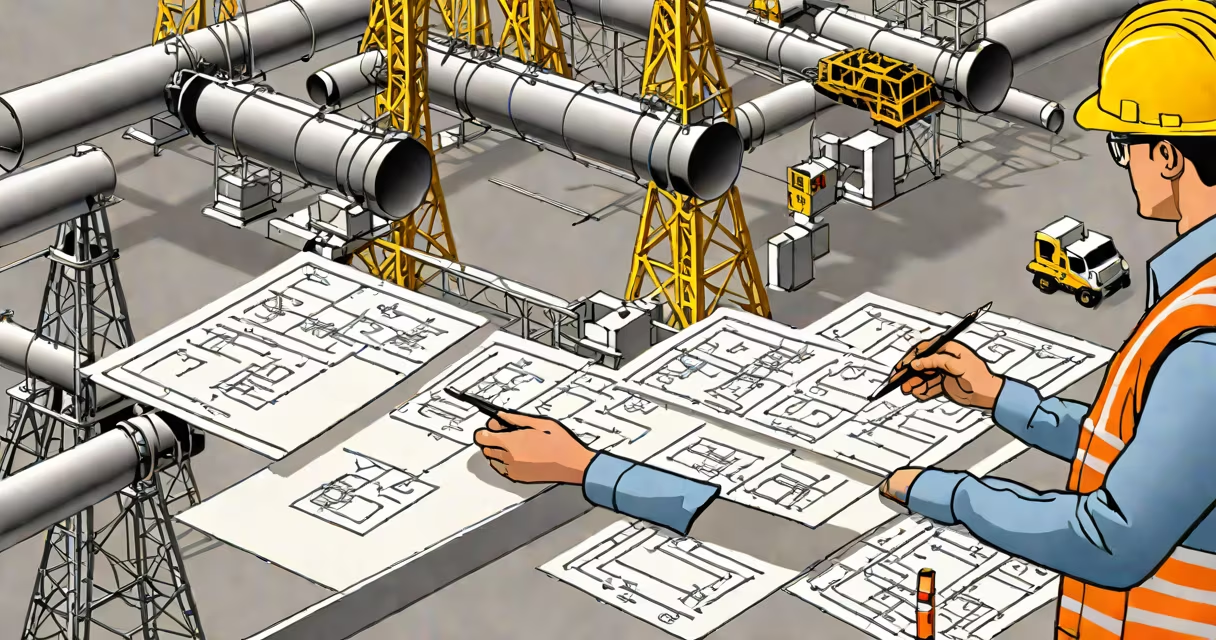
Construction quality control is the systematic process of verifying that materials, workmanship, and completed structures meet specified design requirements, safety codes, and industry standards. It involves inspections, testing, documentation, and corrective actions to prevent defects and ensure long-term performance.
Quality control begins before construction starts and continues through every phase-site preparation, foundation work, framing, mechanical installations, and final completion. Its goal is not just to catch errors but to prevent them by enforcing consistent procedures and measurable criteria.
For example, a concrete pour must be tested for compressive strength at 7 and 28 days. If results fall below the required 4,000 psi, the batch fails and must be replaced. This test is part of quality control, not just oversight.
Quality control operates through a sequence of planned activities tied to project milestones. These include pre-construction reviews, in-process inspections, material testing, and final acceptance checks.
Each task follows a documented procedure. For instance, HVAC ductwork must be sealed and pressure-tested before being covered by drywall. A quality control technician verifies the seal integrity using a smoke test or air leakage measurement. If leaks exceed 0.1% of total volume, the system is rejected and reworked.
Records are maintained throughout. A daily log tracks inspections, deviations, and approvals. These logs serve as legal proof of compliance during audits or disputes. The U.S. Department of Housing and Urban Development (HUD) requires such records for federally funded projects.
Construction quality control relies on four interdependent elements: planning, execution, monitoring, and improvement. Planning defines acceptable tolerances-e.g., floor flatness within 1/8 inch over 10 feet. Execution ensures workers follow approved methods. Monitoring detects variances. Improvement closes gaps through feedback loops.
There are three primary types of quality control in construction:
| Type | Description | Example |
|---|---|---|
| Preventive | Actions taken before work begins to avoid issues. | Reviewing structural drawings for code compliance before pouring foundations. |
| Corrective | Measures applied after a defect is found. | Reinforcing a cracked beam with carbon fiber wraps. |
| Adaptive | Adjustments based on ongoing feedback. | Changing insulation thickness after thermal imaging shows heat loss. |
Preventive control is most effective. According to the National Institute of Standards and Technology (NIST), fixing a defect during design costs 10 times less than correcting it during construction and 100 times less than fixing it after occupancy.
Construction quality control applies to all project types-residential, commercial, industrial, and infrastructure. High-risk environments like hospitals, schools, and bridges demand stricter controls due to public safety implications.
A hospital operating room must maintain positive air pressure. Quality control ensures the HVAC system meets ISO 14644-1 cleanroom standards. Failure risks surgical infections. On a $20 million hospital project in Denver, a single missed seal in the ductwork led to a $450,000 rework and a six-week delay.
Regulatory bodies enforce quality control. The International Code Council (ICC) mandates third-party inspections for structural components in high-wind zones. In Florida, all new residential buildings must pass wind-load certification before occupancy permits are issued.
People often confuse quality control with quality assurance. Quality control focuses on detecting defects in finished work. Quality assurance is broader-it ensures processes are designed to prevent defects from occurring in the first place.
For example, inspecting 100 concrete samples for strength is quality control. Requiring all mix designs to be approved by a certified engineer before batching is quality assurance. Both are essential, but they operate at different stages.
Another misconception is that quality control slows progress. In reality, early detection reduces costly rework. A 2022 study by the Construction Industry Institute found that projects with formal quality control programs completed 17% faster on average than those without.
I once observed a roofing subcontractor skip flashing installation on a 12-unit apartment complex. The error wasn't caught until rain caused ceiling damage in five units. Repairing the issue cost $23,000 and delayed move-ins by three weeks. Had a quality control check occurred during the framing stage, the problem would have been caught and fixed for under $300.
Quality control is not a one-time audit. It's embedded in daily workflows. Contractors who treat it as a box-checking exercise fail. Those who integrate it into team training, tool selection, and schedule planning see better outcomes.
To grasp the foundational meaning of quality control itself, see what is quality control mean. It explains the core concept behind all quality systems, whether in construction, software, or food production.
Construction quality control is not optional. It is a technical necessity that protects lives, reduces waste, and ensures value. Projects that invest in it from day one finish safer, faster, and with fewer disputes.