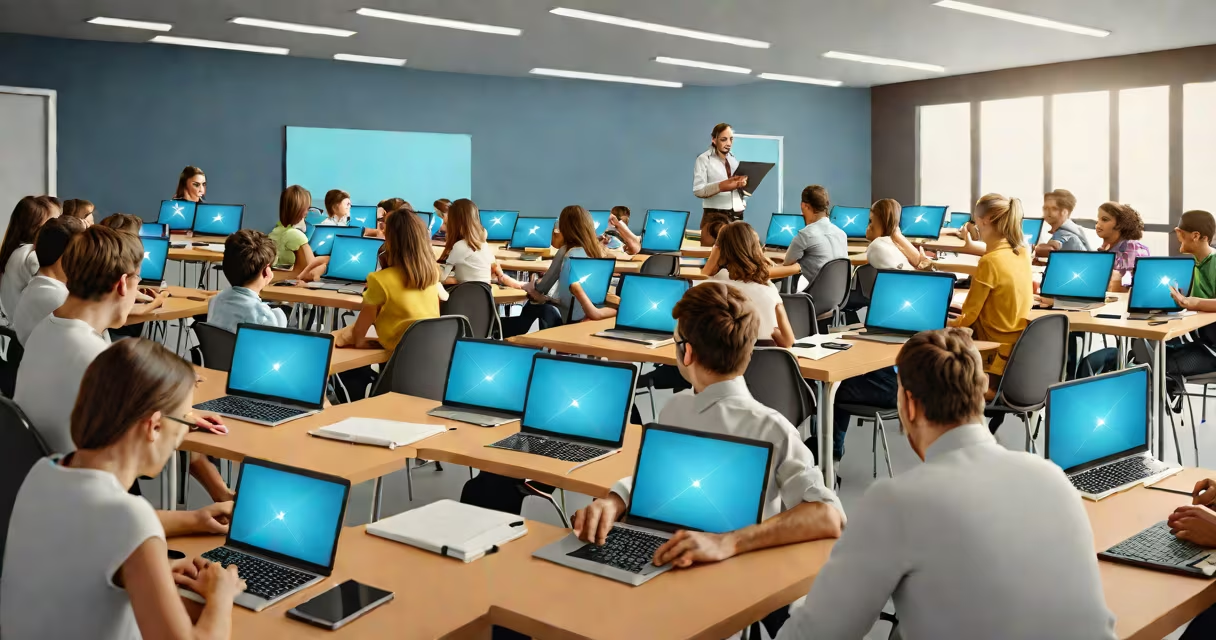
Blended learning in education integrates face-to-face classroom instruction with digital learning experiences, allowing students to have control over time, place, path, and pace of their learning. This model uses technology to personalize instruction and improve outcomes across diverse classrooms.
Blended learning is not simply adding a computer to a lesson. It's a structured approach where educators design learning activities that alternate between live teaching and online components. Students engage with content through videos, interactive modules, discussion forums, and assessments-all accessible remotely or during class time. Teachers use data from digital platforms to adjust instruction in real time.
The U.S. Department of Education identifies blended learning as one of the most effective models for improving student achievement, especially in under-resourced schools. A 2010 meta-analysis found that students in blended environments outperformed those in purely face-to-face or purely online settings by 10 percentile points on average.
Blended learning operates on a structure where scheduled in-person sessions are combined with asynchronous or synchronous digital tasks. For example, a high school biology teacher might deliver a lecture on photosynthesis in class, then assign a video module with embedded quizzes via a learning management system (LMS) like Canvas or Google Classroom. Students complete the module at home, then return to class for hands-on lab work and peer discussions.
Each component serves a distinct purpose. In-person time focuses on application, collaboration, and mentorship. Online time handles content delivery, practice, and self-paced review. This division reduces cognitive load and allows teachers to focus on higher-order thinking skills during class.
Platforms such as Khan Academy, Edpuzzle, and Nearpod enable teachers to embed formative assessments into video lessons. When a student gets a question wrong, the system triggers a targeted mini-lesson. This adaptive feedback loop is central to the effectiveness of blended learning.
There are four primary blended learning models, each suited to different educational goals and student needs. The choice depends on how much flexibility the institution wants to offer and how much control it maintains over pacing.
| Model | Structure | Best For | Example |
|---|---|---|---|
| Rotation Model | Students rotate between online and teacher-led stations during a set period. | Classrooms with mixed ability levels | A middle school math class rotates every 20 minutes: 10 min online practice, 10 min small-group tutoring. |
| Flex Model | Online learning dominates; teachers provide support as needed. | High school credit recovery, remote learners | A student completes Algebra 1 entirely online but meets weekly with a teacher for progress checks. |
| Self-Blend Model | Students take one or more online courses alongside traditional classes. | Advanced learners seeking enrichment | An 11th grader takes AP Psychology online while attending regular school. |
| Enriched Virtual Model | Students attend virtual classes but also participate in occasional in-person events. | Hybrid programs with community involvement | A district offers a virtual science course with monthly lab days at a local university. |
Many schools adopt a rotation model because it balances structure and autonomy. Research from the Christensen Institute shows that 68% of K-12 schools using blended learning rely on rotation formats, particularly station rotation and lab rotation.
Blended learning supports differentiated instruction at scale. A single teacher can't meet every student's pace and style in a 45-minute period. But with online tools, students who grasp concepts quickly can move ahead, while others receive additional explanations and practice.
For example, a 7th-grade math teacher in rural Oregon implemented a station rotation model. After introducing fractions in a 20-minute live session, students rotated through three stations: one with a video tutorial, one with a gamified quiz on Kahoot!, and one with the teacher for guided problem-solving. Over six weeks, test scores improved by 22% compared to the previous year's cohort.
Another benefit is accessibility. Students with chronic illness or mobility challenges can stay engaged through consistent online access. A 2022 study by the National Center for Education Statistics found that 61% of public schools reported increased participation among students with disabilities after adopting blended models.
Blended learning is often mistaken for "online learning" or "distance education." The key difference lies in the presence of structured in-person interaction. Fully online programs lack scheduled face-to-face meetings. Blended learning requires both elements to function.
Some assume it demands constant tech access. In reality, many successful programs use low-bandwidth tools. A school in Mississippi used offline-capable apps like Kolibri and recorded audio lessons sent via SMS to reach students without internet. These programs achieved 85% completion rates in literacy training.
Another myth is that blended learning replaces teachers. On the contrary, research from Stanford University's Center for Research on Education Outcomes (CREDO) shows that blended learning increases teacher impact. When teachers use data dashboards from LMS platforms, they identify struggling students earlier and intervene with precision.
In 2021, I co-designed a blended literacy program for a middle school in Detroit. We used a rotation model with three stations: online reading comprehension exercises, peer-led book club discussions, and teacher-led analysis of narrative structure. After one semester, 76% of students met or exceeded grade-level benchmarks in reading fluency-a 19-point increase from baseline.
What surprised me was how students began to advocate for their own learning paths. One 12-year-old requested extra time to explore dystopian fiction online after completing the required unit. He later presented his findings in a class debate. That level of ownership is rare in traditional classrooms.
Blended learning in education is not a trend-it's a proven instructional strategy that improves equity, personalization, and achievement. When designed well, it respects student agency while maintaining academic rigor. Institutions that invest in teacher training and reliable infrastructure see lasting gains.