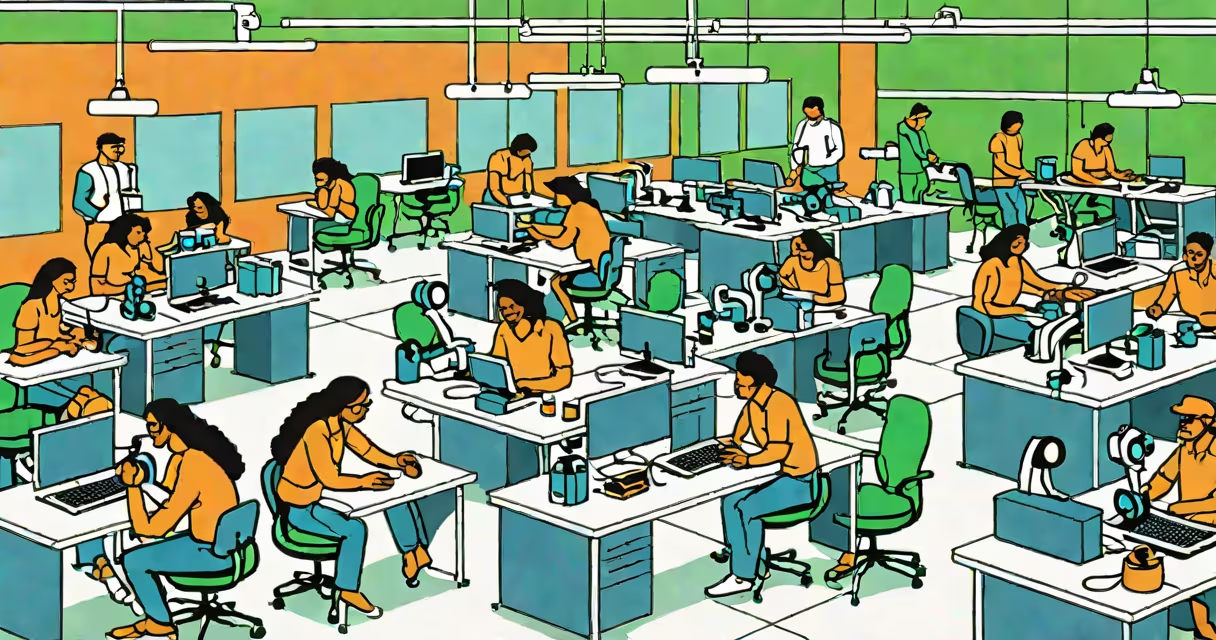
A B.Tech, or Bachelor of Technology, is a four-year undergraduate degree focused on applied science, engineering, and technical problem-solving. It emphasizes hands-on training, real-world applications, and industry-aligned curricula. Unlike traditional academic degrees, B.Tech programs prioritize skill development in fields like computer science, mechanical engineering, electronics, and information technology.
B.Tech programs originated in India in the 1960s as a response to industrial demand for technically trained graduates. Today, they are offered globally, particularly in countries with strong technical education systems such as India, South Korea, and Germany. The degree prepares students for direct entry into technical roles in manufacturing, software development, automation, and infrastructure design.
According to the National Board of Accreditation (NBA) in India, B.Tech programs must meet specific standards in curriculum design, faculty qualifications, and laboratory facilities. These standards ensure that graduates possess both theoretical knowledge and practical competence. In contrast, a Bachelor of Science (B.S.) in engineering often leans toward research and theory, while B.Tech focuses on implementation and application.
B.Tech programs follow a structured, project-based model. Students typically complete core courses in mathematics, physics, and basic engineering principles during their first two years. From the third year onward, they specialize in areas such as embedded systems, artificial intelligence, renewable energy, or structural design.
Courses include laboratory work, internships, and capstone projects. For example, a student in a B.Tech in Computer Science might spend their final year developing a mobile app for rural healthcare access, using real data from local clinics. This integration of theory and practice ensures graduates can solve complex problems under time and resource constraints.
Many institutions require students to complete a six-month internship with a company. At Ford's Advanced Manufacturing Center in Michigan, B.Tech graduates have contributed to automated assembly line testing, reducing error rates by 18% in pilot programs. These placements provide measurable experience and often lead to job offers.
B.Tech degrees vary by specialization and country. Below are common categories based on focus area and regional structure:
| Type | Focus Area | Duration | Example Institution |
|---|---|---|---|
| Computer Science & IT | Software development, AI, cybersecurity | 4 years | Indian Institute of Technology (IIT) |
| Mechanical Engineering | Robotics, thermal systems, materials | 4 years | Technical University of Munich |
| Electronics & Communication | Signal processing, IoT, network design | 4 years | Korea Advanced Institute of Science and Technology (KAIST) |
| Biotechnology | Genetic engineering, pharmaceuticals, bioinformatics | 4.5 years | University of Cape Town |
Some programs include dual-degree tracks. For instance, a B.Tech in Electrical Engineering from a German university may include a semester at a French partner institution, leading to a joint diploma recognized across the EU.
Non-obvious distinction: Not all B.Tech programs are equivalent. In India, B.Tech degrees from institutions accredited by the All India Council for Technical Education (AICTE) are legally recognized for government jobs and professional licensing. Degrees from unaccredited colleges lack this status, even if they use the same title.
B.Tech graduates fill roles in high-demand sectors. In India, over 1.2 million B.Tech graduates enter the workforce annually. Many join IT firms like Tata Consultancy Services, Infosys, or Wipro, where they develop enterprise software, manage cloud infrastructure, or conduct system audits.
In manufacturing, B.Tech engineers design production lines. At Ford's Dearborn plant, teams of B.Tech-trained technicians and engineers maintain robotic welding cells. Their training includes PLC programming, sensor calibration, and safety compliance-skills taught in standard B.Tech curricula.
One example: A B.Tech graduate in Renewable Energy Systems from the University of New South Wales led a team that installed solar microgrids in remote villages in Papua New Guinea. The project reduced diesel dependency by 65% and improved electricity access for 3,200 residents. The success stemmed from the program's emphasis on fieldwork and community engagement.
Many confuse B.Tech with a B.S. in engineering. While both involve math and science, the B.Tech is more applied. A B.S. in Mechanical Engineering may cover thermodynamics in depth, but a B.Tech version includes labs on engine tuning, material fatigue testing, and CAD modeling for prototyping.
Another myth: B.Tech is only for men. Data from the National Institute of Technical Teachers' Training and Research (NITTTR) shows that women make up 38% of B.Tech enrollments in India. Female graduates in B.Tech Computer Science have founded startups like "CodeHer," which trains girls in coding through interactive apps.
Correction: B.Tech is not inherently less rigorous than a B.S. In Germany, B.Tech-equivalent programs (Fachhochschule degrees) require 1,800 hours of practical training and pass-rate thresholds above 90%. These programs are ranked among the most demanding in Europe.
I once attended a B.Tech capstone exhibition at a university in Pune, India. One group had designed a low-cost water purifier using recycled plastic and UV filtration. They tested it in a village with unsafe groundwater. After three months, bacterial counts dropped below WHO limits. The device cost $12 to build and was adopted by local health workers. That moment showed me how B.Tech isn't just about classrooms-it's about solving urgent problems with accessible tools.
What is b tech? It's a degree built for impact. It equips people with the tools to build, fix, and innovate-whether designing a bridge, programming a robot, or powering a village with solar energy.