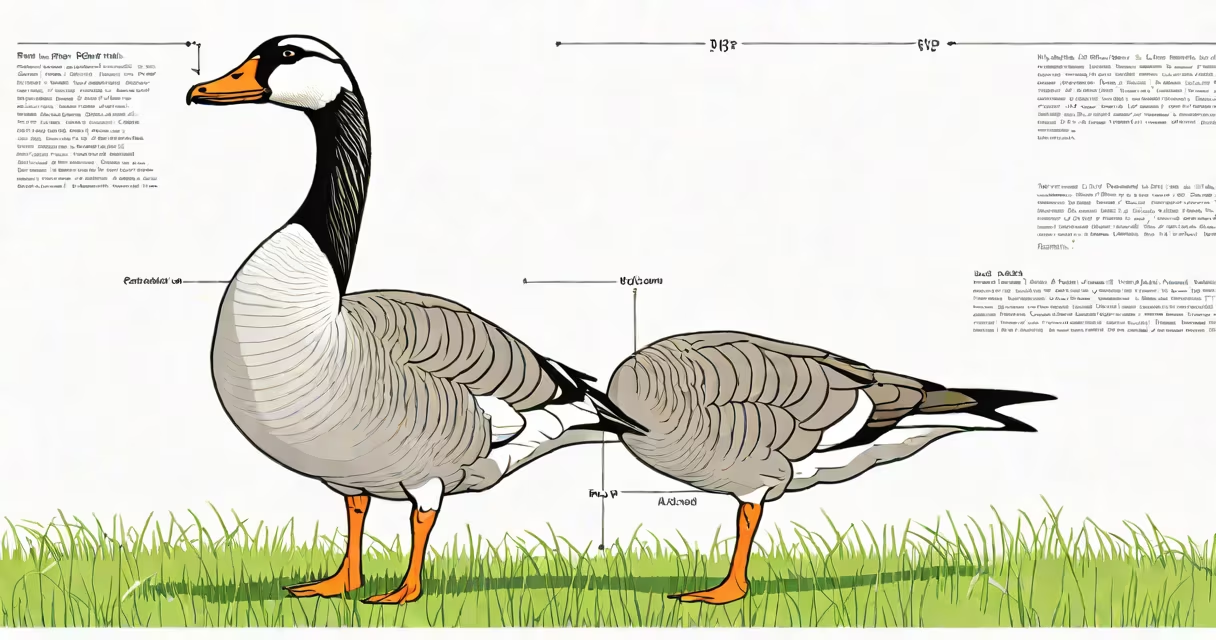
A male goose is called a gander. This term applies to adult males across all domestic and wild goose species, distinguishing them from females (called geese) and young birds (goslings).
Ganders are typically larger and more assertive than females. They display strong territorial behavior, especially during breeding season, and often lead flocks in migration. Their vocalizations are deeper and more resonant than those of females, a trait used in identification.
The term "gander" originates from Old English *gandere*, derived from *gand* (goose) and the suffix *-ere* indicating gender. It has been used consistently since the 14th century in English literature and ornithological records.
When identifying birds in the wild or on farms, "gander" is the standard term for adult male geese. For example, in a flock of Canada geese near a lake in Minnesota, the dominant bird with a longer neck and louder honking is the gander. He patrols the perimeter and warns others of approaching predators.
On commercial farms raising geese for meat or feathers, workers refer to males as ganders during health checks and breeding cycles. This helps maintain accurate records and ensures proper management of mating pairs.
Wildlife biologists use the term in field reports. A 2021 study published in *The Journal of Avian Biology* tracked migratory patterns of barnacle geese in Iceland. Researchers noted that ganders led the formation during flight, maintaining position at the front of the V-shaped group.
All goose species have distinct male forms. The following table outlines common species and their male counterparts:
| Species | Male Name | Size Range (cm) | Distinct Feature |
|---|---|---|---|
| Canada Goose | Gander | 90-110 | Black head with white chin strap |
| Barnacle Goose | Gander | 65-75 | Gray plumage with black neck ring |
| Greylag Goose | Gander | 75-85 | Grayish-brown body, long neck |
| Domestic Peking Goose | Gander | 80-100 | White feathers, large knob above bill |
Despite size differences, all male geese share behavioral traits: they defend territory, court females through synchronized movements, and participate in chick-rearing duties. In some species, such as the snow goose, males may weigh up to 8 kg-nearly double the average female weight.
Many people assume that "gander" refers only to domesticated birds. This is incorrect. Wild populations use the same terminology. A gander seen near a riverbank in Scotland is a wild barnacle goose male, not a farm animal.
Another misconception is that ganders are always aggressive. While they can be protective, aggression varies by species and environment. A study from the University of Exeter found that ganders in urban parks were less likely to attack humans than those in remote wetlands, likely due to habituation.
Some confuse "gander" with "drake," which is the male of ducks. Ducks and geese belong to different families-ducks are Anatidae subfamily Anatinae, while geese are Anserinae. The confusion arises because both are waterfowl, but their male names differ.
In March 2023, a gander was filmed defending a nesting site in a park in Portland, Oregon. The bird repeatedly charged at a dog approaching within 10 meters. Park staff confirmed the incident via video footage and reported the gander's behavior as typical for the species during breeding season.
Biologists later identified the bird as a male Canada goose. Its neck was visibly thicker than the female's, and it had a darker bill. The park's wildlife team labeled the bird "Gander #7" in their seasonal logbook. This case demonstrates how the term is applied in real-life monitoring and public safety reporting.
Using correct terminology improves communication among scientists, farmers, and conservationists. Mislabeling a gander as a "goose" leads to inaccurate data in population surveys. The U.S. Fish and Wildlife Service requires precise gender labeling in migration tracking programs.
For backyard keepers, knowing the difference helps manage flock dynamics. A single gander can dominate multiple females, reducing breeding success if not monitored. On a farm in Wisconsin, a farmer discovered that removing an overly aggressive gander improved egg production by 18% over six months.
When observing geese in nature, focus on physical traits: ganders tend to have sturdier builds, longer necks, and more pronounced bills. Behavioral cues-such as leading the flock or loud honking-are also reliable indicators.
Understanding what is a male goose called is essential for accurate observation and responsible stewardship of waterfowl populations. Whether in a research paper, a farm report, or a casual walk through a nature reserve, using the correct term supports clarity and precision.