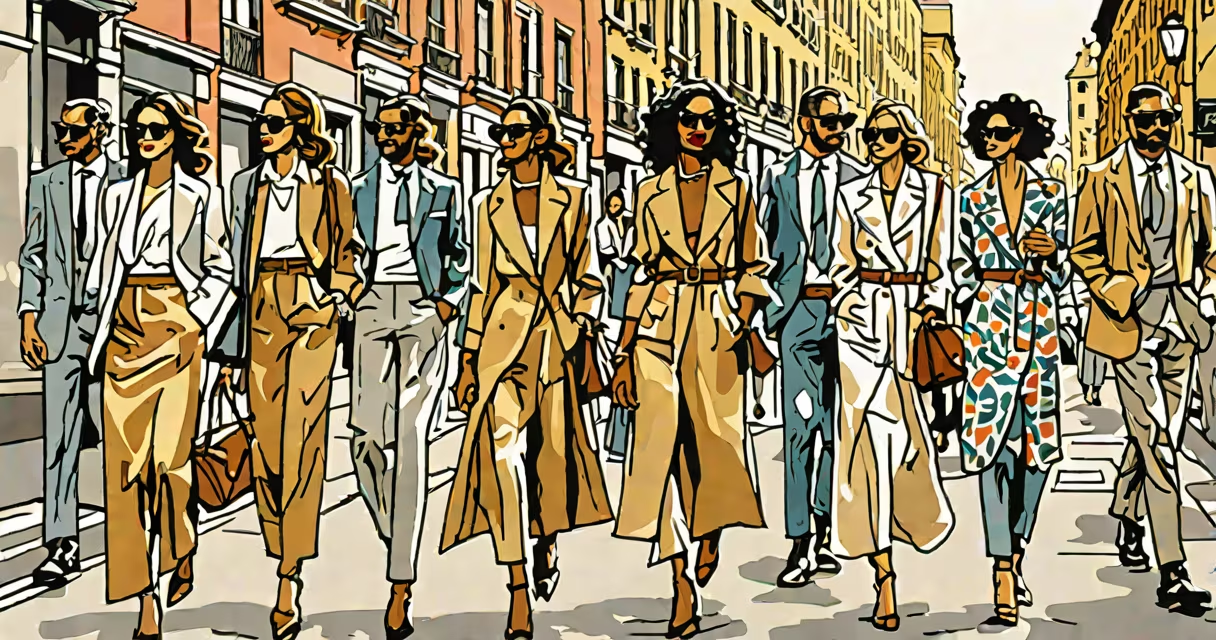
fashion and communication is the practice of using clothing, accessories, and appearance to convey identity, mood, values, and social signals. It functions as a nonverbal language that communicates intentions, affiliations, and cultural positioning without spoken words.
Fashion operates as a system of signs. What people wear sends messages-intentionally or not-about who they are, where they belong, and how they wish to be perceived. A person in a tailored suit may signal professionalism; someone in bold streetwear might express individuality or allegiance to a subculture. These signals are interpreted within specific social and cultural frameworks.
According to the Fashion Institute of Technology (FIT), clothing serves as "a primary medium for self-expression and social interaction." This aligns with semiotic theory, which treats fashion as a sign system where garments act as symbols. For example, a black dress at a funeral communicates mourning; a red dress at a party signals confidence or flirtation. Meaning depends not just on the garment, but on context, audience, and shared norms.
Fashion communicates through visual cues, material choices, color, silhouette, and styling. These elements combine to form a message that audiences decode instantly, often unconsciously. A high-waisted denim skirt paired with a vintage band tee and combat boots doesn't just look "retro"-it signals a specific aesthetic preference and potentially a generational or political alignment.
Color psychology plays a role. Red evokes energy and urgency; blue suggests calm and trust. In branding, companies like Nike use consistent color palettes across apparel lines to reinforce brand identity. When a customer wears a Nike hoodie with the iconic swoosh, they're not just wearing clothing-they're broadcasting affiliation with a global athletic culture.
Even absence communicates. Minimalist wardrobes with neutral tones can signal restraint, focus, or a rejection of consumerism. The "quiet luxury" trend, popularized in the early 2020s, relies on understated design and high-quality fabrics to communicate wealth without overt display-a deliberate contrast to flashy logos.
Fashion communicates across multiple levels: personal, social, cultural, and commercial. Each layer adds complexity to the message being sent.
| Type | Message Focus | Example |
|---|---|---|
| Personal Identity | Self-expression, mood, individuality | A student wears mismatched socks and a handmade patchwork jacket to assert uniqueness. |
| Social Affiliation | Group belonging, subcultural alignment | Skateboarders wear baggy pants and graphic tees to signal membership in a youth movement. |
| Cultural Significance | Tradition, heritage, regional pride | An Indigenous woman wears a handwoven shawl during a ceremony, honoring ancestral craft and lineage. |
| Commercial Messaging | Brand loyalty, product appeal | A celebrity wearing a designer gown at an awards show promotes the label's visibility and desirability. |
These layers often overlap. Wearing a hijab, for instance, can simultaneously express religious devotion, cultural pride, and resistance to Western stereotypes. The same garment carries multiple meanings depending on context and viewer interpretation.
Fashion and communication is not merely about following trends. While trends do circulate through media and advertising, the core function of fashion as communication lies in intentionality and interpretation-not conformity.
Many assume that fashion is superficial or frivolous. But research from the University of the Arts London shows that clothing choices influence how others perceive competence, trustworthiness, and leadership potential. In a 2021 study, participants judged individuals in formal attire as more capable in professional settings-even when the task was unrelated to appearance.
Another misconception is that fashion communication is universal. It is not. A white wedding dress symbolizes purity in Western cultures but represents mourning in parts of East Asia. Similarly, wearing green in some African nations signifies funerals. Context shapes meaning. A single outfit can have entirely different interpretations across regions.
In 2023, the U.S. Supreme Court justices wore traditional black robes during oral arguments. This uniform choice isn't about personal style-it's a deliberate visual cue. The robe communicates authority, neutrality, and institutional continuity. It's a form of ceremonial fashion designed to reinforce legal legitimacy.
Consider the 2018 #MeToo movement. Survivors and allies wore white dresses to public events and protests. The color white, traditionally associated with innocence and purity, was repurposed to challenge narratives of shame. The collective use of white became a visual statement against sexual violence-proof that fashion can serve as protest language.
On a smaller scale, I once observed a college student in New York City wearing a vintage military jacket with patches from different countries. She didn't explain the history behind each patch. But passersby stopped to ask about them. Her jacket became a conversation starter-an unspoken invitation to share stories. That moment demonstrated how fashion can initiate dialogue, build connection, and create community.
Fashion and communication is not synonymous with "style." Style is a personal aesthetic. Communication is about impact-the effect on others. Someone might wear a unique outfit because they like it (style), but if others interpret it as rebellious or avant-garde, then communication has occurred regardless of intent.
fashion and communication is not about looking good-it's about sending signals. Whether worn in silence or displayed in public, clothing acts as a living language. It reflects internal states and external realities. Understanding it requires reading beyond fabric and stitching-to the values, histories, and identities embedded in every thread.