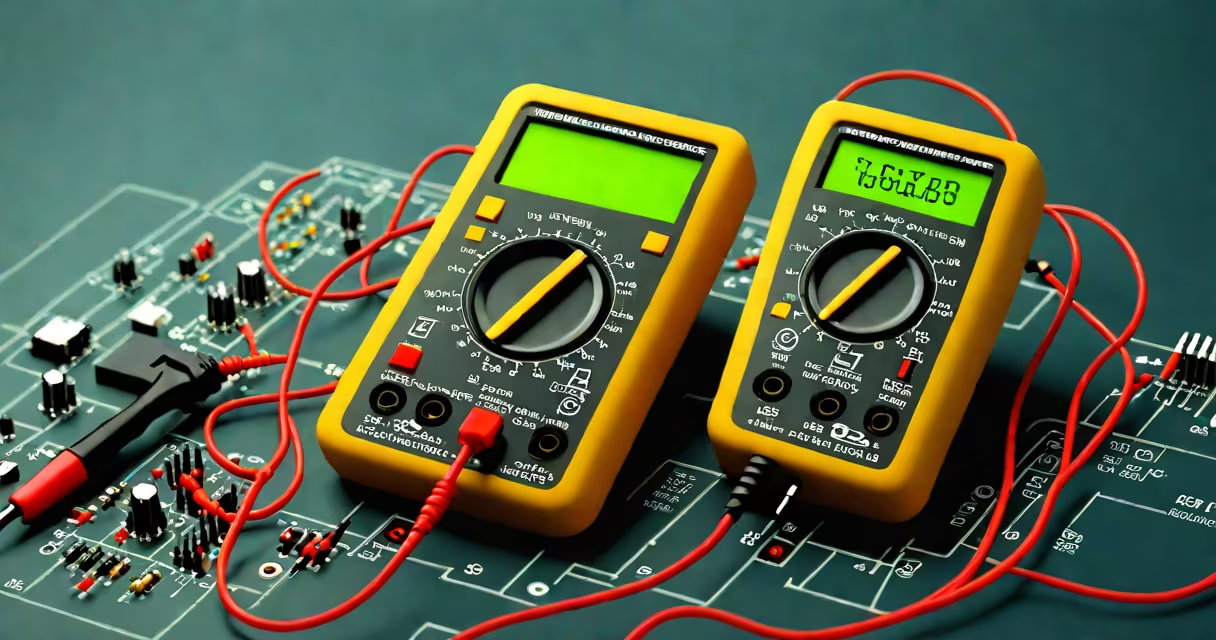
A digital multimeter is an electronic test instrument that measures voltage, current, and resistance in electrical circuits. It displays results numerically on an LCD or LED screen, offering precise readings with minimal human error compared to analog meters.
These tools are essential for diagnosing issues in wiring, troubleshooting appliances, and verifying circuit integrity. They come in handheld models suitable for field work and benchtop units for lab environments. A typical digital multimeter includes a selector dial, input jacks, and test leads with probes.
According to the National Institute of Standards and Technology (NIST), digital multimeters provide accuracy within ±0.5% for basic models under controlled conditions, making them reliable for both hobbyists and certified electricians.
The digital multimeter converts physical electrical quantities into digital signals using internal analog-to-digital converters (ADCs). When you connect the probes to a circuit, the device samples the voltage, current, or resistance and translates it into a numeric value displayed on the screen.
For voltage measurements, the meter draws minimal current from the circuit to avoid altering the reading. In continuity mode, it sends a small current through a path and beeps if resistance is below 50 ohms, indicating a complete connection.
When measuring current, the multimeter must be placed in series with the circuit. This requires breaking the circuit and inserting the meter between components. Some models include a fuse to protect against overload during high-current tests.
Digital multimeters support several core functions:
Most consumer-grade digital multimeters offer at least four functions. Industrial models may include temperature measurement via thermocouple inputs and data logging for trend analysis.
| Function | Typical Range | Use Case |
|---|---|---|
| Voltage (DC) | 200 mV - 1000 V | Testing batteries, car electronics |
| Voltage (AC) | 200 V - 600 V | Measuring household outlets |
| Current (DC) | 200 µA - 10 A | Checking power draw in circuits |
| Resistance | 200 Ω - 2 MΩ | Verifying wire continuity or resistor values |
One often-overlooked feature is autoranging. This function automatically selects the correct measurement scale, eliminating guesswork. Manual-ranging models require users to choose the appropriate range, which can lead to incorrect readings or damage if set too low.
Many users assume that any multimeter can safely measure household AC voltage. However, safety ratings matter. A meter rated for CAT III 1000 V aims to withstand transient surges common in building wiring. Using a lower-rated meter on a 240-volt outlet risks internal damage or electric shock.
Another mistake is connecting the current jack to measure voltage. Doing so can blow the internal fuse or destroy the ADC. Always verify probe placement before turning on the circuit.
Some people confuse digital multimeters with oscilloscopes. While both analyze electrical signals, a multimeter shows average values over time. An oscilloscope plots voltage changes in real time, revealing waveform shape, noise, and timing details. For analyzing signal quality, especially in digital circuits, an oscilloscope is necessary.
I used a Fluke 175 multimeter to troubleshoot a non-working garage door opener. The unit had no power at the control board. I set the meter to DC voltage and touched the red probe to the positive terminal and black to ground. The display read 0 volts. I then checked the wall switch and found 120 V AC at the junction box. Tracing the wiring revealed a loose connection behind the switch.
This example shows how a digital multimeter identifies open circuits and confirms power presence. Without it, I'd have assumed the issue was in the motor or control board.
Homeowners use digital multimeters to test smoke detector batteries, confirm proper grounding in outlets, and verify solar panel output. Electricians rely on them during installation checks and after repairs. Engineers use them in prototype development to validate circuit behavior before moving to complex simulation tools.
Understanding what is a digital multimeter begins with recognizing its role as a precision diagnostic tool. It's not just a gadget-it's a window into circuit health. debugging a microcontroller, a digital multimeter delivers accurate, actionable data.
Always match the meter's safety rating to your application. Never bypass the fuse or ignore the input jack labels. And remember: a digital multimeter doesn't replace knowledge-it amplifies it.