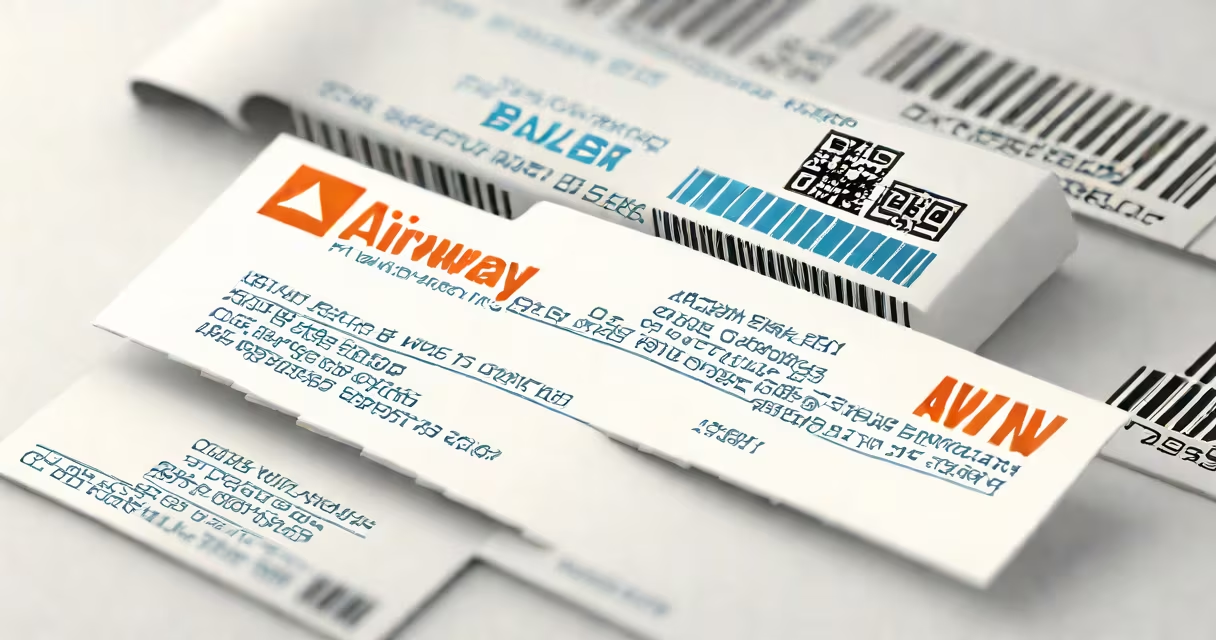
An airway bill is a legally binding document issued by an airline or freight forwarder that serves as both a contract of carriage and a receipt for goods shipped via air. It details the origin, destination, consignee, shipper, and contents of a shipment, and enables customs clearance and tracking throughout international transit.
Unlike a purchase invoice or packing slip, the airway bill is not a financial instrument. It is a transport-specific document required for air cargo movement under International Air Transport Association (IATA) standards. The document is generated during the booking process and assigned a unique 11-digit tracking number, often called an AWB number.
For example, when a U.S.-based electronics manufacturer ships 500 units of a smartphone model from Los Angeles to Tokyo, the freight forwarder issues an airway bill. This document includes the flight number, departure and arrival airports, declared value, and special handling instructions such as "fragile" or "temperature-controlled." Without this document, the airline will not accept the cargo.
The airway bill functions as a control mechanism across multiple stages of air freight. Once created, it is split into three copies: one for the shipper, one for the carrier, and one for the consignee. The carrier's copy is scanned at each airport hub, updating the shipment's location in real time.
Each airway bill contains a 11-digit serial number. The first three digits indicate the airline's IATA code-for example, 001 for Emirates, 016 for Delta. The remaining eight digits are sequentially assigned by the carrier. This system prevents duplication and ensures accountability.
When customs officials inspect the shipment at the destination airport, they verify the airway bill against the import declaration. If the details don't match-such as incorrect commodity classification-the shipment may be delayed or seized. According to IATA's 2023 Global Air Cargo Report, 93% of international air cargo movements rely on properly completed airway bills.
There are two primary types of airway bills: non-negotiable and negotiable. Most commercial shipments use non-negotiable airway bills, which are tied to a specific consignee. The recipient must present valid identification to claim the cargo.
Negotiable airway bills allow transfer of ownership during transit. These are rare and typically used in high-value or time-sensitive transactions, such as pharmaceuticals shipped under a letter of credit. The document can be endorsed and transferred to a third party, similar to a negotiable instrument.
| Type | Ownership Transfer | Use Case | Common Carrier |
|---|---|---|---|
| Non-negotiable | No | General retail, electronics, consumer goods | Most airlines and freight forwarders |
| Negotiable | Yes | High-value goods, export financing, intercompany transfers | Specialized freight carriers, banks |
Airway bills follow a standardized format defined by IATA's Cargo Services Manual. Key fields include:
One non-obvious distinction: the airway bill is not a title of ownership. Unlike a bill of lading in sea freight, it does not confer legal title to the goods. The consignee gains possession only after presenting the airway bill to the airline's agent at the destination airport.
Airway bills are essential for all international air freight shipments. They are mandatory for cross-border movement under IATA regulations and national customs laws. The U.S. Customs and Border Protection requires an airway bill for all imports exceeding $2,500 in value.
Domestic air shipments within the U.S. still require airway bills, though enforcement is less strict. Airlines like FedEx and UPS generate their own proprietary airway bills under IATA standards. For example, FedEx uses a 12-digit tracking number starting with "96" for domestic express services.
Freight forwarders handle the creation and validation of airway bills. They ensure compliance with IATA's Dangerous Goods Regulations and country-specific import restrictions. A forwarder in Dubai once rejected a shipment of lithium-ion batteries because the airway bill failed to include the correct UN number (UN3480) and hazard class.
During a recent incident at Frankfurt Airport, a mislabeled airway bill caused a 72-hour delay for a shipment of medical supplies bound for Nairobi. The error was caught during customs inspection because the commodity description did not match the actual product listed in the bill. The shipment was rerouted after verification, highlighting the document's role in preventing errors.
People often mistake the airway bill for a bill of lading. While both are transport documents, the bill of lading applies to sea and rail freight. It can be negotiable and serves as proof of ownership. The airway bill is strictly non-negotiable and is not used in maritime transport.
Another common error is confusing the airway bill with a commercial invoice. The commercial invoice details the transaction value, payment terms, and product specifications. It is used for customs valuation and tax purposes. The airway bill focuses solely on transportation logistics.
Some shippers assume the airway bill is optional for small packages. This is false. Even a 2-pound package sent via DHL Express requires a valid airway bill. Without it, the carrier cannot process the shipment through automated sorting systems.
On a personal note, while managing a shipment of 120 surgical instruments from Boston to Singapore, I discovered that the original airway bill lacked the required IATA safety certification stamp. The airline refused to load the cargo until the documentation was corrected. This delay cost $450 in overnight courier fees and highlighted how one missing field can halt global movement.
Understanding the airway bill is critical for anyone involved in international trade. It is not a formality-it is a functional, enforceable contract that ensures safe, traceable, and compliant movement of goods across borders.
When planning a shipment, always verify the airway bill details with your freight forwarder. Confirm the consignee name, address, and contact information. Double-check the commodity description and declared value. These steps prevent costly delays and ensure delivery within expected timelines.
The airway bill is the foundation of air cargo operations. It enables tracking, supports regulatory compliance, and ensures accountability. Without it, global air freight would cease to function.