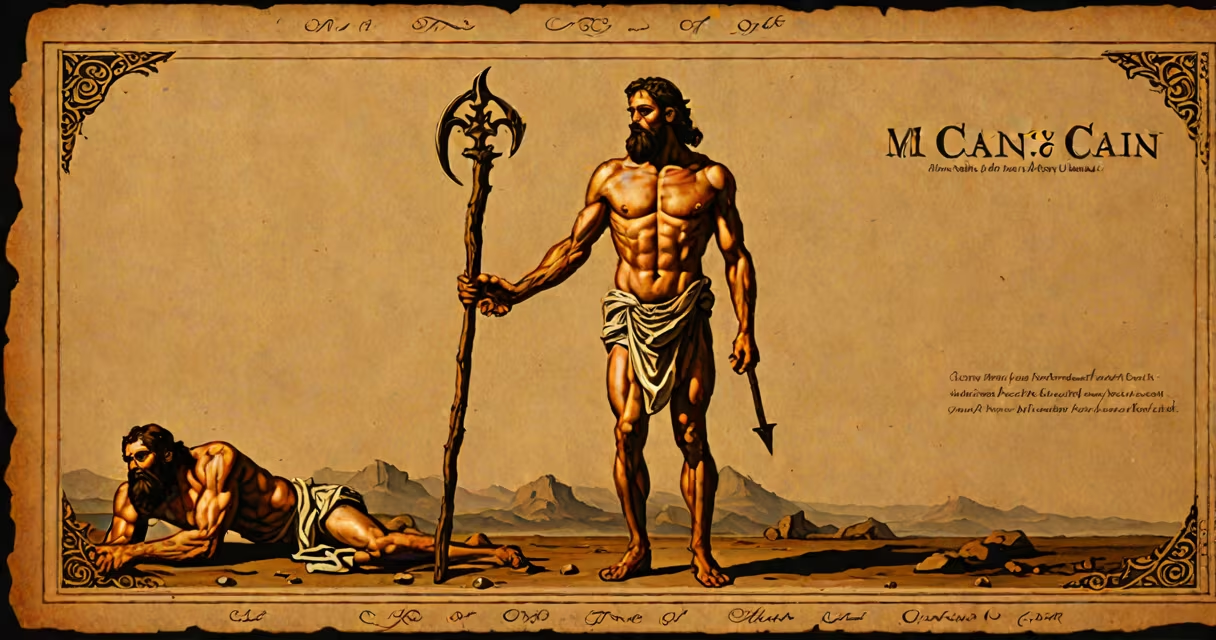
The mark of Cain is a divine sign placed on Cain after he murdered his brother Abel, protecting him from being killed in revenge. It appears in Genesis 4:15, where God says, "Whoever kills Cain will suffer vengeance seven times over." The mark is not described in detail, but its purpose was to ensure Cain's survival despite his sin.
Genesis 4:1-16 records the story: Cain, a farmer, becomes jealous of his brother Abel, a shepherd. After offering a sacrifice that God rejects, Cain murders Abel. God confronts Cain, saying, "Where is Abel your brother?" Cain replies, "I do not know. Am I my brother's keeper?" God then declares, "The voice of your brother's blood cries out to me from the ground."
Cain fears retribution and pleads, "My punishment is too great to bear. Today you are driving me from the soil, and I will be hidden from your presence; I will be a restless wanderer on the earth." God responds by placing a mark on Cain to protect him: "Anyone who kills Cain will suffer vengeance seven times over." This mark is not a curse-it is a safeguard against immediate justice.
The mark functions as a divine intervention. It is not a physical tattoo or visible birthmark, but a spiritual or symbolic sign known only to God and those who witness its effect. The Hebrew word used-"ot" (אֹת)-means "sign" or "token," not necessarily something visible. It could be a change in demeanor, a supernatural aura, or a divine decree recognized by others.
God's promise to protect Cain shows that divine justice includes mercy. Even after a grave sin, God prevents further violence. The mark ensures Cain cannot be killed by anyone else, establishing a precedent: human life is sacred, even for a murderer. This aligns with later laws in Exodus 20:13 ("You shall not murder") and Numbers 35:16-21, which outline capital punishment only under judicial process.
Some ancient Jewish texts, such as the Targum Onkelos and the Midrash Rabbah, interpret the mark as a visible sign-often described as a horn or flame above Cain's head. These interpretations reflect cultural attempts to visualize the invisible. However, the Bible itself gives no visual description, leaving the nature of the mark ambiguous.
The mark of Cain is not a material object. It is a divine act-God's direct intervention. There are no types or variants of the mark in scripture. It is singular: one sign, one purpose, one moment in narrative.
However, interpretations have varied across time and tradition:
No single interpretation is definitive. The ambiguity is intentional. The text does not explain the mark's form, allowing readers to focus on its function: divine protection amid judgment.
The mark of Cain appears only once in the Bible-in Genesis 4:15. It is not referenced again in the Old Proof, New Proof, or Apocrypha. Its brevity underscores its role as a narrative device, not a recurring theme.
Yet, the concept has influenced theology, literature, and art for centuries. In medieval Christian art, Cain is often depicted with a serpent-like mark or a crown of thorns. In William Shakespeare's *King Lear*, the line "I am a man more sinned against than sinning" echoes Cain's plea for mercy. In modern fiction, the mark appears in novels like *The Book of the Dead* by Michael Dibdin, where it symbolizes inherited guilt.
Historically, the mark has been misused. During the 17th and 18th centuries, European colonizers used the idea of the "mark of Cain" to justify enslaving Africans, claiming they were descendants of Cain and thus cursed. This distorted reading contradicts the original text, which affirms life and protection, not racial damnation. The Vatican condemned such interpretations in 1995, stating that "no race or people is cursed by God."
Several widespread misunderstandings persist:
| Misconception | Correction |
|---|---|
| The mark is a physical tattoo or birthmark. | Bible does not describe its appearance. "Mark" (Hebrew *ot*) means a sign or token-not necessarily visible. |
| The mark condemns Cain forever. | It protects him. God says, "I will put a mark on Cain," not "I will punish him." |
| The mark causes Cain to be feared or hated. | It prevents hatred from turning into murder. The mark enables survival, not ostracization. |
| The mark is a curse. | It is a mercy. The curse is exile and wandering (Genesis 4:12), not the mark itself. |
A common error is equating the mark with the "mark of the beast" in Revelation 13:16-18. They are unrelated. The mark of the beast is a symbol of allegiance to evil, while the mark of Cain is a sign of divine grace. One leads to destruction; the other to preservation.
Consider a modern scenario: a person convicted of murder is sentenced to life imprisonment. The state does not execute them immediately. Instead, they are protected by law from being killed by others. This system reflects the principle behind the mark of Cain-protection from personal vengeance, even for serious crimes.
In 2018, a U.S. court case involving a man accused of murdering his father highlighted this idea. The defense argued that the defendant had been abused and was acting under duress. The judge acknowledged the complexity of human action and the need for justice that includes mercy. While not referencing the Bible, the ruling echoed the logic of Genesis 4:15-protecting the accused from mob justice.
Another example: in 2021, a school shooting survivor wrote a letter to the shooter's family. She stated, "I don't want him dead. I want him to live with the weight of what he did-just like Cain." Her words reveal how the story continues to inform ethical reflection on punishment and redemption.
I once visited the Church of the Holy Sepulchre in Jerusalem, where a mosaic from the 6th century depicts Cain fleeing with a glowing symbol above his head. The artist chose not to show a face or hands-only the mark. It was striking: the symbol wasn't meant to be seen, but felt. That moment confirmed what the text implies: the mark isn't about sight-it's about belief in divine oversight.
The mark of Cain is a sign of divine protection, not punishment. It appears in Genesis 4:15 as a safeguard against retaliation after Cain kills Abel. Its lack of physical description allows it to serve as a symbol of mercy within justice. The mark does not define Cain's identity-it preserves his life. Understanding this clarifies a core biblical theme: even after sin, God offers protection, not annihilation.