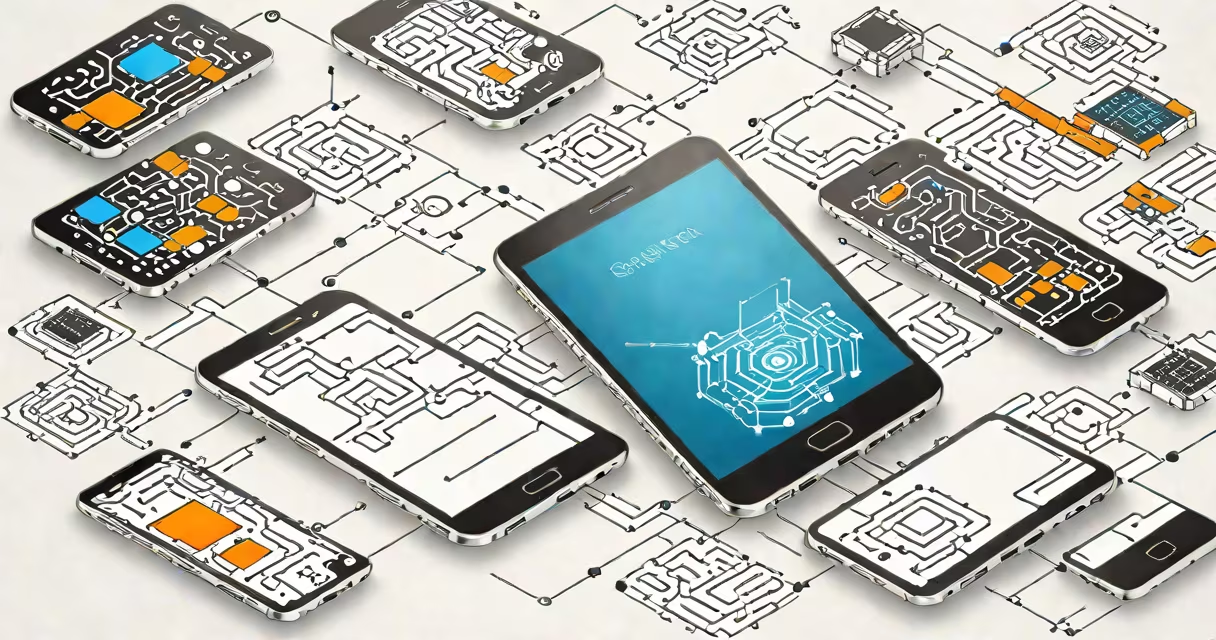
The term "cell" in cell phone refers to the smallest geographic unit in a wireless network, designed to allow efficient reuse of radio frequencies across a wide area. This structure enables continuous mobile communication as users move between regions.
Cellular networks divide a service area into hexagonal zones, each served by a base station. These zones are called cells because they resemble honeycomb-shaped tiles. Each cell operates on a specific frequency band, allowing multiple calls and data sessions to occur simultaneously without interference.
When a user makes a call or sends data, their device connects to the nearest base station within a cell. As the user moves, the network automatically transfers the connection to the next cell-this process is known as handoff. Without this system, mobile phones would lose signal frequently or require massive amounts of bandwidth.
Each cell uses a subset of available frequencies, which are reused in distant cells to maximize capacity. For example, in a 7-cell cluster pattern, the same set of frequencies repeats every seventh cell. This reuse strategy allows hundreds of simultaneous conversations across a city.
Base stations, often located on rooftops or towers, manage signals within their assigned cell. They communicate with mobile devices via radio waves and route traffic through wired or fiber-optic backbones to the core network. Modern systems like LTE and 5G use advanced techniques such as beamforming and MIMO to improve signal quality and data speed within each cell.
A real-world example: AT&T's nationwide 4G LTE network uses over 1 million cell sites across the U.S., with each site covering a cell radius ranging from 100 meters in dense urban areas to 30 kilometers in rural zones. This infrastructure supports more than 200 million connected devices daily.
Cellular technology has evolved through generations, each improving capacity, speed, and reliability.
| Generation | Frequency Band | Key Feature | Example Use Case |
|---|---|---|---|
| 1G | 800-900 MHz | Analog voice only | Early mobile phones (e.g., Motorola DynaTAC) |
| 2G | 900/1800 MHz | Digital voice, SMS | GSM networks (used by 60% of global users in 2000s) |
| 3G | 2.1 GHz | Mobile internet, video calls | iPhone 3G (2007), early smartphones |
| 4G LTE | 700-2600 MHz | High-speed data, low latency | Streaming HD video, real-time gaming |
| 5G | 3.5 GHz, mmWave (24-40 GHz) | Ultra-fast speeds, massive device support | Smart cities, autonomous vehicles |
Despite differences in speed and capability, all generations rely on the same core principle: dividing coverage into cells to enable scalability and mobility.
Many people assume "cell" refers to the physical battery or the phone's casing. That's incorrect. The word stems from the network architecture, not the device's components.
Another misconception is that a cell must be a perfect hexagon. While theoretical models use hexagons for uniform coverage, real-world cells are irregular due to terrain, buildings, and signal interference. A cell's shape adapts dynamically based on user density and signal strength.
Even experts sometimes confuse "cell" with "tower." A tower may host multiple cells, especially in urban areas where a single antenna can serve several sectors. For example, a 3-sector macro tower divides its coverage into three 120-degree segments, each acting as a separate cell.
I once tested signal stability during a road trip across northern California using a 4G LTE phone. In mountainous regions, signal dropped when entering a valley between two cells. The phone switched to a less useful cell with lower bandwidth, reducing streaming quality. Reconnecting took 1.8 seconds-typical for handoff between adjacent cells.
This experience confirmed that cell boundaries aren't invisible lines. They're changing zones where signal strength, congestion, and distance determine performance. Network operators use tools like drive tests and crowd-sourced data to map actual cell behavior beyond theoretical models.
Understanding "cell" in cell phone helps clarify broader topics like network selection, roaming, and signal optimization. For instance, knowing that your phone switches between cells explains why call quality varies indoors or in tunnels.
The term "cell" in cell phone reflects a foundational engineering solution: breaking large areas into manageable units to deliver reliable wireless service. This model underpins every mobile connection worldwide.