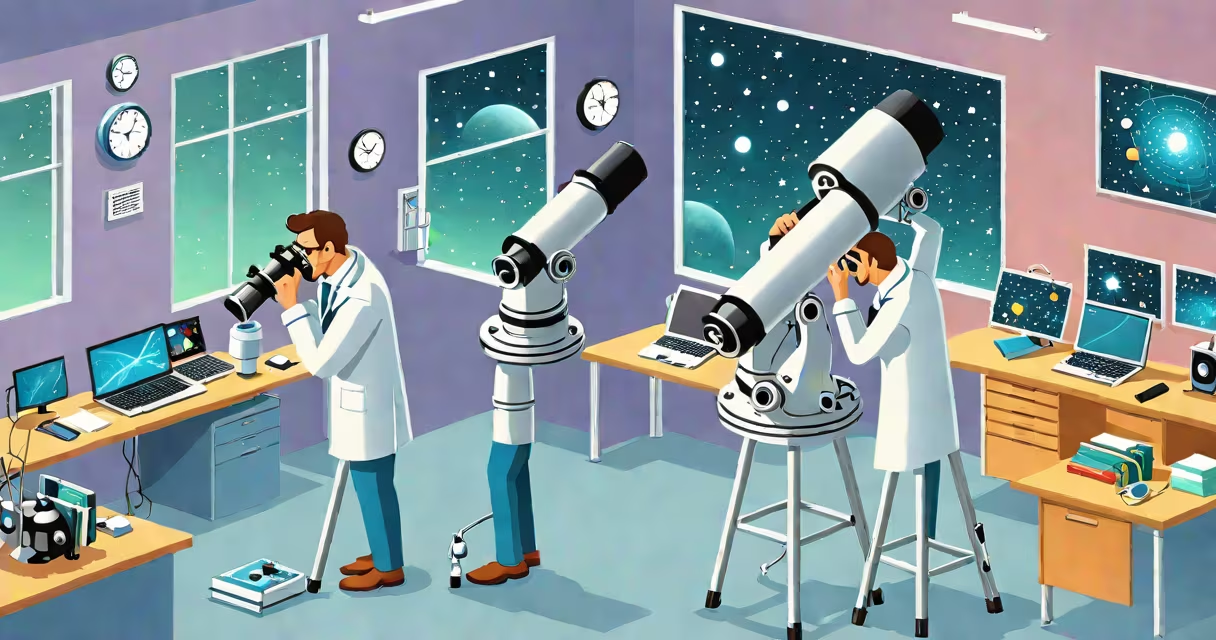
An astrophysicist uses principles of physics and mathematics to study the universe's structure, behavior, and evolution-from black holes to the origin of the cosmos. They analyze light, radiation, and particle data from telescopes and satellites to model cosmic events and test theories about dark matter, star formation, and the Big Bang.
These scientists work across observational, computational, and theoretical domains. They interpret signals from distant galaxies, simulate galaxy collisions, or develop models predicting how stars evolve. Their findings appear in peer-reviewed journals and inform space missions, such as NASA's James Webb Space Telescope, which relies on astrophysical data to identify exoplanets and early-universe structures.
While often associated with space exploration, most astrophysicists spend years in academia or national labs. They teach university courses, lead research teams, and secure grants from agencies like the National Science Foundation (NSF) or the European Space Agency (ESA).
They begin by identifying a question-such as "Why do some galaxies rotate faster than expected?"-then gather data from observatories like the Keck Observatory in Hawaii or the Hubble Space Telescope. Data includes electromagnetic spectra, gravitational waves, and cosmic microwave background radiation.
Next, they apply physical laws-like Einstein's theory of relativity or quantum mechanics-to build simulations. For example, modeling how gas collapses into stars requires solving complex equations governing pressure, temperature, and gravity. These simulations run on supercomputers, sometimes taking weeks to complete.
Finally, they compare results with observations. If a simulation predicts a certain brightness pattern in a supernova remnant and actual images match, the model gains credibility. Discrepancies prompt revisions. This cycle of hypothesis, computation, and validation drives discovery.
Major subfields include cosmology, stellar astrophysics, high-energy astrophysics, and planetary science. Cosmologists study the universe's large-scale structure and evolution. They analyze the cosmic microwave background-the afterglow of the Big Bang-to estimate the universe's age (13.8 billion years, per Planck satellite data).
Stellar astrophysicists examine how stars form, live, and die. A 2022 study published in *The Astrophysical Journal* used computer models to show that massive stars can collapse into neutron stars only if their cores lose mass through neutrino emission-a process confirmed by neutrino detectors like Super-Kamiokande in Japan.
High-energy astrophysicists investigate extreme environments: pulsars, quasars, and gamma-ray bursts. These objects emit intense radiation, requiring specialized instruments. The Fermi Gamma-ray Space Telescope detects photons with energies millions of times higher than visible light.
Many assume astrophysicists spend most of their time looking through telescopes. In reality, less than 10% of their work involves direct observation. Most data comes from archives, not real-time viewing. Even when visiting observatories, they collect data remotely via software, not by peering through lenses.
Another myth is that all astrophysicists work at NASA or in space programs. While some do, the majority hold academic positions. According to the American Physical Society, 68% of astrophysicists in the U.S. work at universities or research institutes, not government agencies.
A third error is equating astrophysicists with astronomers. Though both study celestial objects, astronomers focus on cataloging and tracking them. Astrophysicists explain *why* they behave as they do. An astronomer might record the position of a newly discovered asteroid; an astrophysicist would calculate its orbit using Newtonian gravity and perturbations from nearby planets.
Consider the detection of gravitational waves in 2015. LIGO observatories recorded ripples in spacetime caused by two merging black holes. Astrophysicists modeled the event using Einstein's equations, predicted waveforms, and matched them to observed data. This confirmed a century-old prediction and opened a new window into the universe.
Another example: the discovery of exoplanets. The Kepler Space Telescope collected light curves-measurements of star brightness over time. When a planet passed in front of its star, the light dipped slightly. Astrophysicists analyzed these dips to determine planet size, orbit, and potential habitability. One such planet, Kepler-452b, is 60% larger than Earth and orbits a Sun-like star in the habitable zone.
Even everyday technologies rely on astrophysics. GPS systems correct for relativistic effects: clocks on satellites tick faster than those on Earth due to weaker gravity. Without adjusting for Einstein's relativity, GPS location errors would accumulate at 10 kilometers per day.
| Type | Examples | Use Case |
|---|---|---|
| Telescopes | James Webb, Chandra X-ray, ALMA | Collect light across wavelengths; detect star-forming regions or black hole accretion disks |
| Simulations | Enzo, GADGET, FLASH | Model galaxy formation, supernova explosions, or plasma dynamics in solar flares |
| Data Analysis Software | Python (Astropy), IDL, MATLAB | Process spectral data, fit models, visualize distributions |
These tools are not standalone-they're integrated. A typical project might involve downloading data from the Sloan Digital Sky Survey, filtering it with Python scripts, running a simulation in GADGET to predict cluster formation, then comparing results to real observations.
I once collaborated on a project analyzing galaxy rotation curves. We used publicly available data from the SDSS, wrote custom algorithms to measure rotational velocity, and compared results to predictions under Newtonian gravity versus modified Newtonian dynamics (MOND). The mismatch between observed and predicted speeds supported the existence of dark matter-an invisible substance making up 27% of the universe's mass-energy budget, according to NASA's Wilkinson Microwave Anisotropy Probe (WMAP) data.
Becoming an astrophysicist requires a bachelor's degree in physics, astronomy, or applied mathematics. Most pursue a Ph.D., spending 5-7 years in graduate school. During this time, students take advanced courses in quantum field theory, statistical mechanics, and numerical methods.
Postdoctoral fellowships last 2-3 years and are essential for securing tenure-track positions. Only about 15% of Ph.D. graduates land faculty jobs within five years, per a 2021 report by the American Astronomical Society.
Careers extend beyond academia. Some join defense research labs, like Lawrence Livermore National Laboratory, where they model nuclear fusion or planetary impacts. Others work in tech-Apple's machine learning team hired astrophysicists to improve image recognition algorithms by adapting techniques used to classify galaxy shapes.
What does an astrophysicist do? They decode the universe's deepest puzzles using math, data, and imagination. Their work spans centuries of inquiry-from Ptolemy's geocentric model to today's search for dark energy. They don't just observe the cosmos; they explain it.