A calculus problem involves analyzing how quantities change, computing slopes of curves at specific points, or measuring accumulated totals through integration. These tasks rely on derivatives for instantaneous rates and integrals for total accumulation over intervals.
Calculus problems often begin with a function-like f(x) = x² − 4x + 3-and ask for its rate of change at a point, maximum/minimum values, or the area beneath the curve between two x-values. They may involve motion, growth, or optimization scenarios.
For example, a standard problem asks: "Find the slope of the tangent line to y = x³ − 2x at x = 1." Solving this requires taking the derivative f'(x) = 3x² − 2, then evaluating it at x = 1, yielding f'(1) = 1. This gives the instantaneous rate of change at that point.
Every calculus problem centers on one of two core operations: differentiation or integration. Differentiation finds the rate at which a quantity changes-such as velocity from position-or identifies peaks and valleys in a function's graph.
Integration computes total quantities from rates. For instance, if a car's speed varies over time, integrating the speed function over a time interval gives the total distance traveled. This is the foundation of the Fundamental Theorem of Calculus.
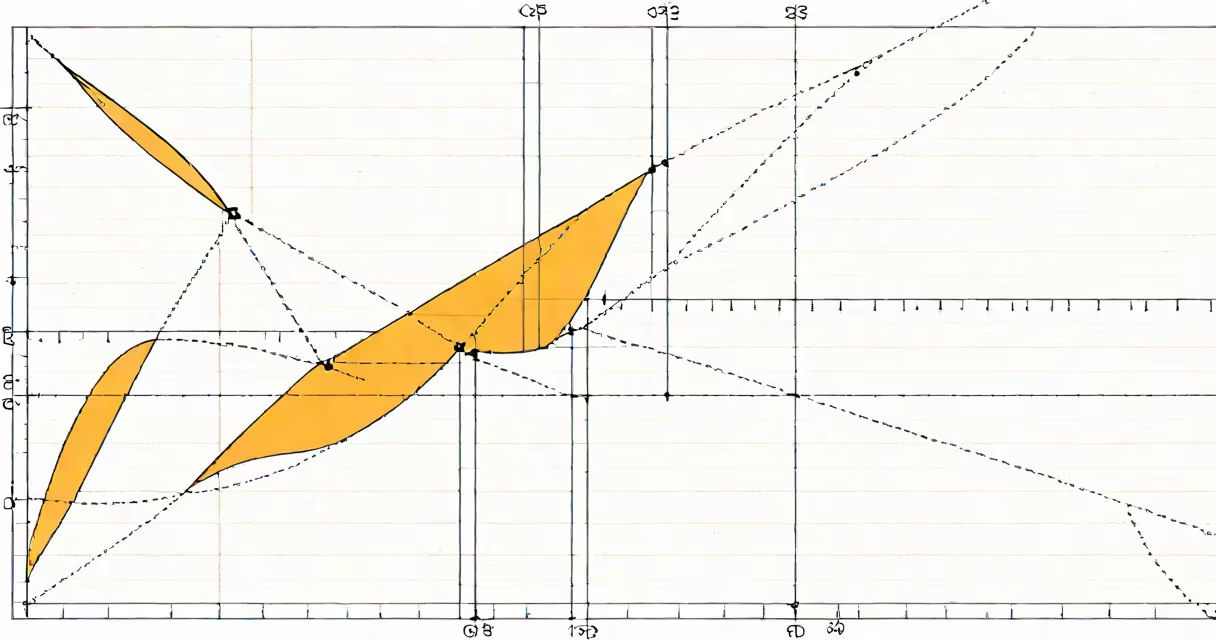
Problems often include visual elements: graphs of functions, tangent lines, shaded regions under curves, or labeled coordinates. A typical problem may show a parabola with a dotted tangent line at x = 2 and ask for the slope there.
Calculus problems fall into several categories based on their goal:
| Type | What It Computes | Real-World Example |
|---|---|---|
| Derivative | Rate of change at a point | Instantaneous velocity of a rocket at t = 5 seconds |
| Optimization | Maximum or minimum value | Minimizing material cost for a cylindrical can with fixed volume |
| Area Under Curve | Total accumulation | Calculating total revenue from a variable price function over 10 days |
| Related Rates | Change in one quantity relative to another | How fast the shadow length grows as a person walks away from a streetlight |
Each type uses symbolic notation: f'(x) for derivatives, ∫f(x)dx for integrals, and limits like limₓ→ₐ f(x) for continuity checks. Problems may also include constraints, such as "find the largest rectangle with perimeter 20 units," requiring both algebra and calculus.
One non-obvious distinction: many students assume calculus problems require complex formulas. But a simple problem like "At what time does a ball thrown upward reach its peak?" relies only on f(t) = −16t² + 64t, then solving f'(t) = 0. The solution is t = 2 seconds-no advanced tools needed.
Some people confuse calculus problems with algebraic ones. Algebra solves equations like 2x + 3 = 7. Calculus deals with changing quantities-motion, growth, curvature. A problem asking "When is the slope of y = x² equal to 6?" is calculus because it involves derivatives, not just solving for x.
Another misconception: calculus problems always involve numbers. Not true. Many focus on symbolic expressions. For example, "Show that the derivative of sin(x) is cos(x)" uses identities and limit definitions, not numerical substitution.
I once observed a student struggle with a related rates problem involving a conical tank draining water. The equation was dV/dt = k·h², but they tried plugging in values too early. The correct path required differentiating volume about time while holding geometry constant-a step missed by those who treat calculus as arithmetic with extra steps.
Look for these signs: the presence of derivatives (prime notation, dy/dx), integrals (∫), limits, or words like "rate," "instantaneous," "maximum," "area," or "total."
For example: "A particle moves along a line with position s(t) = t³ − 6t² + 9t. Find when the particle changes direction." This is a calculus problem because direction change occurs when velocity v(t) = s'(t) = 0. Solving 3t² − 12t + 9 = 0 yields t = 1 and t = 3. The particle reverses at those times.
Another example: "Find the area bounded by y = x² and y = 2x." This requires setting up ∫(2x − x²)dx from x = 0 to x = 2. The result is 4/3 square units. The shaded region between two curves is a classic calculus setup.
These problems are not just abstract exercises. Engineers use them to model stress on bridges, economists to predict market shifts, and biologists to track population growth. The form remains consistent: a function, a question about change or accumulation, and a solution rooted in mathematical rules.
Recognizing a calculus problem begins with identifying the nature of the change being analyzed. Whether it's a falling object, a growing investment, or a shifting temperature, the structure of the problem reflects a deeper pattern: how things evolve over time or space.