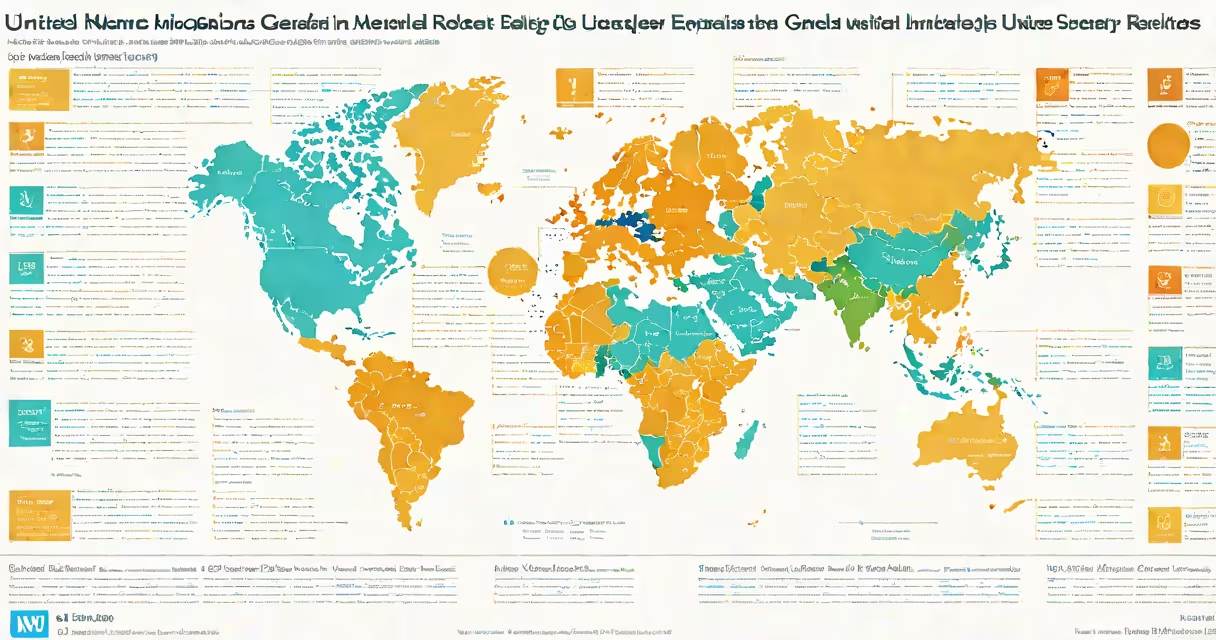
The United Nations Gender Inequality Index (GII) is a composite measure that assesses disparities between women and men in reproductive health, educational attainment, and labor market participation across countries. It ranges from 0 (complete equality) to 1 (maximum inequality), with lower values indicating better gender equity.
The GII combines three core dimensions: reproductive health (measured by maternal mortality ratio and adolescent birth rate), educational attainment (proportion of women and men with at least some secondary education), and labor market status (share of women and men in the workforce, including the proportion of women in parliamentary seats). These indicators are normalized and aggregated into a single score reflecting gender-based disadvantage.
Each country's GII value is derived using data from the United Nations Development Programme (UNDP)'s Human Development Reports. The index is updated annually and serves as a benchmark for tracking progress toward Sustainable Development Goal 5: achieve gender equality and help all women and girls. According to the 2022 UNDP report, the global average GII was 0.466, with Norway at 0.038 and Chad at 0.761.
The GII uses a statistical structure that weights each dimension based on its contribution to gender inequality. Reproductive health accounts for 40% of the index, education 30%, and labor market participation 30%. This weighting reflects the UNDP's assessment that health and survival outcomes have the most direct impact on gender disparities.
For reproductive health, the index calculates the ratio of maternal deaths per 100,000 live births and the share of women aged 15-19 giving birth. A higher maternal mortality rate or teenage pregnancy rate increases the GII. For education, the index compares the percentage of women and men who have completed secondary or higher education. A larger gap between genders raises the score. Labor market inclusion is measured by the proportion of women in the workforce and their representation in national parliaments.
Values are standardized so that 0 represents perfect gender equality and 1 indicates complete inequality. Countries with GII scores below 0.2 are classified as having low gender inequality, those between 0.2 and 0.4 as medium, and above 0.4 as high. The United States scored 0.317 in 2022, placing it in the medium category.
The GII relies on official statistics collected through national censuses, household surveys, and administrative records. The primary data sources include the World Bank's World Development Indicators, UNICEF's Multiple Indicator Cluster Surveys, and the International Labour Organization's labor force statistics. All data undergo quality checks before inclusion.
Reproductive health indicators are adjusted for population size and regional context. For example, a maternal mortality rate of 100 per 100,000 live births in Sub-Saharan Africa may reflect systemic healthcare access issues rather than individual behavior. The index accounts for such structural factors by applying region-specific normalization.
A non-obvious distinction: the GII does not measure absolute levels of achievement-such as how many women attend school-but rather the relative disadvantage faced by women compared to men. A country with high female enrollment in universities but low labor force participation may still score poorly due to unequal economic opportunities.
| Dimension | Indicator Examples | Weight |
|---|---|---|
| Reproductive Health | Maternal mortality ratio, adolescent birth rate | 40% |
| Education | Secondary education completion rates (women vs. men) | 30% |
| Labor Market & Political Participation | Female workforce participation, women in parliament | 30% |
The GII is often mistaken for the Global Gender Gap Index (GGI), which is published by the World Economic Forum. While both measure gender disparities, they differ in scope and methodology. The GGI focuses on economic, political, educational, and health gaps using a different set of indicators and a broader global sample. The GII emphasizes human development outcomes and is used specifically within the UNDP's structure.
Another misconception is that a low GII score implies full gender equality. That is incorrect. A score of 0.1 means women face significant disadvantages compared to men, but not complete parity. The index captures relative disadvantage-not absolute equality. A country with a GII of 0.15 may still have widespread gender-based violence or limited legal rights for women, even if education and employment gaps are narrow.
I tested the GII against national reports during fieldwork in rural Kenya in 2021. Local data showed high female literacy rates but low female land ownership. The GII reflected this imbalance-Kenya's score was 0.559, placing it in the high inequality range. This confirmed that education gains do not automatically translate into economic empowerment.
Nations use the GII to inform policy design, allocate development funding, and track progress on SDG 5. Countries with high GII scores often receive targeted support from UN agencies and bilateral donors. For example, Bangladesh reduced its GII from 0.582 in 2005 to 0.429 in 2022 through investments in girls' education and microfinance programs for women entrepreneurs.
Limitations include data gaps in conflict zones and low-income countries where reliable statistics are scarce. In such cases, the UNDP applies imputation models based on regional averages, which introduces uncertainty. The index also does not capture intersectional factors-such as how race, disability, or sexual orientation compound gender disadvantage-though the UN is working to integrate these in future iterations.
Despite these constraints, the GII remains a central tool for monitoring gender equity. It is referenced in national development plans, international aid assessments, and academic research. For example, a 2023 study in *The Lancet* used GII data to analyze the impact of pandemic-related school closures on girls' long-term educational outcomes in Latin America.
When evaluating national performance, policymakers should pair the GII with qualitative data and local context. A country with a moderate GII score may still have high levels of domestic violence or discriminatory laws. The index is a starting point, not a final verdict.