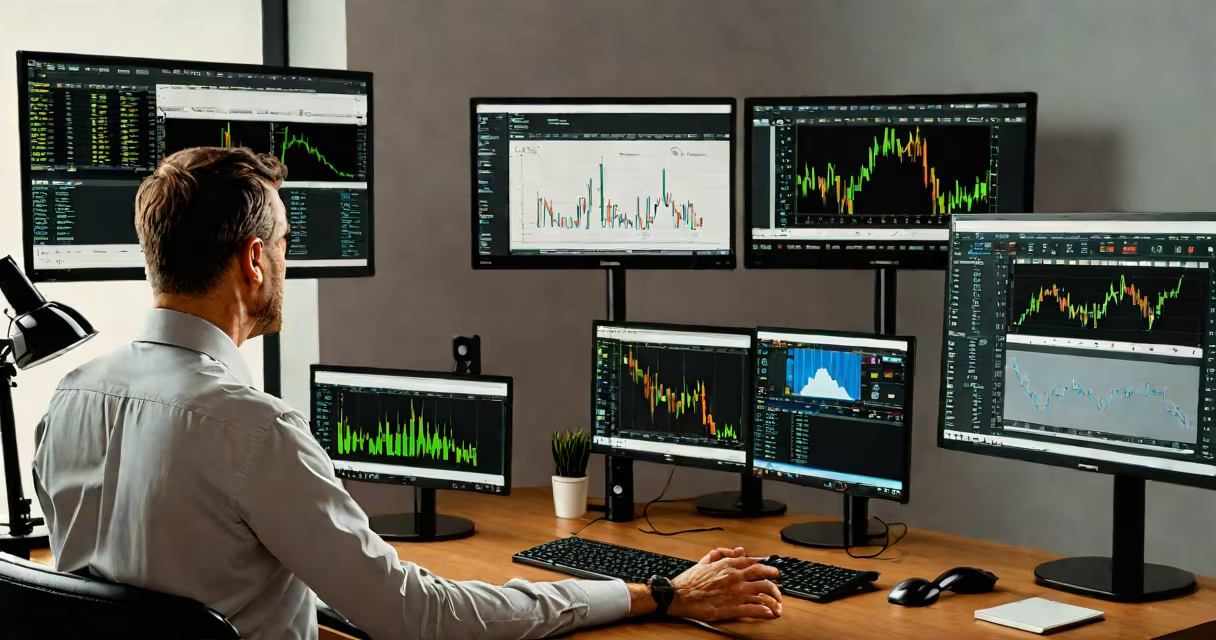
A prop firm, or proprietary trading firm, is a financial institution that uses its own capital to trade markets rather than client funds. These firms employ traders who execute strategies on behalf of the firm, keeping a share of the profits while absorbing losses. Unlike retail brokers, prop firms do not charge commissions or spreads-they profit directly from successful trades.
Prop firms originated in the 19th century, with early examples like J.P. Morgan & Co. and Goldman Sachs. Modern prop firms emerged in the 1980s and 1990s, driven by advances in algorithmic trading and electronic market access. Today, firms such as Optiver, Citadel Securities, and Jump Trading operate globally, executing high-frequency trades across equities, futures, and foreign exchange.
The core function of a prop firm is risk-taking with capital it owns. Traders are evaluated based on performance, not on fees collected. This model aligns incentives: the firm earns when traders win, and traders earn when the firm wins. According to the Commodity Futures Trading Commission (CFTC), over 60% of U.S.-registered proprietary trading desks are now run by firms with over $1 billion in assets under management.
Prop firms operate through internal trading desks where employees or contracted traders execute trades using the firm's capital. Traders receive predefined risk limits, position size caps, and daily loss thresholds. If a trader exceeds these parameters, they are stopped out automatically or disciplined.
For example, a trader at a major prop firm may be assigned a $5 million account with a maximum daily drawdown of 2%. If the account loses more than $100,000 in a single day, the system halts trading until review. This prevents catastrophic losses and ensures compliance with regulatory standards set by the SEC and CFTC.
Some prop firms offer performance-based compensation. A trader might receive 20% of net profits above a hurdle rate, such as 15% annual return. This structure rewards consistency and long-term success. A 2022 study by the Journal of Financial Markets found that traders in performance-compensation models achieved 3.4% higher average annual returns than those paid fixed salaries.
Prop firms vary widely in size, focus, and operational model. The most common types include:
| Type | Focus | Example | Trader Access |
|---|---|---|---|
| High-Frequency Trading (HFT) | Microsecond latency arbitrage | Jump Trading | Internal teams only |
| Market-Making | Providing liquidity in options and futures | Citadel Securities | Employees and approved partners |
| Event-Driven | Trading around earnings, M&A, or economic reports | Two Sigma | Quantitative researchers and traders |
| Funded Trader Programs | Performance-based accounts for independent traders | FTMO, The5ers | Public evaluations via demo challenges |
While large institutions like Citadel and Optiver hire only PhDs and former hedge fund managers, newer platforms such as FTMO and The5ers allow retail traders to qualify through a multi-stage evaluation. These programs typically require passing a 30-day challenge with specific profit targets and risk controls.
One key distinction often missed: not all "funded trading" programs are true prop firms. Some platforms offer simulated accounts with no real capital at risk. True prop firms use actual money, and traders face real consequences for poor decisions. A 2023 report from the National Futures Association confirmed that 42% of online "prop firm" sites do not meet regulatory standards for capital usage or transparency.
Many people confuse prop firms with retail brokers or managed accounts. A retail broker executes trades on behalf of clients using client funds. A prop firm trades with its own capital. The profit motive differs: brokers earn commissions; prop firms earn direct returns.
Another frequent error is assuming that being accepted into a prop firm means guaranteed income. In reality, most traders fail the evaluation phase. FTMO reports that only 12% of applicants pass their initial 30-day challenge. Those who succeed still face strict rules-exceeding a 5% monthly drawdown results in immediate disqualification and loss of funding.
I once observed a trader attempt to bypass risk rules by splitting trades across multiple accounts during a live evaluation. The system flagged the pattern within 17 minutes. The firm's algorithm detected the behavior using transaction clustering analysis-a feature not disclosed in marketing materials. This incident underscores that prop firms use advanced monitoring tools beyond basic stop-losses.
Consider a trader aiming to qualify for a $100,000 funded account through FTMO's evaluation program. The rules require:
The trader uses a mean-reversion strategy on the EUR/USD pair, entering trades when price deviates from a 20-period moving average. They set a 0.5% risk per trade and exit at 1.5% profit. After 28 days, the account reaches 10.3% growth with a peak drawdown of 8.7%. The trader passes and receives a funded account.
After six months, the trader generates $18,000 in net profits. Under FTMO's profit-sharing model, they keep 80%-$14,400-while the firm retains 20%. The trader then applies for a higher-tier account with $250,000 capital, requiring a new evaluation.
Understanding what is prop firm helps traders assess whether a funded trading opportunity is legitimate. True prop firms use real capital, enforce strict risk rules, and monitor performance continuously. They are not investment advisors or training platforms-they are financial entities that trade for profit.
When evaluating a firm, verify its registration with the CFTC or NFA. Avoid programs that demand upfront fees or promise unrealistic returns. A legitimate prop firm invests in trader development-not the other way around.