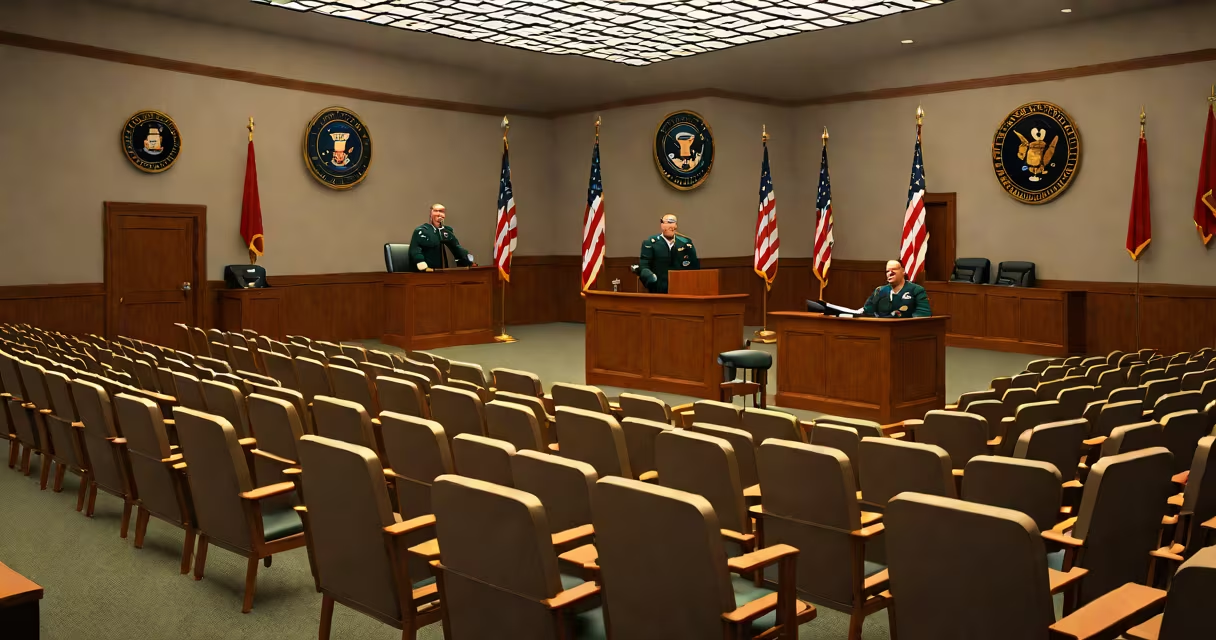
The UCMJ punitive articles are the core legal provisions in the Uniform Code of Military Justice that define criminal conduct subject to military trial and punishment. They cover 150 specific offenses ranging from theft and desertion to sexual assault and insubordination, each carrying potential penalties such as confinement, forfeiture of pay, or dismissal.
These articles form the foundation of military criminal law in the United States. Enacted in 1951 and codified under Title 10 of the U.S. Code, they apply uniformly across all branches of the armed forces. Unlike civilian law, which varies by state, military law is federal and consistent nationwide. The UCMJ punitive articles are enforced through a structured system of command authority, investigations, and courts-martial.
Each article specifies both the prohibited act and the maximum punishment. For example, Article 120 covers rape and sexual assault, with a maximum penalty of life imprisonment. Article 86 addresses absence without leave (AWOL), punishable by up to six months' confinement and reduction in rank. These penalties are not automatic-they depend on the severity of the offense, the service member's record, and the discretion of the court-martial panel.
When a service member is accused of violating a punitive article, the process begins with an investigation by a military investigator, typically from the Office of Special Investigations (OSI) or a similar unit. If evidence supports charges, the commander may refer the case to a court-martial. The accused then faces either a summary, special, or general court-martial, depending on the seriousness of the alleged offense.
For instance, a charge under Article 134-"General Article"-covers conduct prejudicial to good order and discipline, including acts that bring discredit upon the armed forces. This article is broad and often used for offenses not explicitly listed elsewhere. A soldier who posts offensive material online that undermines unit cohesion could be charged under Article 134. The prosecution must prove beyond a reasonable doubt that the behavior harmed military effectiveness.
Penalties are determined by the court-martial panel. A general court-martial can impose the death penalty for certain capital offenses, though this is rare. Most cases result in confinement, loss of pay, reduction in rank, or dismissal. The Uniform Code of Military Justice mandates that sentencing be proportional to the offense and the individual's history. The U.S. Court of Appeals for the Armed Forces reviews appeals to ensure fairness and legal accuracy.
UCMJ punitive articles fall into distinct categories based on the nature of the offense. The table below outlines major categories, their corresponding articles, and typical penalties.
| Category | Articles | Examples of Offenses | Max Penalty |
|---|---|---|---|
| Personal Conduct | 120, 121, 122 | Rape, sexual assault, indecent exposure | Life imprisonment (Art. 120) |
| Desertion & Absence | 85, 86, 87 | Desertion, AWOL, failure to report | Death (Art. 85), 6 months (Art. 86) |
| Property Crimes | 96, 97, 98 | Theft, larceny, destruction of government property | 10 years (Art. 97) |
| Command & Discipline | 88, 89, 90 | Insubordination, disobedience, refusal to obey orders | 1 year (Art. 89) |
| General Misconduct | 134 | Conduct bringing discredit on the armed forces | Life imprisonment (discretionary) |
Article 134 is frequently misunderstood. It is not limited to overt crimes-it applies to behavior that harms military morale or operational readiness. In 2019, a Marine was convicted under Article 134 for posting racially charged comments on social media during deployment. The court ruled the post created a hostile environment and undermined unit cohesion, even though no direct physical harm occurred.
Many assume that UCMJ punitive articles only apply to combat situations or wartime. This is incorrect. The UCMJ governs all service members at all times, whether deployed or stateside. A sailor stationed in San Diego can face charges under Article 134 for making threats on a public forum, just as a soldier in Afghanistan can.
Another misconception is that military courts are less fair than civilian ones. In reality, the U.S. Court of Appeals for the Armed Forces (CAAF) has upheld constitutional rights in numerous rulings. For example, in *United States v. Lomax* (2020), the court ruled that a service member's right to confront witnesses under the Sixth Amendment applied in military trials. This decision reinforced that due process protections exist within the military justice system.
A lesser-known fact: some punitive articles have been updated since 1951. Article 120 was revised in 2012 to replace outdated language like "carnal knowledge" with modern terms such as "sexual assault." The change reflected evolving standards on consent and gender equity. The Department of Defense reports that these updates reduced reporting bias and improved conviction rates in sexual assault cases.
Consider a scenario involving a Navy petty officer stationed aboard the USS *Abraham Lincoln*. During a port visit in Japan, the officer was caught stealing a $200 electronic device from a shipmate's locker. The incident was reported via the Navy's internal reporting system.
An investigation confirmed the theft using security footage and witness statements. The commanding officer referred the case to a special court-martial under Article 97 (larceny). The charge carried a maximum penalty of 10 years' confinement and dishonorable discharge.
At trial, the defense argued the officer had a history of financial stress and no prior disciplinary record. The prosecution presented video evidence and testimony from the victim. The panel sentenced the officer to 18 months' confinement, forfeiture of all pay and allowances, and reduction in rank from E-5 to E-1.
This case illustrates how punitive articles are applied: evidence-based charging, proportionate sentencing, and accountability regardless of rank or location. The outcome was reviewed by the Navy's Judge Advocate General, confirming compliance with UCMJ standards.