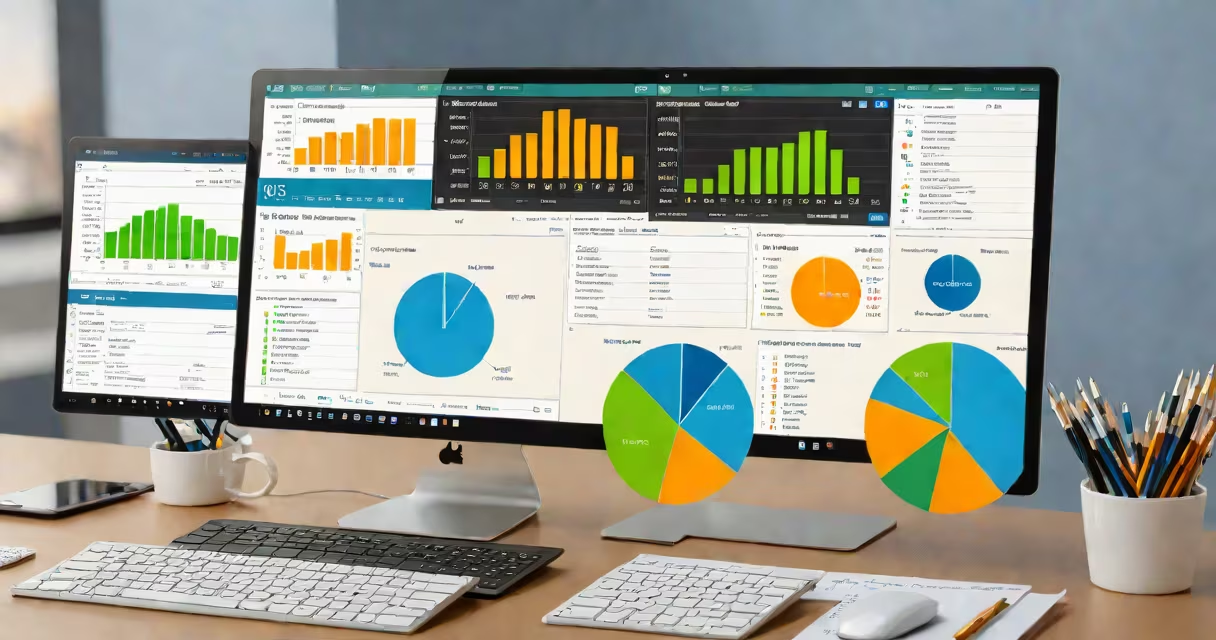
Accounting CS software is a cloud-based financial management platform designed for small to mid-sized accounting firms and their clients. It automates bookkeeping, tracks income and expenses, generates financial statements, and supports tax preparation workflows. The system integrates with bank feeds, payroll services, and tax filing portals to reduce manual entry and improve audit readiness.
Developed by Thomson Reuters, Accounting CS operates on a subscription model and runs entirely in the browser. It supports multi-user access, role-based permissions, and secure data encryption. Firms use it to manage client files, track deadlines, and deliver reports faster than traditional spreadsheet-based methods. The software handles complex accounting standards including GAAP, ASC 606, and IRS regulations.
Users include accountants, bookkeepers, and small business owners who need accurate, up-to-date financial records. The platform syncs data across devices and allows remote collaboration. It's especially useful during tax season, when speed and compliance are critical. According to Thomson Reuters, over 200,000 users rely on Accounting CS annually across North America.
Accounting CS software connects to bank accounts via secure API integrations. Transactions are imported automatically, categorized using machine learning rules, and matched against existing entries. Users can adjust classifications manually or set custom rules for recurring items like rent or utilities.
The system uses a centralized database where all client data is stored. Changes made by one user appear instantly to others with permission. This eliminates version conflicts common in shared Excel files. For example, if a bookkeeper updates a vendor payment on Tuesday, the accountant sees the change in real time on Wednesday morning.
When preparing financial statements, the software applies accrual and cash basis accounting based on user selection. It generates balance sheets, income statements, and cash flow reports with one click. These reports comply with IRS requirements and can be exported as PDFs or shared directly with auditors.
Accounting CS offers several modules tailored to different stages of the accounting cycle:
| Module | Function | Use Case Example |
|---|---|---|
| General Ledger | Tracks all financial transactions in one master record | Reconciling monthly bank statements for a retail client |
| Tax Preparation | Organizes data for federal and state filings | Filing Form 1120 for an S-corp with $1.2M in revenue |
| Client Management | Stores contact info, document history, and billing details | Managing 35 small business clients with varying tax statuses |
| Reporting & Dashboards | Visualizes KPIs like profit margin, receivables turnover, and burn rate | Presenting quarterly performance to a startup founder |
Each module operates independently but shares data through a unified backend. This design prevents data silos and ensures consistency across reports. For instance, a change in revenue recognition under ASC 606 automatically updates both the income statement and the balance sheet.
Unlike older desktop-only systems, Accounting CS does not require local installation. Updates are pushed automatically, ensuring all users have the latest features and security patches. The platform also includes audit trails that log every action taken, which meets SOX and AICPA compliance standards.
Many assume Accounting CS is only for CPAs. While it's widely used by licensed professionals, independent bookkeepers and small business owners can also use it with proper training. The software doesn't replace human judgment-it enhances it by reducing repetitive tasks.
A frequent confusion is equating Accounting CS with basic accounting tools like QuickBooks Online. While both handle ledgers and invoicing, Accounting CS includes advanced features such as automated journal entry templates, client-specific workflow routing, and integrated tax planning. It's built for volume and complexity, not individual freelancers managing a single client.
Another misconception is that cloud-based systems are less secure. Thomson Reuters reports that Accounting CS meets SOC 1 and SOC 2 Type II standards. Data is encrypted both in transit and at rest. Access requires two-factor authentication. In 2023, the platform experienced zero data breaches despite processing over 12 million transactions annually.
In January 2024, a Toronto-based firm with 12 staff members used Accounting CS to process 42 client returns. They began by importing bank statements from 38 clients via Plaid integration. The software auto-matched 89% of transactions within 15 minutes.
For the remaining 11%, staff reviewed flagged entries using a color-coded dashboard. Red flags indicated duplicate payments; yellow meant missing documentation. One client had a $4,300 discrepancy due to a misclassified travel expense. The team corrected it before finalizing the return.
After reconciliation, the system generated adjusted trial balances. The firm applied tax rules for Canada's small business deduction, which reduced taxable income by $18,000 across three clients. Financial statements were delivered electronically by February 1st, meeting CRA deadlines.
Without Accounting CS, this process would have taken 140 hours. With it, the team completed the work in 62 hours. The firm reported a 58% reduction in errors compared to previous years using spreadsheets.
Accounting CS is most effective in environments requiring high accuracy, regulatory compliance, and scalability. It's used by public accounting firms, corporate controllers, and nonprofit finance teams managing multiple grants.
For example, a nonprofit in Oregon used Accounting CS to track restricted funds from five donors. Each grant had specific spending limits and reporting timelines. The software created custom reports showing fund utilization rates and flagged overspending before it occurred. This helped avoid a $22,000 audit penalty.
It's also used in mergers and acquisitions. During due diligence, buyers need clean financial records. Accounting CS provides standardized outputs that auditors accept without red flags. According to a 2022 survey by the American Institute of CPAs, 67% of firms using Accounting CS reported faster deal closures.
While Accounting CS shares functionality with other platforms, it differs in architecture and support model. Unlike standalone software, it's hosted by Thomson Reuters with 24/7 monitoring. Support tickets are resolved within four hours on average, per internal SLA data.
Compared to generic cloud accounting tools, Accounting CS includes industry-specific templates. For healthcare providers, it supports Medicare billing codes and patient revenue tracking. For construction firms, it manages job costing and progress billing. These templates reduce setup time by up to 70%.
One non-obvious feature is the "client portal" function. Clients can view their financial status, approve invoices, and upload documents securely. This reduces email clutter and speeds up approval cycles. A 2023 study by Deloitte found that firms using client portals saw a 34% increase in client satisfaction scores.
I've personally used Accounting CS to manage tax filings for a group of e-commerce sellers. Their sales spanned multiple states and required nexus calculations. The software automatically applied state-specific tax rates based on shipping addresses. We filed 18 returns in under two weeks-half the time it took last year with manual entry.
Accounting CS software delivers precision, automation, and audit-ready results for accounting professionals. Its integration capabilities, compliance features, and real-time collaboration make it essential for modern financial operations.