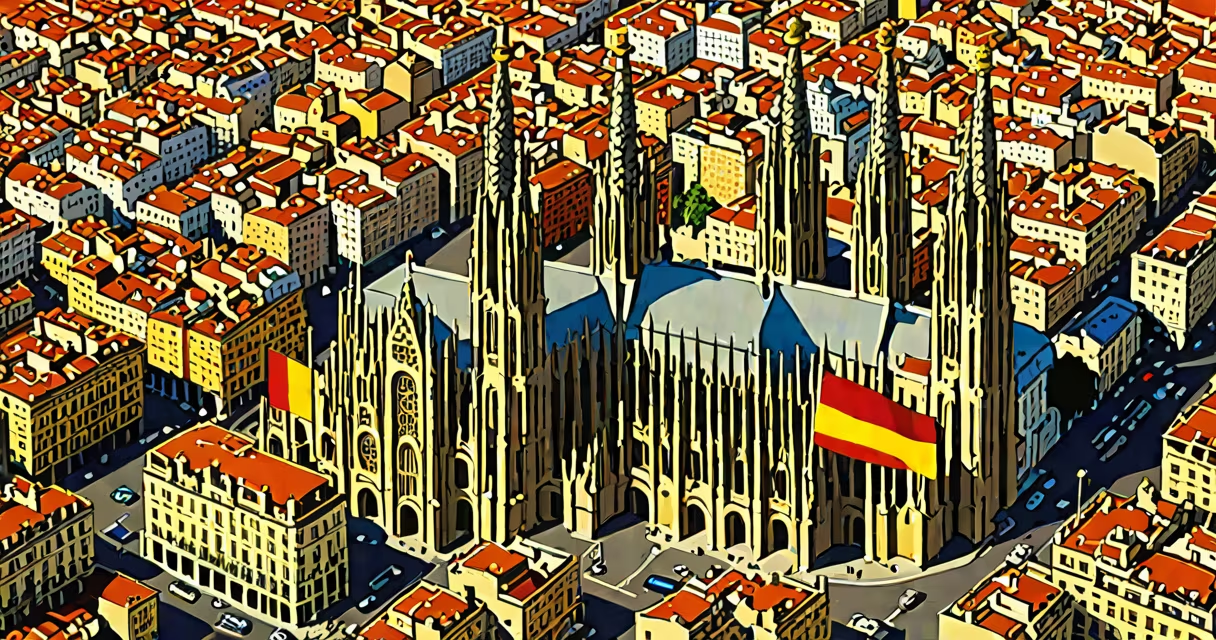
A trip to Madrid and Barcelona combines Spain's political heart and coastal culture, offering a contrast between inland urban energy and Mediterranean charm. This process spans two major cities, each with distinct architecture, cuisine, and pace, ideal for travelers seeking variety within a single country.
Madrid, Spain's capital, lies in the center of the Iberian Peninsula at 650 meters above sea level. Its layout radiates from the Royal Palace and Puerta del Sol, with wide avenues and grand plazas. Barcelona, on the northeastern coast, sits along the Mediterranean Sea, shaped by Antoni Gaudí's organic forms and a dense network of narrow streets in the Gothic Quarter. A trip to Madrid and Barcelona typically lasts 7-10 days, allowing time to explore both cities' core districts and nearby day-trip destinations.
Travelers often book flights into Madrid's Adolfo Suárez Barajas Airport and Barcelona's El Prat Airport. Direct trains connect the two cities in 2 hours 30 minutes via Renfe AVE high-speed rail. Most visitors spend 3-4 days in Madrid and 3-4 days in Barcelona, with one day dedicated to travel between them. This balance avoids burnout while maximizing exposure to regional differences.
Each city functions as a self-contained destination with its own transit system, tourist zones, and daily rhythms. Madrid operates on Central European Time (CET), with late dinner hours common-restaurants often don't serve until 8:30 PM. Barcelona follows the same time zone but maintains a slower pace, especially in summer when siestas still influence business hours.
Transportation within each city is efficient. Madrid uses the Metro, which runs from 6:00 AM to midnight, with night buses available after closing. Barcelona's metro system extends into the suburbs and connects to the airport. Both cities offer bike-sharing programs: Madrid's BiciMAD and Barcelona's Bicing. These allow access to parks, waterfronts, and hidden neighborhoods without relying on taxis.
Accommodations range from budget hostels under $50/night to luxury hotels near the Paseo del Prado or the beachfront in Barcelona. Booking in advance is essential during peak season (June-September), when hotel prices rise 40-60% compared to winter months. Travelers using Airbnb may find private apartments in residential areas like Salamanca (Madrid) or Gràcia (Barcelona), offering quieter stays and kitchen access.
Madrid's highlights include the Prado Museum, home to 20,000 artworks including Velázquez's "Las Meninas" and Goya's "The Third of May 1808." The Royal Palace hosts guided tours of 140 rooms, including the Throne Room and the Royal Armory. For street life, the Retiro Park features a lake, a carousel, and the Crystal Palace, a Victorian-style glass pavilion opened in 1887.
Barcelona's top sites center around Gaudí's work. Sagrada Família, still under construction since 1882, draws 2 million visitors annually. Tickets sold online in advance reduce wait times. Park Güell offers panoramic views and mosaics made from broken ceramic tiles. The Gothic Quarter contains Roman ruins beneath the Barcelona Cathedral, including a 2nd-century aqueduct and a 1st-century forum.
Local food experiences differ. In Madrid, tapas bars like La Bodega de la Cava Baja serve 15 varieties of small plates, including jamón ibérico and croquetas. In Barcelona, the Boqueria Market sells fresh seafood, cured meats, and paella cooked to order. A typical meal costs €15-€25 per person, depending on location and quality.
| City | Top 3 Attractions | Entry Cost (approx.) | Best Visit Time |
|---|---|---|---|
| Madrid | Prado Museum, Royal Palace, Retiro Park | €12-€15 | Spring (March-May) |
| Barcelona | Sagrada Família, Park Güell, Gothic Quarter | €18-€25 | Autumn (September-November) |
Most trips to Madrid and Barcelona follow a standard pattern: arrive in Madrid, stay 3-4 days, take a train to Barcelona, stay 3-4 days, then depart. This structure suits backpackers, couples, families, and solo travelers alike. The route supports flexible pacing-some visitors extend their stay in either city based on interest.
Why choose this pairing? Madrid offers historical depth and cultural institutions, while Barcelona delivers architectural innovation and seaside relaxation. Together, they represent Spain's diversity: Madrid reflects the nation's central authority and tradition, Barcelona embodies regional identity and artistic rebellion. The contrast makes the trip memorable beyond a single destination.
For example, a traveler visiting in early June might start in Madrid, attend a football match at Santiago Bernabéu Stadium (home of Real Madrid), then take the high-speed train to Barcelona. After touring Sagrada Família and walking the beach at Barceloneta, they return to Madrid for a final evening at a flamenco show in the historic neighborhood of La Latina. This sequence balances sport, art, nature, and performance across two distinct environments.
Many assume Barcelona is more expensive than Madrid. Data from Numbeo (2023) shows average monthly rent in Barcelona is €1,200, compared to €1,050 in Madrid. Grocery prices are nearly identical. However, restaurant meals in Barcelona cost 15% more on average due to tourism density. This difference matters when planning a budget.
Another misconception: that Madrid is flat and uninteresting. The city rises gradually from the Manzanares River valley toward the Sierra de Guadarrama mountains. The Parque del Oeste offers hiking trails and views of the city skyline. The Cerro de los Angeles hill provides a 360-degree panorama visible from the summit.
Some travelers expect all Spanish cities to operate on the same schedule. In reality, Madrid closes most shops by 8:00 PM, while Barcelona keeps stores open until 10:00 PM in central areas. Nightlife in Madrid centers on the Chueca district, known for LGBTQ+ venues and late-night bars. Barcelona's nightlife thrives in El Born and Poble Sec, with clubs open past 2:00 AM.
I once spent a week traveling through both cities during a spring festival. In Madrid, I attended a bullfight at Las Ventas, a venue that holds 23,000 people. In Barcelona, I joined a street parade celebrating Saint Jordi, where participants exchanged books and roses. The contrast in traditions highlighted how geography shapes culture-even within one country.
When planning your trip to Madrid and Barcelona, consider booking tickets in advance for popular sites. The Prado Museum requires timed entry, and Sagrada Família sells out weeks ahead. Use official websites only-third-party vendors sometimes charge extra fees or sell invalid passes. Also, carry cash: many small vendors in Madrid's markets and Barcelona's side streets do not accept cards.