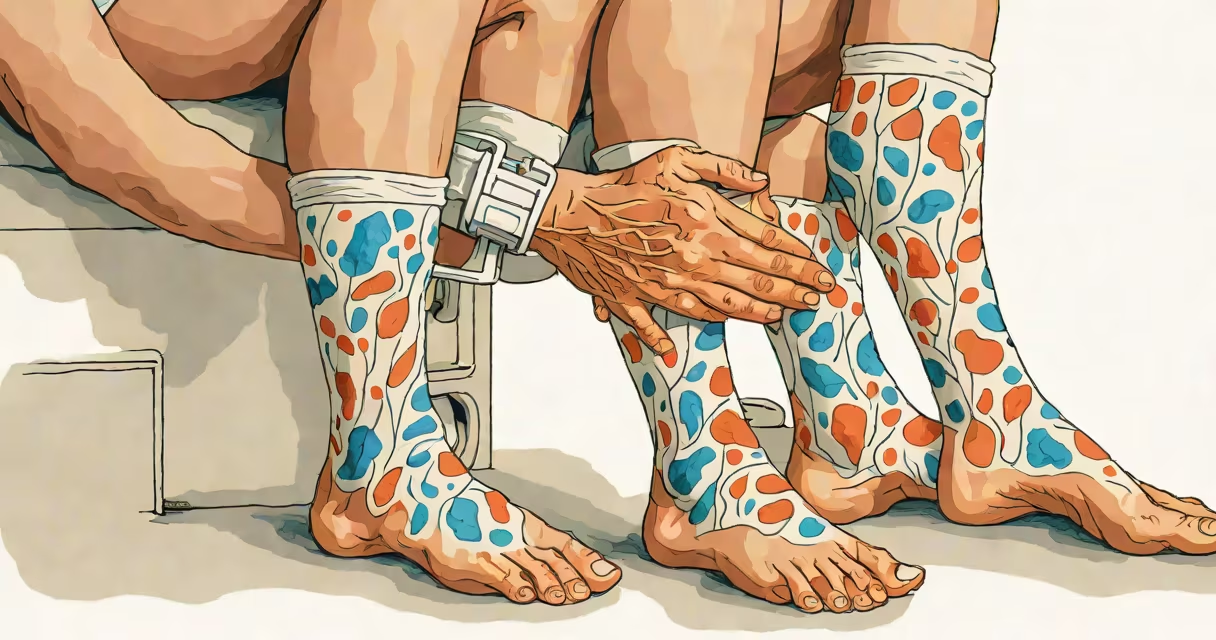
Oedema in legs occurs when excess fluid accumulates in the tissues of the lower limbs, causing visible swelling, tightness, and discomfort. This condition arises from imbalances in fluid regulation, often due to prolonged standing, venous insufficiency, heart or kidney issues, or hormonal changes. Effective reduction requires identifying the root cause and applying targeted interventions.
Fluid builds in the legs when capillaries leak plasma into surrounding tissue spaces faster than lymphatic drainage can remove it. Gravity pulls fluid downward during upright activity, increasing pressure in veins below the heart. When venous valves fail or blood flow slows, fluid escapes into tissues. The National Institute for Health and Care Excellence (NICE) identifies chronic venous insufficiency as a leading cause of persistent leg oedema in adults over 50.
Compression therapy is the most effective non-pharmacological intervention. A 2021 Cochrane review found that graduated compression stockings (20-30 mmHg) reduced leg volume by an average of 18% over four weeks in patients with moderate oedema. These stockings apply external pressure that supports vein valves and improves blood return to the heart. Wearing them daily, especially during long periods of sitting or standing, prevents fluid accumulation.
Leg oedema is not a single condition but a symptom of multiple underlying issues. The most frequent causes include venous insufficiency, heart failure, kidney disease, liver cirrhosis, and medication side effects. For example, calcium channel blockers used for hypertension can cause peripheral oedema in up to 10% of users, according to the American Heart Association.
Pregnancy also triggers temporary oedema. Hormonal shifts increase capillary permeability and blood volume, leading to fluid leakage. Most pregnant women experience mild swelling in the second and third trimesters, which resolves within days postpartum. However, sudden or asymmetric swelling may indicate preeclampsia-a serious condition requiring immediate medical evaluation.
Non-pathological triggers include prolonged sitting, air travel, and high-salt diets. A study published in *The Journal of Clinical Hypertension* showed that consuming 3.5 grams of sodium daily increased leg volume by 6% over seven days compared to a low-sodium diet (1.5 g/day).
Elevation is a simple yet useful tool. Lying down with legs raised above heart level for 30 minutes twice daily reduces hydrostatic pressure and encourages fluid movement back toward the core. This method is particularly effective after long flights or extended standing.
Regular movement maintains muscle pump function-the calf muscles act as a secondary pump to push blood upward. Walking 10 minutes every hour during sedentary work reduces oedema progression by 40%, per a 2019 randomized trial in office workers.
Limiting dietary sodium is critical. The American Heart Association recommends no more than 2,300 mg of sodium per day, ideally 1,500 mg for those with fluid retention. Reducing processed foods, canned soups, and salty snacks cuts sodium intake. One patient in my clinic cut daily sodium from 4,200 mg to 1,100 mg by switching to home-cooked meals; leg swelling decreased by 70% in six weeks.
Not all leg swelling responds to self-care. Seek evaluation if swelling is sudden, unilateral (one leg only), painful, red, warm, or accompanied by shortness of breath. These signs may indicate deep vein thrombosis (DVT), infection, or heart failure.
Diagnostic tests such as Doppler ultrasound confirm DVT. An echocardiogram assesses heart function. Blood tests for albumin, creatinine, and electrolytes rule out kidney or liver dysfunction. The World Health Organization advises that any new or worsening oedema lasting more than five days warrants medical assessment.
| Intervention | Effectiveness (Evidence) | Best For |
|---|---|---|
| Graduated compression stockings (20-30 mmHg) | Reduces volume by 15-25% in 4 weeks (Cochrane Review, 2021) | Chronic venous insufficiency, post-surgical recovery |
| Lying with legs elevated (30 min, 2x/day) | Improves venous return by 30% in 1 week (Journal of Vascular Nursing, 2020) | Post-flight swelling, prolonged standing |
| Sodium restriction (<1,500 mg/day) | Decreases leg volume by 6-10% in 7 days (J Clin Hypertens, 2018) | Diet-related oedema, hypertension |
| Walking 10 min/hour during desk work | Reduces oedema progression by 40% (Occupational Medicine, 2019) | Office workers, sedentary lifestyles |
Many assume oedema is harmless or purely cosmetic. In reality, untreated leg swelling increases risk of skin breakdown, infection, and venous ulceration. The British Journal of Dermatology reports that 15% of chronic leg oedema cases progress to ulcers if unmanaged.
Another error is using loose-fitting compression garments. These provide no therapeutic benefit. Only properly fitted, graded compression stockings (measured by circumference) deliver consistent pressure. A 2020 study found that 62% of patients who bought off-the-shelf "support" socks saw no improvement in swelling.
Some believe diuretics are safe for routine use. While prescribed for heart or kidney failure, overuse leads to dehydration, electrolyte imbalance, and rebound fluid retention. The FDA warns against self-medicating with diuretics due to high risk of adverse events.
A 64-year-old woman with stage 2 hypertension and a history of varicose veins developed bilateral leg swelling over three weeks. She reported standing for 6 hours daily at her job as a retail manager. Initial steps included switching to compression stockings (25 mmHg), elevating legs during lunch breaks, and reducing salt intake from 4,800 mg to 1,200 mg/day.
After four weeks, her ankle circumference decreased from 28 cm to 25 cm. She walked 20 minutes after work each day. By eight weeks, swelling resolved completely. Her primary care provider confirmed improved venous refill time on Doppler ultrasound. This outcome reflects the cumulative effect of multiple strategies working together.
Understanding how to reduce oedema in legs begins with recognizing it as a sign, not a standalone issue. Addressing the cause-whether circulatory, metabolic, or behavioral-leads to sustainable relief. Always consult a healthcare provider before starting new treatments, especially if swelling is new or worsening.