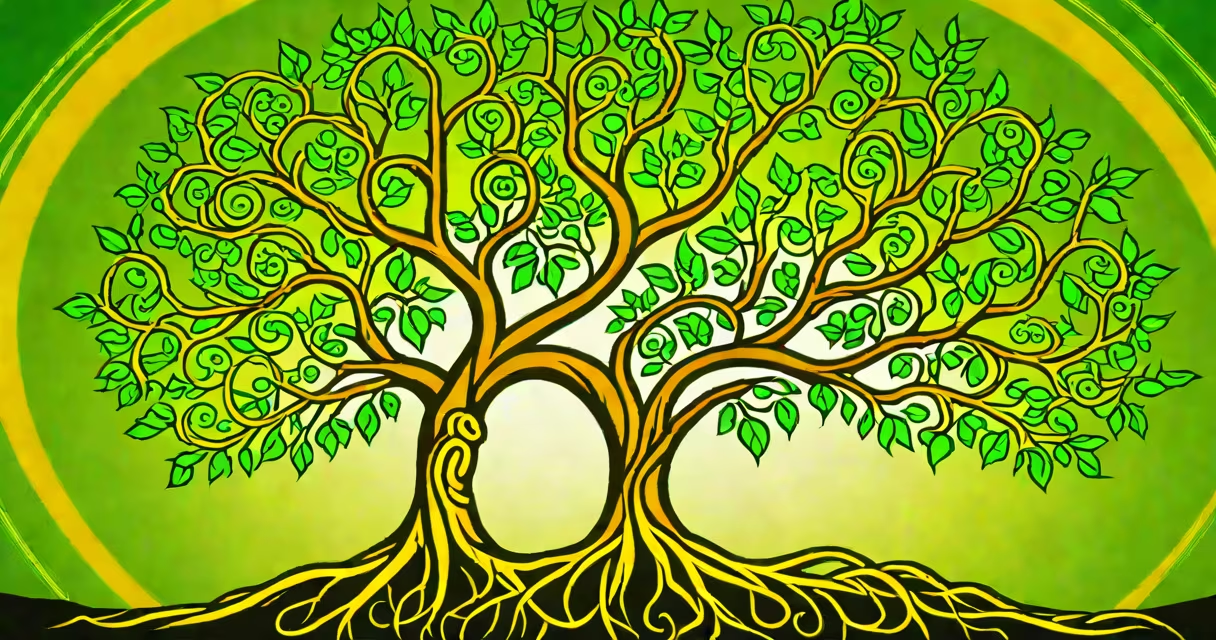
The tree of life Christian meaning refers to a sacred symbol in Scripture representing eternal life, divine wisdom, and God's presence. Found in Genesis and Revelation, it signifies spiritual nourishment, restoration, and the ultimate union between humanity and God.
In Genesis 2:9, the tree of life stands in Eden's center, described as "pleasant to the sight and good for food." Its placement underscores divine provision and access to eternal life. After Adam and Eve's disobedience, they were barred from it-symbolizing the separation caused by sin. Yet the tree remains central to Christian hope: Christ is seen as the new life-giver who restores access through redemption.
Revelation 22:2 expands the image: "On each side of the river stood the tree of life, bearing twelve crops of fruit, yielding its fruit every month." This vision presents the tree not as lost, but as restored in the New Jerusalem-a place where believers eat from it forever. The imagery connects eternal life with continuous spiritual renewal.
The tree of life operates as both literal and symbolic reference. Early Church Fathers like Augustine interpreted it as a metaphor for Christ-the Word made flesh who offers everlasting life. Others, such as Origen, saw it as representing the divine Logos, the rational principle through which creation was formed.
Modern theologians continue this tradition. N.T. Wright, in *The New Proof and the People of God*, argues that the tree of life symbolizes the fulfillment of God's covenant promises. He notes that in Jewish apocalyptic literature, the tree often appears as a sign of resurrection and cosmic renewal-themes echoed in Paul's letters and Revelation.
For many Christians, the tree of life is not just ancient text-it's lived faith. In liturgical practice, especially during Easter and Pentecost, churches incorporate tree motifs in art and altar decorations. Some denominations even plant trees in churchyards as acts of remembrance and commitment to eternal life.
The tree of life appears in multiple contexts within Christian scripture and tradition. Below are the primary expressions:
| Context | Scripture Reference | Interpretation |
|---|---|---|
| Eden's garden | Genesis 2:9 | Symbol of original innocence and unbroken fellowship with God. Access denied after the Fall. |
| Divine presence | Revelation 2:7, 22:2 | Represents eternal life and the final restoration of creation. Believers are promised access. |
| Wisdom and righteousness | Proverbs 3:18 | "She is a tree of life to those who take hold of her." Wisdom is personified as a life-giving force. |
| Christ as the source | John 6:51 | Jesus says, "I am the living bread that came down from heaven." His body is the sustenance that grants eternal life. |
These layers show how the tree of life evolved from a physical garden feature into a theological anchor. It's not static-it grows in meaning across time and culture.
Many confuse the tree of life with the tree of the knowledge of good and evil. They stand together in Eden, but serve opposite purposes. The latter brings awareness of moral choice and consequence; the former offers communion with God and eternal life. Misidentifying them leads to theological error-especially in popular media.
Another misconception is that the tree of life is merely a metaphor. While symbolic, it carries real weight in Christian doctrine. The early Church did not treat it as purely allegorical. In the 4th century, the *Apocalypse of Peter* describes the tree as a real, resurrected entity in the afterlife. This view persisted in Eastern Orthodox tradition, where icons of the tree appear in church frescoes.
A lesser-known point: the tree of life is not unique to Christianity. Ancient Mesopotamian texts describe similar trees, and Zoroastrianism features the *Haoma* plant as a life-giving substance. But Christian theology reframes these earlier symbols through the lens of Christ's sacrifice and resurrection. As scholar John Walton writes in *The Lost World of Genesis One*, "The biblical tree is not a mythic relic-it is a covenantal sign."
I once visited St. John's Cathedral in downtown Chicago during Lent. A large wooden carving of the tree of life dominated the sanctuary wall. Each branch held small metal plaques engraved with names of parishioners who had died. The artist explained that the tree wasn't just decoration-it was a daily reminder of resurrection and continuity beyond death.
This experience showed me how the tree of life Christian meaning moves beyond doctrine into lived ritual. It's not abstract. It's tactile. It's communal. When people light candles near the tree during memorial services, they're not just honoring memory-they're affirming belief in eternal life.
For individuals seeking deeper purpose, reflecting on the tree of life can offer clarity. It reminds us that life isn't only about survival-it's about becoming. Growth, healing, and relationship with God are ongoing processes. As the Bible says, "Blessed is the man who walks not in the counsel of the wicked..." (Psalm 1:1)-a verse often paired with the tree in Christian meditation.
Even in scientific discourse, the idea persists. Biologists studying symbiotic relationships in forests have noted that certain trees form underground networks through fungi-sharing nutrients, communicating threats. These "wood-wide webs" mirror the biblical image of interconnected life. Though not theological, they reinforce the idea that life thrives through connection-a theme central to the tree of life Christian meaning.
The tree of life Christian meaning is not a single interpretation. It's a changing symbol that speaks across centuries, cultures, and disciplines. Whether read in a devotional journal or studied in a seminary classroom, it continues to inspire awe and conviction.