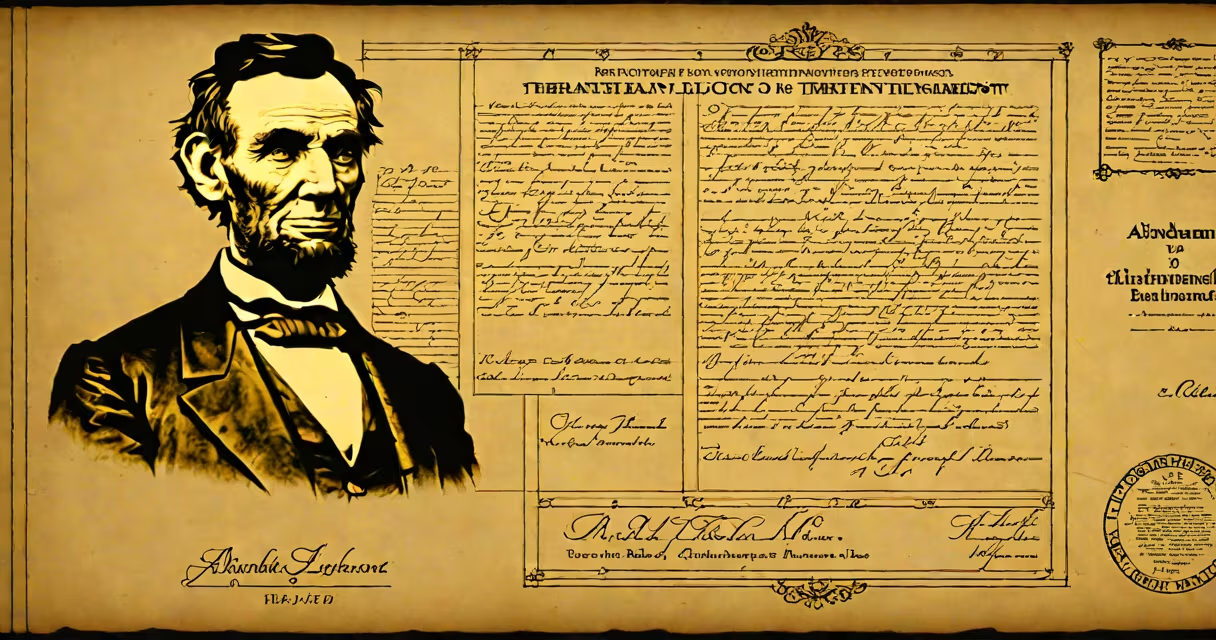
Abraham Lincoln and the Thirteenth Amendment together ended legal slavery in the United States by combining executive leadership with constitutional reform. Lincoln championed the amendment as a wartime measure to preserve the Union and abolish human bondage, culminating in its ratification in December 1865.
The Thirteenth Amendment was the first of three Reconstruction Amendments passed after the Civil War. It formally abolished slavery and involuntary servitude except as punishment for a crime. Lincoln did not draft the amendment, but he actively supported its introduction in Congress and pressured lawmakers to pass it before the war ended. His administration used executive authority to issue the Emancipation Proclamation in 1863, which freed enslaved people in Confederate states, but only a constitutional amendment could permanently end slavery nationwide.
Lincoln's role was strategic. He believed the Constitution allowed for amendments, and he used his influence to secure votes in the House of Representatives. On January 31, 1865, the House passed the amendment with a two-thirds majority. Lincoln personally lobbied wavering representatives, including those from border states, using political persuasion and promises of postwar reconciliation. His efforts were critical-without his backing, the amendment likely would have stalled.
The amendment consists of two sections. Section 1 declares: "Neither slavery nor involuntary servitude, except as a punishment for crime whereof the party shall have been duly convicted, shall exist within the United States, or any place subject to their jurisdiction." This language explicitly prohibits slavery throughout federal and state jurisdictions.
Section 2 grants Congress the power to enforce the amendment through appropriate legislation. This provision enabled future civil rights laws, such as the Civil Rights Act of 1964 and the Fair Housing Act of 1968, which relied on congressional authority derived from the amendment.
Unlike the Emancipation Proclamation-which applied only to areas in rebellion-the Thirteenth Amendment applied to all states. It removed slavery as a legal institution, not just a wartime policy. The amendment's reach extended beyond the battlefield into courts, plantations, and homes.
The Thirteenth Amendment is one of three Reconstruction Amendments. The others are the Fourteenth Amendment (granting citizenship and equal protection under the law) and the Fifteenth Amendment (prohibiting racial discrimination in voting).
| Amendment | Year Passed | Key Purpose | Impact |
|---|---|---|---|
| Thirteenth | 1865 | Abolish slavery | Ended legal slavery nationwide |
| Fourteenth | 1868 | Define citizenship; ensure equal protection | Laid foundation for desegregation rulings |
| Fifteenth | 1870 | Prohibit race-based voter denial | Enabled Black men to vote in many states |
While the Thirteenth Amendment abolished slavery, it did not address the systemic inequalities that followed. The loophole allowing involuntary servitude as punishment for crimes remains in effect today. This clause has been cited in debates over prison labor and mass incarceration, particularly in states like Alabama and Georgia, where inmates perform agricultural and industrial work without pay.
Many assume the Emancipation Proclamation ended slavery. It did not. The proclamation applied only to states in rebellion and had no force in Union-controlled areas or border states like Maryland and Delaware. Slavery continued legally in those regions until the Thirteenth Amendment took effect.
Another misconception is that Lincoln opposed slavery on moral grounds from the start. He did not. Lincoln's primary goal was preserving the Union. He viewed slavery as a moral evil but believed the federal government lacked the power to ban it in states where it existed. His stance evolved during the war, especially after the Union began accepting Black soldiers and recognizing emancipation as a military necessity.
A lesser-known fact: Lincoln did not live to see the amendment ratified. He was assassinated on April 14, 1865, five months before the final ratification by Georgia on December 6, 1865. The amendment became part of the Constitution on December 18, 1865, when Secretary of State William Seward certified the required number of state approvals.
The Thirteenth Amendment laid the legal groundwork for civil rights progress. In 1954, the Supreme Court cited the amendment's spirit in Brown v. Board of Education, ruling that segregated schools violated equal protection. The amendment's broad language allowed courts to interpret "involuntary servitude" to include modern forms of exploitation.
In 2007, the U.S. Department of Labor estimated that over 100,000 people in the U.S. were victims of trafficking and forced labor. Cases involving domestic workers, farm laborers, and sex trafficking survivors have been prosecuted under the Thirteenth Amendment's prohibition of involuntary servitude. Courts have ruled that coercion, debt bondage, and psychological manipulation constitute violations of the amendment.
For example, in United States v. Kaur (2014), a California court convicted a man who trapped a migrant worker in a warehouse, denied him food and movement, and forced him to work 16-hour days. The judge ruled that the conditions amounted to "involuntary servitude" under the Thirteenth Amendment, despite no formal contract or wage agreement.
I once visited the National Archives in Washington, D.C., and stood before the original Thirteenth Amendment text. The ink was faded, the paper brittle. A small plaque noted that it was signed by Secretary Seward on December 18, 1865. What struck me wasn't the document's age-it was the weight of what it represented. For the first time in American history, slavery was no longer protected by law. The amendment didn't fix everything, but it changed the nation's legal identity.
Abraham Lincoln and the Thirteenth Amendment represent a turning point in American history. Lincoln's leadership helped pass the amendment, but its lasting impact came from the constitutional change it enacted. The amendment did not eliminate racism or economic inequality, but it removed slavery as a legal institution.
Understanding Abraham Lincoln and the Thirteenth Amendment requires separating myth from fact. Lincoln was not a perfect abolitionist-he was a pragmatic leader going through a fractured nation. Yet his support for the amendment was decisive. Without his political maneuvering, the amendment may have failed.
Today, the Thirteenth Amendment remains a living document. It continues to inform debates on labor rights, criminal justice reform, and human dignity. Its legacy is not just in the past-it shapes how Americans define freedom.