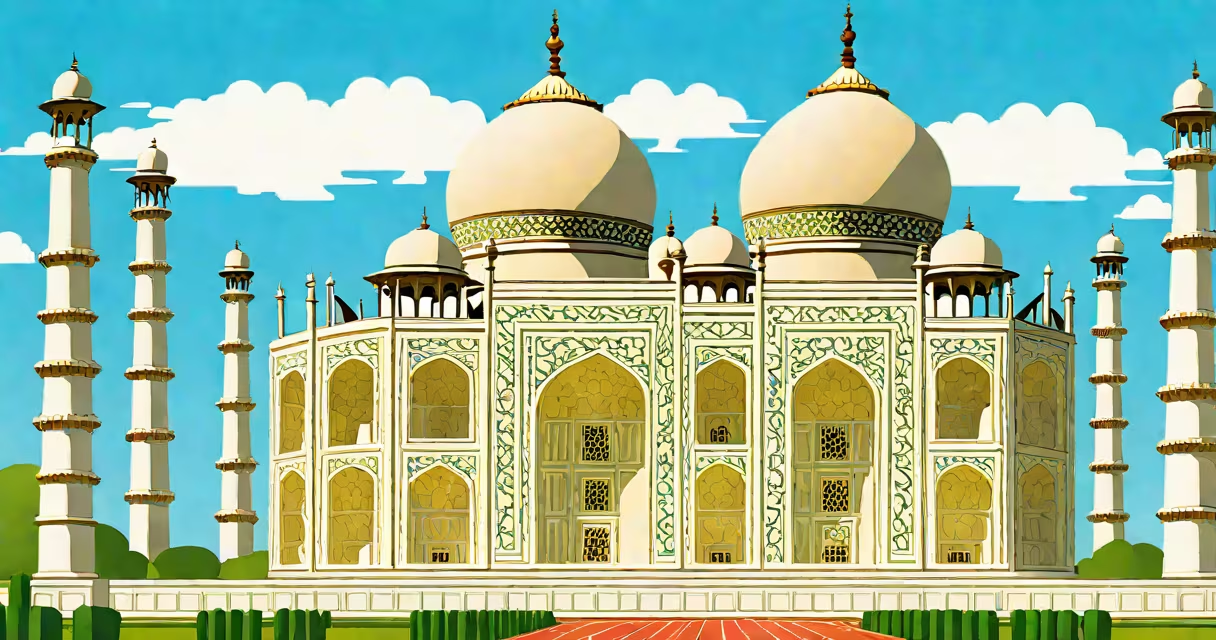
The taj mahal is a 17th-century white marble mausoleum in Agra, India, built by Mughal Emperor Shah Jahan as a tomb for his favorite wife, Mumtaz Mahal. It combines Persian, Islamic, and Indian architectural styles and is recognized as a UNESCO World Heritage Site.
Construction began in 1632 and took approximately 22 years to complete, involving over 20,000 artisans and laborers. The complex spans 17 hectares and includes gardens, gateways, and subsidiary buildings. The main structure is made of Makrana marble, quarried 400 kilometers away, and features complex pietra dura inlays using semi-precious stones.
Shah Jahan intended the taj mahal to symbolize eternal love. After his death, he was buried beside Mumtaz Mahal in the central chamber. The symmetry of the design reflects cosmic balance, with the reflection in the long pool mirroring the building perfectly during sunrise and sunset.
Construction relied on a centralized workforce managed by the imperial court. Skilled architects from Persia, Turkey, and India collaborated under Ustad Ahmad Lahori, who served as chief designer. The foundation was laid on a bed of wells and wooden piles to counteract groundwater swelling.
Materials were transported via river barges and animal caravans. The marble was cut into precise shapes using hand tools and templates. Workers used pulleys and levers to lift blocks weighing up to 20 tons. Each stone was fitted without mortar, relying on interlocking joints and gravity.
Artisans spent months creating floral patterns in lapis lazuli, jade, turquoise, and onyx. These inlays form calligraphy from the Quran and botanical motifs. The colors change subtly throughout the day due to the marble's sensitivity to light and weather.
Questions about the taj mahal fall into four categories: historical facts, architectural details, symbolic meanings, and lesser-known anecdotes. Each category reveals different layers of the monument's significance.
| Type | Example Question | Answer |
|---|---|---|
| Historical | Who commissioned the taj mahal? | Shah Jahan |
| Architectural | What material forms the main structure? | Makrana marble |
| Symbolic | Why is the complex perfectly symmetrical? | To reflect divine order and balance |
| Anecdotal | What happened to the architect's hands after completion? | According to legend, Shah Jahan had them cut off to prevent replication. |
Some questions test spatial awareness. For example: "Which side of the taj mahal contains the main entrance?" The answer is the south side, which faces the garden. This orientation aligns with Islamic tradition, where prayer direction (qibla) is west, but the entrance is positioned to allow visitors to enter from the east, symbolizing the path toward the afterlife.
Many assume the taj mahal was built solely by slaves. In reality, workers were paid artisans, many of whom were Muslim, Hindu, and Christian. Records from the Mughal court show wages were standardized and benefits included food and housing.
Another myth is that the entire structure is white. The marble changes color based on time of day and season. At dawn, it appears pinkish; at noon, pure white; at dusk, golden. Pollution in Agra has also caused discoloration since the 1980s, prompting conservation efforts.
A lesser-known fact: the minarets are slightly tilted outward. This design helps if they collapse during an earthquake, they fall away from the main tomb rather than onto it. The tilt is about 2.5 degrees, measured using ancient surveying tools.
Use this five-question quiz to test understanding of taj mahal trivia questions:
Answers:
I once visited the taj mahal at sunrise during a monsoon season. The air was thick with mist, and the marble glowed pale gold. As the sun rose, the reflection in the pool became sharp and still-exactly as described in Mughal court records. That moment confirmed how deeply intention shaped the space.
For more on cultural heritage and personal stories behind landmarks, explore common questions about me to understand how history connects to individual memory.