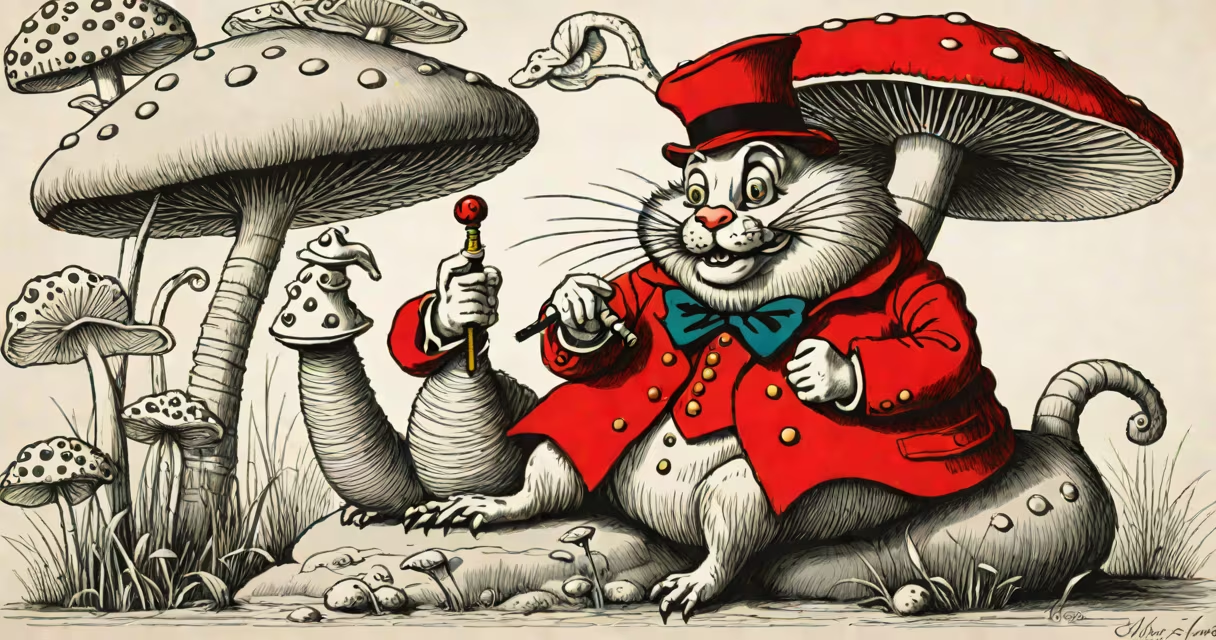
The 1951 Disney animated film's caterpillar is a hallucinogenic, pipe-smoking character who speaks in riddles and appears on a giant mushroom. He delivers the famous "Who are you?" line and influences Alice's size changes through his advice.
The caterpillar appears during Alice's descent into Wonderland's absurd logic. After she drinks from a bottle labeled "DRINK ME," her size shrinks dramatically. She encounters the caterpillar perched on a mushroom, who asks, "Who are you?" This moment marks a turning point in Alice's identity crisis. The character's dialogue is adapted from Lewis Carroll's original text in *Alice's Adventures in Wonderland*, but Disney altered the tone to include humor and surrealism.
He is voiced by actor Sterling Holloway, known for his distinctive Southern drawl. His appearance combines exaggerated features-large eyes, a long nose, and a prominent mouth-with a red coat and a blue hat. The design reflects early 20th-century caricature styles, particularly those seen in political cartoons of the time. His posture and movements mimic a slow, deliberate smoker, reinforcing his role as a philosophical observer.
The caterpillar's scene is structured around a series of questions and reversals. Alice approaches him, unsure of her identity. He responds with a riddle: "Who are you?" Alice replies, "I-I hardly know, sir, just at present-at least I know who I was when I got up this morning-but I think I must have been changed several times to-day." The caterpillar then instructs her to eat the mushroom to grow or shrink, depending on which side she bites.
This exchange introduces the central theme of identity fluidity. Alice's physical transformation mirrors her psychological confusion. The caterpillar doesn't offer solutions-he observes. His silence after Alice leaves suggests detachment rather than guidance. He is not a mentor but a test of perception.
Disney animators used a technique called "rotoscoping" to give the caterpillar lifelike movement. They filmed live actors performing gestures and then traced over the footage frame by frame. This method preserved subtle facial expressions and hand motions, making the caterpillar feel more human than cartoonish. The result is a character who feels both alien and familiar.
The caterpillar's red coat and blue hat are symbolic. Red often represents danger or passion; blue suggests calm or distance. Together, they create visual tension. His pipe is a nod to Victorian-era smoking culture, though he never actually smokes-it's a prop. The absence of smoke adds to the dreamlike quality of the scene.
His speech pattern mimics a 1950s American accent, blending Southern drawl with theatrical delivery. This contrasts with the British setting of Carroll's original story. The change aligns with Disney's effort to make the film accessible to a broad U.S. audience. The caterpillar's voice is not meant to sound authentic to 19th-century England-it's designed to be memorable and slightly absurd.
One non-obvious detail: the caterpillar's mushroom is shaped like a toilet seat. This detail was confirmed by Disney archives and appears in early concept art. The designers used bathroom imagery to emphasize the grotesque humor of Wonderland's logic. A mushroom that resembles a toilet seat subverts expectations and reinforces the idea that Wonderland is a place where normal rules don't apply.
Many viewers assume the caterpillar is a villain or a trickster. He is neither. He gives Alice clear instructions-"Eat a piece of the mushroom, and you'll grow taller or shorter"-but offers no emotional support. His lack of empathy is intentional. He exists to challenge Alice's sense of self, not to comfort her.
Another misconception is that the caterpillar is based on a real person. He is not. While Holloway's voice has a recognizable timbre, the character is a composite of literary, artistic, and cultural influences. He draws from Carroll's original description-"a large caterpillar sat on the top of a mushroom, and had its head in the clouds"-but adds Disney's stylized interpretation.
Some fans believe the caterpillar's dialogue is improvised. It is not. Every line was written by screenwriters Ted Sears, Winston Hibler, and Erdman Penner. The script was revised multiple times to balance whimsy and coherence. The final version includes the line: "You're not going to be able to talk to me unless you've grown bigger." This line sets up the next scene, where Alice grows too large to fit through a door.
| Version | Appearance | Voice Style | Role in Story |
|---|---|---|---|
| 1951 Disney | Red coat, blue hat, smoking pipe, oversized features | Southern drawl, slow pacing | Philosophical observer, identity tester |
| 1933 Paramount (silent) | Black-and-white silhouette, minimal detail | None (silent film) | Background figure, no dialogue |
| 2010 Tim Burton | Green, glowing eyes, elongated body, wears a crown | English accent, dramatic delivery | Political symbol, manipulator of power |
| 1972 BBC adaptation | Animated, child-like, sings songs | British child voice | Comic relief, sings "The Caterpillar Song" |
The 1951 version stands out for its restraint. Unlike Burton's version, which portrays the caterpillar as a tyrant in a green throne, Disney's version keeps him grounded in absurdity. He is not evil-he is indifferent. His stillness contrasts with Alice's frantic movement, emphasizing the disconnect between logic and emotion.
The caterpillar became a cultural icon. His image appeared on merchandise, including lunchboxes, posters, and clothing. In 1955, Disneyland opened with a caterpillar statue near the entrance to Fantasyland. The attraction was later replaced, but the image remained a symbol of the park's whimsical aesthetic.
Academic analysis confirms the caterpillar's significance. According to the University of California, Santa Barbara's Digital Humanities Lab, the character exemplifies "postmodern fragmentation" in children's media. His disjointed speech patterns and ambiguous morality reflect a worldview where meaning is unstable. This aligns with psychoanalytic theories of childhood development, where identity formation occurs through questioning rather than certainty.
I once watched the 1951 film with a group of college students studying literature. One student pointed out that the caterpillar's silence after Alice leaves is more telling than his words. "He doesn't care," she said. "He's not trying to help. He's just watching." That moment stayed with me-the idea that some characters exist not to guide, but to reveal.