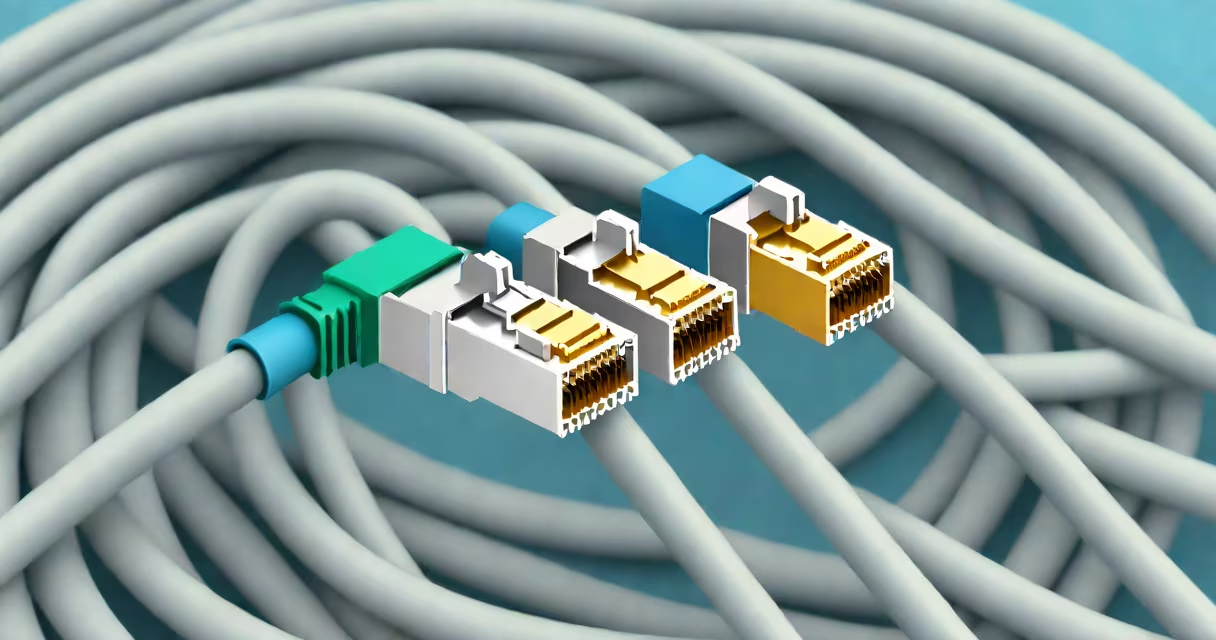
Shielded Cat 6 is a type of twisted-pair Ethernet cable designed for high-speed data transmission with reduced electromagnetic interference, using both foil and braided shielding around individual pairs and the entire cable bundle.
It supports data rates up to 10 Gbps over distances up to 55 meters, making it suitable for modern networks requiring consistent performance under electrical noise. Unlike unshielded Cat 6, shielded variants include physical barriers that block external signals from disrupting data flow.
The shielding layers-typically aluminum foil around each wire pair and a copper braid around the whole cable-work together to minimize crosstalk and external EMI. This makes shielded Cat 6 essential in environments with heavy machinery, industrial equipment, or dense wiring setups where signal integrity is critical.
Shielded Cat 6 uses four twisted pairs of copper wire, each pair individually wrapped in aluminum foil to reduce crosstalk between adjacent wires. The entire group is then enclosed in a braided copper shield, which acts as a Faraday cage against external radio frequency (RF) interference.
When data travels through the cable, the twisting of the pairs cancels out electromagnetic radiation generated by the current. The foil and braid shields further prevent external noise-such as from motors, fluorescent lights, or nearby power lines-from corrupting the signal.
For the shielding to work, the cable must be properly grounded at both ends. Without grounding, the shield becomes ineffective and can even act as an antenna, picking up more interference. This requirement distinguishes shielded Cat 6 from unshielded versions, which don't need grounding.
Shielded Cat 6 comes in two primary configurations: FTP (Foiled Twisted Pair) and STP (Shielded Twisted Pair).
| Type | Shielding Layers | Best For | Common Use Case |
|---|---|---|---|
| FTP | Foil around each pair; no braid | Low to moderate EMI environments | Office networks, home theaters |
| STP | Foil around each pair + braided copper shield around all pairs | High EMI areas, industrial settings | Factories, server rooms, medical imaging systems |
Some cables use S/FTP ( Foil + Individual Pair Foil) or S/STP ( Braid + Individual Pair Foil), offering layered protection. These are rated for higher bandwidth and longer runs.
According to the TIA-568 standard, Cat 6 cables must support frequencies up to 250 MHz. Shielded Cat 6 exceeds this, handling up to 500 MHz in controlled conditions, though actual performance depends on installation quality and grounding.
Shielded Cat 6 is deployed in environments where signal degradation cannot be tolerated. Data centers, financial trading floors, and broadcast studios rely on it to maintain stable 10 Gbps connections over long runs.
A hospital in Chicago replaced unshielded Cat 6 in its radiology department after MRI machines caused intermittent network failures. After switching to shielded Cat 6 with proper grounding, packet loss dropped from 12% to less than 0.1% during scans.
Industrial automation systems often run shielded Cat 6 alongside power lines. A manufacturing plant in Detroit reported a 90% reduction in communication errors after upgrading from Cat 5e to shielded Cat 6 in its PLC control network.
Home users rarely need shielded Cat 6 unless they live near high-voltage power lines or have extensive audio/video equipment. For most residential setups, unshielded Cat 6 suffices.
Many assume that "Cat 6" automatically means "shielded." That's incorrect. Cat 6 is a category rating based on performance, not shielding. Unshielded Cat 6 is common and sufficient for most office and home use.
Another misconception is that shielding eliminates all interference. It doesn't. Poor termination, damaged cables, or improper grounding still allow signal degradation. A poorly crimped RJ45 connector can introduce noise even in a fully shielded cable.
Some vendors label cables as "shielded Cat 6" without specifying the type. Always verify whether the shielding is foil-only (FTP), braid-only (STP), or combined (S/FTP). A cable labeled "shielded" with no details may lack the full protection needed for demanding applications.
I once tested a batch of cables advertised as "shielded Cat 6" at a trade show. Upon inspection, they had only foil wrapping around individual pairs, no braid. When run near a 60 Hz transformer, they failed compliance tests due to excessive crosstalk. The label was misleading.
A tech firm in Seattle upgraded its internal network from Cat 5e to shielded Cat 6. The building housed 120 employees, with 40 devices connected via PoE switches for VoIP phones and wireless access points.
Before the upgrade, users experienced lag during video calls and file transfers. Network diagnostics showed 3% packet loss during peak hours. The IT team traced the issue to EMI from nearby elevators and HVAC systems.
They replaced all horizontal cabling with STP Cat 6, ensured all patch panels were grounded, and used shielded RJ45 jacks. After rollout, packet loss dropped to 0.02%, and VoIP call quality improved. The change required no additional hardware-just better cabling.
Cost: $1.80 per meter for STP Cat 6 vs. $1.10 for unshielded Cat 6. Total upgrade cost: $3,600 for 2,000 meters. Payback came within six months due to fewer support tickets and faster workflows.
Shielded Cat 6 differs from Cat 3 and Cat 5e in performance and shielding. Cat 3 supports only 10 Mbps and lacks shielding. Cat 5e supports 1 Gbps but lacks the shielding needed for high-noise environments.
While Cat 5e can carry 10 Gbps over short runs, it fails under sustained load due to crosstalk. Shielded Cat 6 maintains stability because of its structured shielding and tighter twist rates.
Similarly, Cat 3 connectors are incompatible with Cat 6 ports. Using a Cat 3 connector on a Cat 6 cable results in poor contact and signal loss. Always match connector type to cable specification. See connector compatibility.
Shielded Cat 6 is not a universal solution. It requires correct installation, grounding, and compatible hardware. But when used correctly, it delivers reliable, high-speed connectivity in challenging environments.