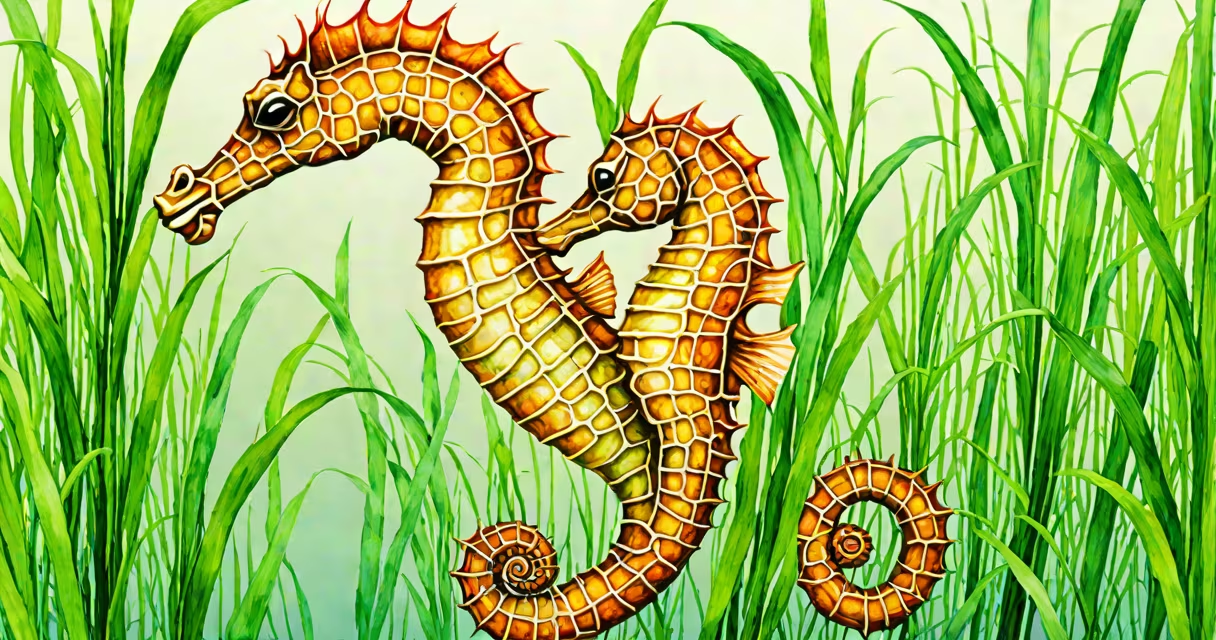
Sea horse images show small, equine-headed fish with prehensile tails, often photographed in their natural habitats or in controlled aquarium settings. These images show their distinctive body shapes, color variation, and behavior patterns.
Seahorses belong to the genus *Hippocampus* and are native to shallow tropical and temperate waters worldwide. Their bodies are encased in bony plates rather than scales, giving them a rigid, armored appearance. This structure makes them appear almost sculptural in high-resolution photographs. They move slowly using a dorsal fin that beats rapidly-up to 70 times per minute-while steering with their pectoral fins.
Photographers capture sea horse images using specialized underwater gear. Macro lenses allow close-ups that reveal fine details such as skin texture, eye movement, and gill flares. For example, a 2022 study by the National Oceanic and Atmospheric Administration (NOAA) documented seahorse populations in Florida's seagrass beds using remote-operated vehicles equipped with 4K cameras. These images showed individual markings used to track population health.
Images of seahorses fall into distinct categories based on purpose and context. The most common types include:
| Type | Purpose | Example Source |
|---|---|---|
| Scientific documentation | Population tracking, species identification | NOAA's Coral Reef Conservation Program |
| Conservation awareness | Raising public interest in protection efforts | Smithsonian Marine Station at Fort Pierce |
| Commercial photography | Stock imagery, educational materials | Getty Images, Shutterstock |
| Underwater art | Visual storytelling, artistic expression | Photographer David Doubilet's work |
Scientific images prioritize accuracy. A photo taken during a survey off the coast of Baja California in 2021 included scale markers and GPS coordinates. Researchers used this to measure changes in seahorse size over time. In contrast, commercial images often emphasize aesthetics-colorful backgrounds, dramatic lighting, and posed subjects.
One non-obvious fact: seahorses do not have teeth. Instead, they suck in prey through a long snout. High-speed video footage captured in 2019 revealed that they strike within 5 milliseconds-a speed faster than human reaction time. This rapid motion is rarely visible in still images, making changing video essential for understanding their feeding mechanics.
Marine biologists rely on sea horse images to monitor species distribution and habitat degradation. The International Union for Conservation of Nature (IUCN) lists several seahorse species as vulnerable due to habitat loss and overfishing. Images from reef surveys help assess recovery rates after conservation interventions.
For example, in 2020, researchers in Indonesia used drone-mounted cameras to map seagrass meadows in Sulawesi. They identified 146 individual seahorses across 12 sites. The images were cross-referenced with genetic samples to confirm species identity. Without visual records, distinguishing between similar-looking species like *Hippocampus kuda* and *Hippocampus erectus* would be nearly impossible.
Public outreach campaigns use sea horse images to promote marine protection. The "Save Our Seahorses" initiative by the World Wildlife Fund features striking photos of seahorses entangled in fishing nets. These images led to policy changes in the Philippines, where gillnet bans were expanded in coastal zones with high seahorse density.
Many people mistake seahorses for mythical creatures due to their horse-like heads and upright posture. However, they are fully aquatic fish. Unlike most fish, they swim vertically and lack a caudal fin. Their tail is adapted for grasping, not propulsion.
A frequent error is assuming all sea horses look alike. In reality, species vary widely in size, color, and pattern. The dwarf seahorse (*Hippocampus zosterae*) measures just 2.5 cm, while the big-belly seahorse (*Hippocampus abdominalis*) reaches 35 cm. Coloration ranges from pale beige to vivid red, often matching the seagrass or coral they inhabit.
Another misconception: seahorses are solitary. While adults avoid each other during feeding, pairs form long-term bonds. During courtship, they perform synchronized dances lasting up to 12 hours. Photographers have documented these rituals in the wild, capturing the subtle movements that signal mating readiness.
In 2023, a team from the University of Miami deployed a network of underwater cameras along the Florida Keys coastline. Over six months, they collected 1,247 images of seahorses. Each image was tagged with location, date, and estimated size.
Using machine learning software trained on 15,000 labeled seahorse images from the Smithsonian Institution's database, researchers identified 237 individuals. They tracked one female, nicknamed "Daisy," across five sites. Her color shifted from golden brown to dark orange over time-likely due to seasonal changes in algae cover.
When Daisy was last seen, she had a missing tail tip. This injury matched a known predator attack pattern from a local octopus population. The image sequence helped scientists estimate survival rates and inform local marine protected area boundaries.