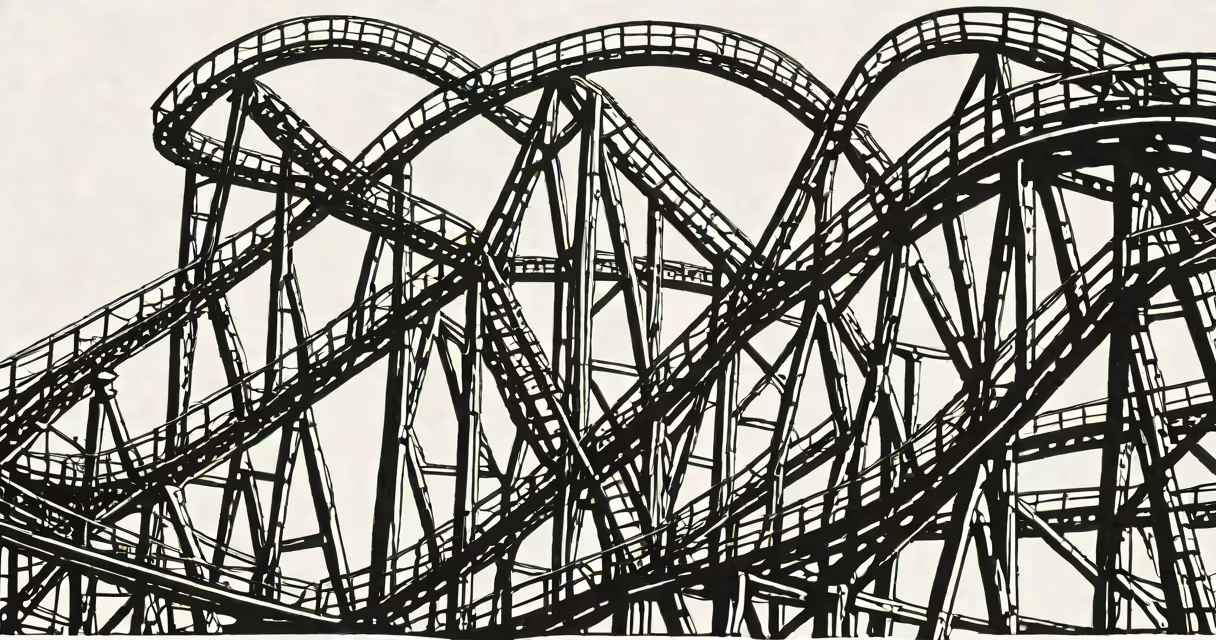
A roller coaster drawing is a visual representation of a roller coaster's track, cars, and structural elements using lines, shapes, and perspective. It serves as a blueprint for engineers, a concept tool for designers, or a creative expression in art and animation.
These drawings range from rough sketches to detailed technical illustrations. They show elevation, curvature, support structures, and car positioning. A single drawing may convey speed, tension, and spatial relationships without color or animation.
Artists use pencil, pen, or digital tools to draft roller coasters. The most effective ones communicate both form and motion. For example, a side view of a loop shows the vertical drop and centrifugal force implied by the curve's tightness.
Each roller coaster drawing relies on consistent scale, vanishing points, and proportional accuracy. Artists begin with a grid or axis system to align track segments. They then map out major features: climbs, drops, inversions, and turns.
Line weight varies to suggest depth. Thicker lines outline the track; thinner lines indicate supports or rails. Shadows are rarely used because the focus is on structure, not lighting. Instead, negative space defines volume.
For animated sequences, multiple drawings are created in sequence to simulate movement. These are called keyframes. A 10-second loop of a roller coaster climbing a hill might use 12 keyframes spaced at 0.83-second intervals to create fluid motion.
Roller coaster drawings fall into three categories based on purpose:
| Type | Purpose | Tools | Example |
|---|---|---|---|
| Concept sketch | Initial idea exploration | Pencil, marker | Quick layout of a spiral drop |
| Technical plan | Construction and safety approval | Vector software, CAD | Exact measurements for steel beams |
| Storyboard frame | Animation or ride simulation | Digital tablet, animation software | Car entering a tunnel at night |
Historically, hand-drawn plans were standard. Today, 90% of new roller coaster designs start in digital formats like AutoCAD or Blender. But many theme parks still require physical sketches for early approval stages.
One non-obvious fact: a roller coaster drawing must account for gravitational forces. Engineers use the drawing to calculate G-forces at each turn. A 90-degree banked turn at 60 mph generates approximately 2.5 Gs. This value is verified mathematically, not visually.
Roller coaster drawings appear in architectural renderings, promotional materials, and video games. Theme parks use them in marketing to show riders what they'll experience. A well-composed drawing can build anticipation.
They're often confused with ride simulations or 3D models. A drawing is static and flat. A simulation includes physics, sound, and camera angles. A 3D model adds texture and lighting. All three serve different purposes.
For example, the roller coaster Outlaw Run at Silver Dollar City was first drawn by designer Alan Schilke in 2011. His initial sketches showed a wooden coaster with a 162-foot drop and a double barrel roll. These drawings were later converted into engineering plans and then into a working ride.
Another common mistake is assuming that a drawing with loops and sharp turns is inherently thrilling. Thrill depends on speed, duration, and rider position. A slow-moving loop with low airtime feels less intense than a high-speed inversion with sudden deceleration.
Suppose you want to draw a roller coaster with a 120-foot climb, a 90-degree helix, and a zero-G roll. Start with a grid at 1 inch = 10 feet. Draw the base line at a 45-degree angle for the climb.
At the peak, add a 360-degree helix. Use circular arcs to maintain consistent radius. The helix should have a 15-foot diameter. Then, place the zero-G roll at the bottom of the descent. This requires a 180-degree flip in the track plane.
Label each segment: "Climb," "Helix," "Zero-G Roll." Use dashed lines for hidden track sections. Finalize with a title: "Skyfall - Vertical Loop Design." This version can be submitted to a park's design team or used in a pitch deck.
I once spent a weekend refining a roller coaster drawing for a school project. I used graph paper and a ruler to ensure symmetry. The final piece was accepted into a local art show focused on mechanical design. It wasn't just a drawing-it became a conversation starter about motion and risk.
When creating a roller coaster drawing, avoid copying existing rides. Originality matters. Even small changes-like shifting the helix to the left or adding a mid-air flip-can make a design unique.