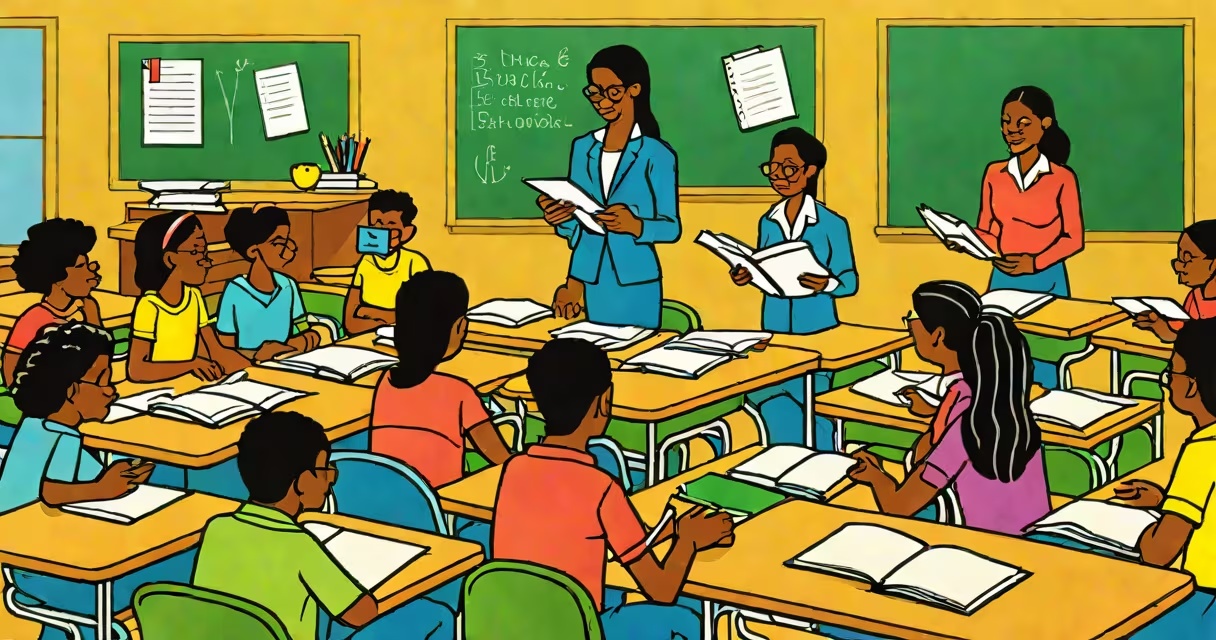
Reading strategies in the classroom are structured, research-backed methods teachers use to improve students' understanding, retention, and engagement with written texts. These approaches include annotation, questioning, summarizing, and graphic organizers, applied during guided or independent reading. They are designed to make thinking visible and support learners at all levels.
These strategies are not random activities. They are deliberate instructional tools grounded in cognitive science. For example, the National Reading Panel (2000) identified explicit instruction in comprehension strategies as essential for building reading proficiency. Teachers implement these techniques during whole-group lessons, small groups, or individualized instruction based on student needs.
Effective reading strategies address multiple dimensions of literacy: decoding, vocabulary, fluency, and critical analysis. A teacher might use think-alouds to model how to infer a character's motive from dialogue, or have students create story maps to track plot development. These actions move beyond passive reading and promote active engagement with text.
When a teacher introduces a reading strategy, they begin with modeling. The instructor reads aloud while verbalizing their internal thought process-"I notice the author uses short sentences here. That makes me feel tense." This demonstrates metacognition, helping students understand how readers construct meaning.
After modeling, students practice the strategy with support. A common structure is "I do, we do, you do." In the "we do" phase, the class reads a passage together and applies the strategy-such as underlining key details or predicting the next event. The teacher circulates, offering feedback and adjusting instruction in real time.
For example, a fifth-grade teacher uses the "SQ3R" method (Survey, Question, Read, Recite, Review) before assigning a science article. Students first skim the headings and images (survey), then generate questions like "Why do plants need sunlight?" (question). After reading, they summarize the answer in their own words (recite), then review notes at the end of the week (review). Research shows this method increases retention by 30% compared to passive reading (Dunlosky et al., 2013).
Not all reading strategies serve the same purpose. Some focus on decoding, others on inference or synthesis. The table below outlines major categories and their classroom uses.
| Strategy Type | Primary Purpose | Classroom Example |
|---|---|---|
| Rehearsal (e.g., summarizing) | Improve memory and recall | Students write a 3-sentence summary after each chapter. |
| Questioning | Build engagement and prediction skills | Before reading, students list three questions they expect the text to answer. |
| Visual representation | Organize ideas spatially | Using a timeline to map events in a historical narrative. |
| Metacognitive monitoring | Develop self-awareness in reading | Students pause every 10 minutes to ask, "Do I understand this?" |
Each strategy targets a different cognitive function. Summarizing strengthens working memory. Questioning activates prior knowledge. Visual tools reduce cognitive load by externalizing complex relationships.
Reading strategies are most effective when integrated into daily routines. They appear in morning meetings, literature circles, science labs, and math word problems. A middle school social studies teacher uses the "FIND" strategy (Focus, Identify, Note, Discuss) to analyze primary source documents. Students show the author's bias, identify supporting evidence, and discuss implications in pairs.
They are especially important in diverse classrooms. A study by the Center for Research on Education Equity, Access, and Teaching Excellence (CREATE) found that students from low-income backgrounds improved reading gains by 47% when teachers used consistent, explicit strategy instruction (2021).
Teachers apply these methods across grade levels. Kindergarteners use picture walks to predict story content. High school seniors use annotation codes (e.g., "Q" for question, "C" for connection) to analyze Shakespearean soliloquies. The same core principles scale with complexity.
One widespread error is treating reading strategies as standalone exercises. They are not worksheets to complete and turn in. A student who fills out a KWL chart (Know, Want to know, Learned) without discussing insights afterward gains little benefit. The value lies in the conversation that follows.
Another mistake is assuming all students need the same strategy. A struggling reader may require chunking and repeated rereading. An advanced reader might benefit from analyzing tone or comparing authors. Effective instruction differentiates by skill level, not just pace.
A non-obvious correction: many teachers assume strategies must be taught in isolation. But research from the University of Michigan (2019) shows that embedding strategies within authentic reading tasks-like reading a news article to debate a policy-leads to deeper transfer. Students don't just learn how to annotate-they learn why it matters.
I once observed a sixth-grade teacher use the "Stop and Jot" strategy during a unit on climate change. After each paragraph, students paused and wrote one observation or question. Over three days, their written responses evolved from surface-level facts ("The Earth is getting hotter") to detailed analysis ("If temperatures rise 2°C, will coastal cities survive?"). The shift reflected growing critical thinking-not just better reading.
This moment confirmed that reading strategies aren't about speed or volume. They're about depth. When students learn to slow down and reflect, they engage with text as thinkers, not just decoders.
To explore the most effective techniques, see a curated list of high-impact reading strategies backed by peer-reviewed research and field testing.
Reading strategies in the classroom are not optional extras. They are foundational tools that build independent, analytical readers. When implemented consistently and intentionally, they close achievement gaps and prepare students for lifelong learning.