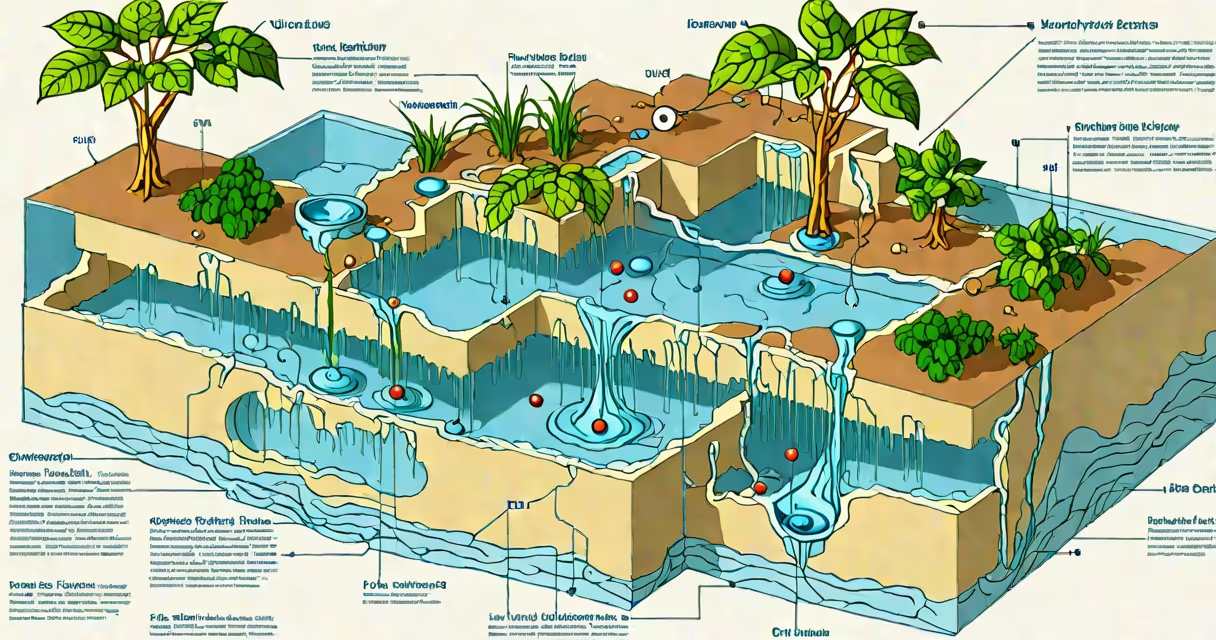
Osmosis meaning in biology refers to the passive movement of water molecules across a selectively permeable membrane from an area of low solute concentration to an area of high solute concentration, driven by the concentration gradient. This process maintains cellular hydration and internal balance without requiring energy input.
Osmosis occurs because water molecules move randomly, and their net flow favors regions with higher solute concentrations. The membrane allows water to pass but blocks most dissolved substances. This selective permeability helps cells regulate internal conditions. For example, red blood cells shrink in hypertonic solutions and swell in hypotonic ones due to osmotic pressure changes.
According to the National Center for Biotechnology Information (NCBI), osmosis is fundamental to kidney function, where water reabsorption in nephrons depends on osmotic gradients established by ion transport. Similarly, the University of California Museum of Paleontology confirms that osmosis enables root hair cells in plants to absorb water from soil, supporting nutrient uptake and turgor pressure.
Water moves through phospholipid bilayers and specialized protein channels called aquaporins. These proteins increase membrane permeability to water, allowing rapid osmotic flow. Aquaporins are especially abundant in kidney tubules and plant roots, where efficient water transport is critical.
The direction of water movement depends on solute concentration differences. A solution with fewer solutes is hypotonic; more solutes make it hypertonic. Equal solute levels define isotonic conditions. When a cell is placed in a hypotonic environment, water enters, increasing internal pressure. In a hypertonic setting, water exits, causing shrinkage or plasmolysis in plant cells.
A real-world example: placing a limp celery stalk in water restores crispness. The stalk's cells are hypertonic compared to pure water. Water enters via osmosis, refilling vacuoles and restoring turgor. This demonstrates osmosis in action outside lab settings.
Osmosis occurs under specific conditions. It requires a semipermeable membrane, a concentration gradient, and solvent mobility. Without any of these, osmosis cannot proceed. The rate depends on temperature, surface area, and the steepness of the concentration gradient.
| Condition | Effect on Osmosis | Example |
|---|---|---|
| Hypotonic solution | Water enters cell | Red blood cells burst in distilled water |
| Isotonic solution | No net water movement | Human cells maintain shape in saline solution |
| Hypertonic solution | Water leaves cell | Plant cells lose turgor; wilting occurs |
One common misconception is that osmosis involves solute movement. It does not. Only water moves. Solutes remain behind unless actively transported. This distinction separates osmosis from diffusion, which can involve any molecule, not just water.
Osmosis is often mistaken for diffusion. While both are passive processes, diffusion moves solutes across membranes, whereas osmosis specifically moves water. Diffusion can occur in gases or liquids without membranes; osmosis requires a selectively permeable barrier.
Another error is assuming osmosis stops at equilibrium. It doesn't. Molecules continue moving, but net flow ceases. Changing equilibrium exists-water still crosses both ways, but equal amounts move in each direction.
I once observed this during a classroom experiment using dialysis tubing filled with sugar solution. When submerged in water, the tube swelled visibly within minutes. The volume increase proved water influx. After several hours, swelling slowed-not because osmosis stopped, but because the system approached equilibrium. This hands-on test clarified that osmosis is continuous, not binary.
Osmosis regulates cell volume, supports nutrient delivery, and powers plant growth. In humans, it drives fluid reabsorption in the kidneys. Each nephron filters about 180 liters of plasma daily; osmosis recovers ~99% of water, preventing dehydration.
In plants, osmosis drives water ascent from roots to leaves. Root cells take up water via osmosis, creating positive pressure that pushes fluid upward through xylem. This mechanism, combined with transpiration pull, lifts water over 100 meters in tall trees.
Understanding osmosis helps explain medical conditions like edema, where excess fluid accumulates in tissues due to disrupted osmotic balance. It also informs agricultural practices-fertilizer overuse can create hypertonic soil, leading to plant dehydration.