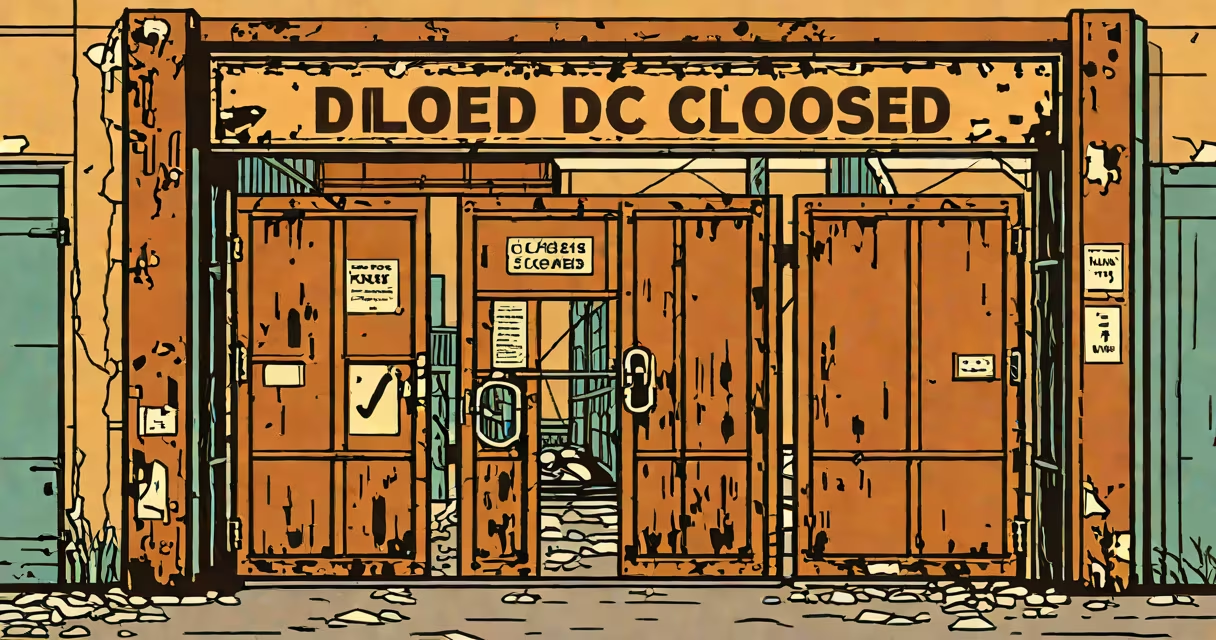
Defunct means no longer operational or functional, especially after a formal organization or system has ceased to exist. It describes something that was once active but now serves no purpose.
The term applies to institutions, companies, systems, or processes that have formally shut down or lost their original function. For example, a bank branch that closed permanently and removed all signage is defunct. The word does not imply failure due to poor performance-it simply marks the end of operation.
Defunct is often used in formal or descriptive contexts, such as legal documents, historical accounts, or news reports. It signals finality: the entity no longer exists in practice, even if records remain.
When something is defunct, it has stopped performing its intended role. This doesn't require a dramatic event-just the absence of continued activity. A defunct software program may still be stored on a server, but if no one uses it and no updates occur, it's defunct.
Unlike temporary closures, defunct status implies permanence. A restaurant closed for renovations is not defunct. But if the building is demolished and the business never reopened, it becomes defunct. The change is irreversible.
Language usage shows this: "The city's old transit authority is defunct," not "The transit authority is temporarily suspended." The latter suggests a pause; the former confirms termination.
Defunct appears most frequently in these categories:
| Type | Examples | Why It's Defunct |
|---|---|---|
| Businesses | Blockbuster Video stores | Shift to streaming eliminated demand |
| Organizations | U.S. Office of War Information (1945) | Dissolved after WWII ended |
| Technologies | CD-ROM drives in modern laptops | Obsolete due to cloud storage and downloads |
| Processes | Manual payroll processing in large corporations | Replaced by automated HR systems |
These cases show that defunct isn't limited to failure. Blockbuster didn't fail because of bad management-it failed because consumer behavior changed. Its model became defunct, not because it was weak, but because it no longer met demand.
Even successful entities can become defunct. The U.S. Postal Service remains operational, but its traditional letter delivery service is defunct in many rural areas due to email adoption. The function persists, but the relevance has vanished.
People often confuse "defunct" with "inactive" or "outdated." These are not synonyms. Inactive means not currently in use but possibly available for restart. Outdated refers to being replaced by newer versions. Defunct means the system or entity no longer exists in any practical sense.
A company may be inactive during holidays but not defunct. Similarly, a 1990s-era fax machine is outdated-but still functional. Only when the machine is destroyed or the service is permanently canceled does it become defunct.
Another mistake is assuming defunct implies blame. A defunct policy doesn't mean it was poorly designed. The U.S. draft registration system was defunct after 1973, not because it failed, but because Congress abolished it. Intent matters less than outcome.
As noted by Merriam-Webster, "defunct" derives from Latin *defunctus*, meaning "dead." It carries a weight of finality. The Oxford English Dictionary confirms that the term is reserved for entities that have ceased to operate, not merely paused.
In 2006, the U.S. General Services Administration announced the closure of the Old Post Office Pavilion in downtown Washington, D.C., a landmark built in 1899. After decades of use, the building was repurposed into a luxury hotel and retail space.
Despite the physical structure remaining, the postal function within it ended. The post office moved to a new facility. By 2010, the USPS had no further operations in the building. The address was reassigned. The original purpose was gone.
At that point, the old post office was defunct-not because it was abandoned, but because its core function had ceased. The building still stands, but the institution inside it no longer exists. This is a clear case of functional extinction.
I visited a shuttered textile mill in Lowell, Massachusetts, in 2018. The machinery was frozen in place, dust-covered, and labeled with "DO NOT OPERATE." Workers had left years earlier. The company filed for bankruptcy in 2009.
Inside, signs read "Formerly operated by New England Textile Co." The plant wasn't just closed-it was defunct. No one returned. No plans to reopen. The machines were not maintained. The site was not even fenced off.
That visit confirmed how defunct differs from dormant. Dormant implies potential revival. Defunct means no revival is expected. The mill's legacy lives in archives, but its operation ended permanently.
Some entities are mislabeled as defunct when they're merely transformed. The BBC's Radio 1 Dance format was rebranded in 2023, but the station continues. It's not defunct-it's evolved.
Similarly, a school district may close a single elementary school due to low enrollment. That school is not defunct-it's repurposed. The district still operates. The closure is administrative, not existential.
Also, digital services aren't automatically defunct when access drops. If a website goes offline temporarily due to maintenance, it's not defunct. Only when the domain expires and the content is deleted does it qualify.
Use "defunct" only when an organization, system, or process has permanently ceased to function. Avoid it for temporary disruptions, outdated tools, or rebranded services. Accuracy matters in communication.
For example, saying "The library's computer lab is defunct" is incorrect if it's just undergoing repairs. But if the lab was dismantled and the computers sold, then yes-defunct is accurate.
Understanding this distinction improves clarity in writing and reporting. Whether describing a failed startup or a historical institution, "defunct" signals finality, not just decline.