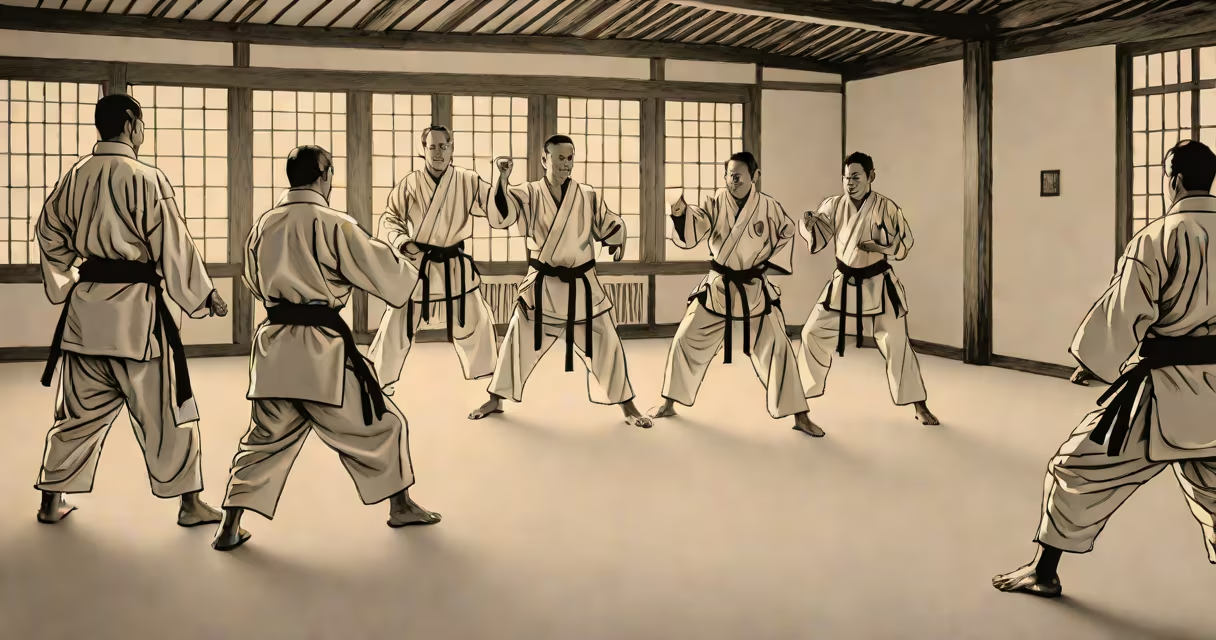
An oriental martial academy is a training institution focused on traditional Asian combat systems such as karate, taekwondo, kung fu, judo, and aikido. These academies emphasize physical conditioning, technical precision, and ethical discipline rooted in centuries-old philosophies.
Unlike commercial fitness gyms or modern combat sports programs, oriental martial academies prioritize lineage, form, and ritual. Students learn movements not just for effectiveness, but as expressions of cultural values-respect, patience, and self-control. Training often begins with basic stances, breathing exercises, and repetitive kata (pre-arranged sequences), building muscle memory and focus over time.
These institutions typically operate under a master-apprentice model. A senior instructor, often holding a high rank (such as black belt or dan level), oversees progression. Students advance through formal grading systems, earning colored belts that signify increasing mastery. The process is deliberate-some academies require years of consistent practice before awarding the first-degree black belt.
Classes follow a predictable structure. Warm-ups begin with stretching and controlled breathing to prepare the body and mind. This is followed by repetition of forms-choreographed sequences of strikes, blocks, and footwork designed to simulate real combat scenarios without sparring.
For example, in a typical 90-minute session at a Shaolin-inspired oriental martial academy, students perform 15 minutes of qigong (energy cultivation), 20 minutes of form drills (e.g., the "Five Animals" sequence), 30 minutes of partner drills using controlled strikes, and 25 minutes of free-form movement under supervision. No contact is permitted during form practice, preserving safety and intent.
Progression is measured not just by physical skill but by behavioral standards. Instructors assess posture, eye contact, verbal respect, and consistency. A student who performs a kick flawlessly but interrupts the class with loud talking may be asked to repeat the form until composure is restored.
Oriental martial academies are built around five foundational elements:
Some academies integrate meditation and mindfulness practices. Research from the National Center for Complementary and Integrative Health (NCCIH) confirms that regular martial arts training improves balance, coordination, and stress resilience in adults and children alike.
Many confuse oriental martial academies with modern mixed martial arts (MMA) gyms or fitness boot camps. MMA focuses on competition, strategy, and real-time adaptation in live combat. Oriental martial academies prioritize internal development, long-term refinement, and adherence to tradition.
A key difference lies in the purpose of training. While MMA prepares fighters for regulated bouts, oriental martial academies aim to cultivate character. As Dr. David J. K. Lee, a scholar of East Asian philosophy at Stanford University, notes: "The goal is not to win fights, but to avoid them through awareness and restraint."
Another misconception is that all oriental martial academies teach the same system. In reality, each school specializes in one or more regional traditions. For instance:
| Martial Art | Origin Region | Key Focus | Training Style |
|---|---|---|---|
| Karate | Okina, Ryukyu Islands (modern-day Okinawa) | Linear strikes, useful stances | Emphasis on kihon (basics), kata, and kumite |
| Taekwondo | Korea | High, fast kicks; changing movement | Patterned forms, breaking, sparring |
| Shaolin Kung Fu | China (Henan Province) | Fluid motion, animal mimicry, internal energy | Qigong, weapon forms, meditation |
| Judo | Japan | Throws, groundwork, use | Randori (free practice), kata, randori |
Each system demands different physical and mental adaptations. A student trained in Japanese jujitsu will struggle with the explosive vertical jumps required in Korean taekwondo unless they adapt their training focus.
In 2022, a 14-year-old student at the Beijing-based Oriental Martial Academy of the Five Dragons began training in Wu-style tai chi. Over 18 months, he practiced 30 minutes daily, attending two weekly classes. His progress was documented through video analysis and instructor feedback.
By month 12, his balance improved enough to stand on one leg for 45 seconds without swaying. By month 18, he could execute the full 108-move form with minimal hesitation. More, teachers noted a marked reduction in reactive anger during peer conflicts-consistent with research linking tai chi practice to lower cortisol levels in adolescents.
This outcome reflects a core principle: oriental martial academy training is not just about defense. It's about cultivating presence. As one instructor said, "When you move slowly, you see. When you see, you act wisely."
I once observed a class at the Kyoto-based Shōrin-ryū academy where a 10-year-old boy performed a complex sequence of hand and foot movements with perfect timing. He didn't win a tournament. But when the instructor bowed to him, the entire room did too-not for victory, but for commitment.
Oriental martial academies remain active in Asia, North America, Europe, and Australia. They serve diverse populations: children seeking confidence, adults managing chronic pain, and older adults improving mobility. According to the World Health Organization (WHO), regular participation in structured physical activity like martial arts reduces the risk of cardiovascular disease by 30% over ten years.
They're also used in conflict resolution programs. The U.S. Department of State has funded several pilot projects pairing oriental martial academies with youth outreach initiatives in urban centers. One program in Los Angeles reported a 40% drop in disciplinary incidents among participating students over two academic years.
Despite their benefits, many schools face challenges. Accreditation varies widely. Some claim authenticity without formal lineage. Others lack proper insurance or medical oversight. Parents should verify credentials through national associations such as the United States Martial Arts Association (USMAA) or the International Taekwon-Do Federation (ITF).
If you're considering enrolling, look for schools that offer transparent syllabi, public class observations, and clear promotion criteria. Avoid those promising rapid advancement or claiming "secret techniques." Authentic oriental martial academies do not sell mastery-they invite sustained effort.