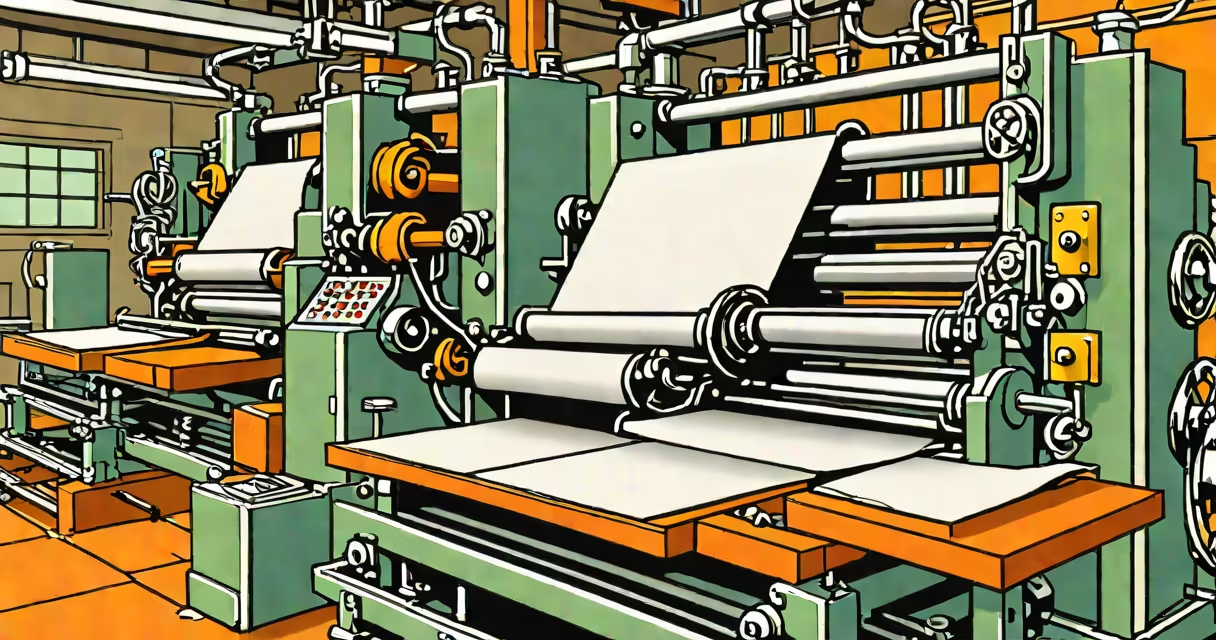
On press book printing is a method of producing books using large-format commercial printing presses, typically offset or digital presses, where pages are printed directly onto paper stock and then bound into finished books in a single continuous workflow. This process enables high-volume production with consistent quality, faster turnaround, and lower per-unit costs compared to manual or small-batch methods.
The core principle of on press book printing lies in integrating the printing and binding stages within the same machine setup. Unlike traditional methods that require separate steps-printing, folding, stitching, and binding-on press systems automate these phases. For example, a high-speed web offset press can print thousands of pages per hour, automatically fold them, stitch the signatures together, and bind them into a hardcover or softcover format. This integration reduces labor, minimizes handling errors, and ensures alignment accuracy across all pages.
Major publishers and academic printers rely on on press book printing for titles with demand exceeding 1,000 copies. A standard run of 5,000 copies of a 300-page textbook can be completed in under 48 hours using a Heidelberg Speedmaster XL 105 press, which prints at speeds up to 15,000 impressions per hour. The process supports both color and black-and-white output, with options for matte or glossy coatings, spot varnishes, and foil stamping.
On press book printing begins with digital file preparation. Publishers submit PDFs with bleed, trim marks, and CMYK color profiles. These files are sent to a prepress department where they undergo imposition-the arrangement of pages on a press sheet to maximize efficiency and minimize waste. A 300-page book may be imposed as 16-page signatures, meaning each press sheet contains four folded signatures.
The press then feeds the paper through rollers coated with ink. In offset printing, ink is transferred from a metal plate to a rubber blanket, then to the paper surface. This indirect transfer ensures sharp detail and consistent tone. After printing, the sheets move to a folding unit where they are creased and folded into signatures. These are then delivered to a binding station where they are stitched with thread or glued with adhesive.
For digital on press systems, such as those from HP Indigo or Xerox iGen, the process uses toner-based or liquid inkjet technology. These systems allow variable data printing-customizing each book with unique text, images, or barcodes-without stopping the press. A university distributing personalized course packets with student names and IDs can produce 2,000 customized books in under six hours using a Xerox iGen 5.
On press book printing falls into two primary categories: offset and digital. Offset printing remains dominant for high-volume runs due to its superior color fidelity and lower cost per unit beyond 1,000 copies. Digital on press is ideal for shorter runs, rapid turnaround, and personalization.
| Type | Best For | Run Size | Cost Per Unit (Est.) | Turnaround Time |
|---|---|---|---|---|
| Offset | Hardcover textbooks, trade paperbacks, catalogs | 1,000+ | $0.85-$1.50 | 3-7 days |
| Digital | Customized books, limited editions, proofing | 50-1,000 | $2.00-$4.50 | 1-3 days |
For example, a nonprofit organization needed 1,200 copies of a 120-page report with full-color photos and maps. Using a Heidelberg M500 offset press, the printer produced the entire run in 14 hours. The final books had consistent color, no smudging, and durable Smyth sewn bindings. The cost came to $1.10 per unit, including shipping.
When used correctly, on press book printing avoids common pitfalls like misalignment, ink bleed, or inconsistent binding pressure. A known issue is "creep"-where inner pages appear slightly longer than outer ones due to the thickness of the spine. Prepress software accounts for this by adjusting page placement during imposition, ensuring text remains centered on each spread.
On press book printing is often confused with print-on-demand (POD), but the two differ. POD systems print individual books only when ordered, usually via cloud-based services like Amazon KDP or IngramSpark. These use desktop or small industrial printers and are optimized for low volume and minimal inventory. On press printing, by contrast, produces large batches upfront and requires storage space and capital investment.
A common mistake is assuming on press printing is only for mass-market books. In reality, many independent authors and small presses use it for limited-run art books, poetry collections, and photography monographs. A fine art publisher in Portland produced 800 copies of a 100-page photo essay using a digital on press system. They selected archival cotton paper, 10-point thick cover stock, and a linen-wrapped spine. The result was a tactile, gallery-ready product priced at $45 per copy.
Another misconception is that on press printing lacks customization. Modern systems support variable data, allowing different covers, chapter titles, or even embedded QR codes per copy. A university press distributed 3,000 copies of a history textbook with unique QR codes linking to supplemental lectures. Each book was printed with a different code, enabling tracking of student engagement.
In 2022, a major educational publisher needed to release a new edition of a college-level biology textbook. The book was 550 pages, full-color, with 200 diagrams and 300 references. Demand forecasted 8,000 units across five U.S. states.
The publisher chose offset on press printing. Files were prepared with Adobe InDesign, exported as PDF/X-1a, and sent to a certified printer in Ohio. The prepress team imposed the layout into 16-page signatures, accounting for creep and edge margins. The job ran on a Heidelberg XL 105 press with a 100% coverage of Pantone 2945 C for the cover and CMYK for interiors.
After printing, the sheets moved to a Goss M-2000 folder and a Stahl binding machine. The books were Smyth sewn, with a 1.5-inch spine width. Final inspection confirmed no misalignments, ink smears, or stitching defects. All 8,000 books shipped within seven days. The average cost per book was $2.80, including binding and shipping.