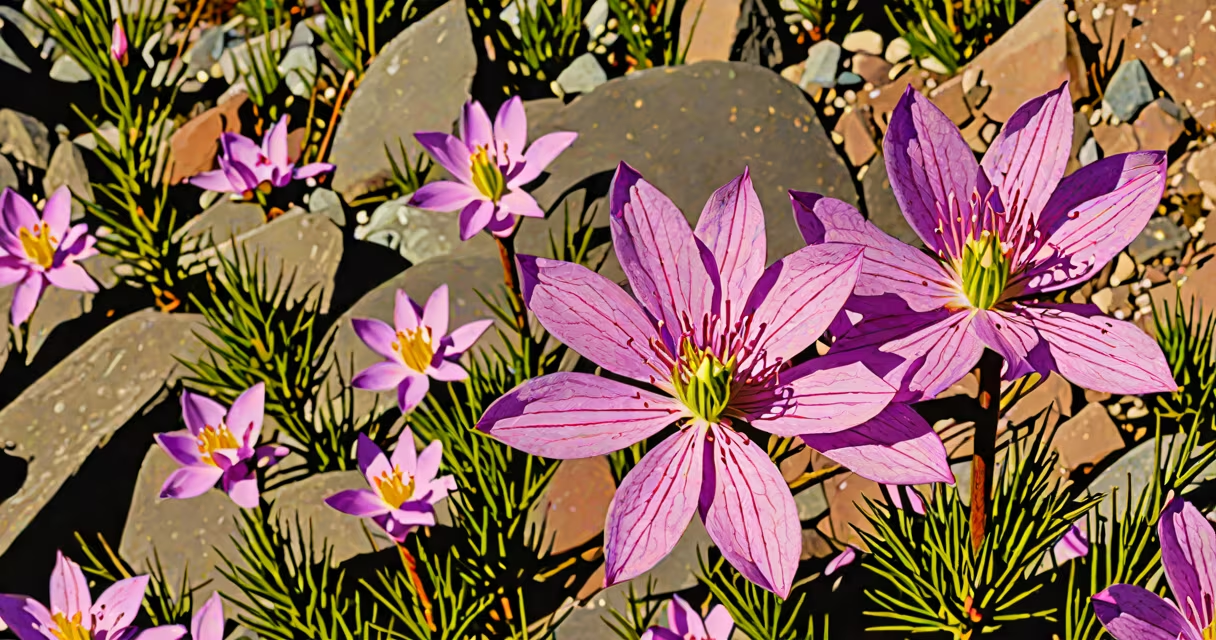
The montana state flower is the bitterroot (Lewisia rediviva), a hardy perennial with pink-and-white blooms that grows in dry, rocky mountain soils. It was officially designated in 1895 and appears on Montana's state flag and seal.
Bitterroot thrives in alpine and subalpine zones across western North America, especially in the Rocky Mountains. Its fleshy roots store water, allowing survival in arid conditions. The plant typically flowers from late spring to early summer, with blooms lasting only a few days. It is not found in lowland forests or wet meadows.
Native American tribes, including the Salish and Blackfeet, used bitterroot roots as food. They roasted or boiled the roots, which have a slightly sweet, nutty flavor. Early settlers collected the plant for medicinal purposes, though it is not toxic and safe to consume in small amounts.
Montana's legislature selected the bitterroot as the official state flower during its first session in 1895. The choice reflected regional pride and ecological identity. The flower was already widely recognized in local literature and artwork, appearing in journals from the 1880s.
At the time, the state was balancing symbolic choices between native species and those with cultural significance. The bitterroot stood out because it was both rare and resilient-qualities associated with Montana's frontier spirit. It was formally adopted through House Bill 146, passed on February 11, 1895.
Unlike many state flowers chosen for their beauty, the bitterroot was selected for its endurance. It survives in thin soil, withstands drought, and resists frost. These traits aligned with Montana's identity as a rugged, high-altitude state.
Bitterroot has a low-growing habit, with rosettes of thick, succulent leaves forming close to the ground. The flowers rise on slender stalks, measuring 2 to 4 inches tall. Petals are soft pink on the outside, white on the inside, with a central cluster of yellow stamens.
It grows in USDA hardiness zones 3-7, primarily in gravelly or sandy soils at elevations between 5,000 and 10,000 feet. It is most common in Montana's Glacier National Park, the Bitterroot Range, and the Absaroka Mountains. It rarely spreads beyond its native range due to slow seed dispersal and poor germination rates.
| Feature | Description |
|---|---|
| Scientific Name | Lewisia rediviva |
| Common Names | Bitterroot, redroot, mountain pink |
| Flowering Time | May to June |
| Soil Preference | Well-drained, rocky, alkaline |
| Native Range | Western U.S., including Montana, Idaho, Wyoming |
Despite its popularity in state symbolism, the bitterroot is not cultivated commercially. It is difficult to grow from seed and requires specific pH and drainage conditions. Gardeners who attempt to transplant it often fail due to root damage during digging.
Some assume the bitterroot is a wild rose or a relative of the peony due to its showy appearance. It is not. It belongs to the Montiaceae family, a group of plants adapted to harsh environments. Its closest relatives include species found in the Sierra Nevada and the Canadian Rockies.
Another misconception is that the flower is endangered. While it is protected in several states, including Montana, it is not listed under the U.S. Endangered Species Act. Populations remain stable in remote areas, though they face threats from mining, road construction, and recreational foot traffic.
A lesser-known fact: the bitterroot's scientific name honors the Lewis and Clark Expedition. Meriwether Lewis collected the first specimens in 1805 near present-day Montana. He named it in honor of his friend William Clark, though the genus was later renamed Lewisia in tribute to botanist William Lewis.
In 2018, Glacier National Park initiated a restoration project to revive native plant populations in the Highline Trail corridor. The area had seen a decline in bitterroot due to soil compaction from hiking. Biologists planted 1,200 seedlings collected from nearby ridges.
After two years, only 17% of the transplants survived. Researchers concluded that the root system needed undisturbed soil and minimal handling. They revised planting methods to use intact root clumps rather than seeds. By year five, survival increased to 44%.
This case illustrates why the bitterroot is not suitable for casual gardening. Its resilience lies in natural conditions, not human intervention. It thrives where few others do-on exposed rock faces, in wind-scoured slopes.
I once observed a bitterroot blooming on a trail near Logan Pass. The flower was tucked into a crevice, its petals nearly touching the ground. It had survived a winter with 18 inches of snow and a spring thaw that washed away topsoil. That moment reinforced why the state chose a plant that endures, not just one that dazzles.
The bitterroot remains a symbol of Montana's natural character. It appears on state license plates, in school textbooks, and on public monuments. Its selection reflects a preference for authenticity over ornamentation-a choice rooted in place, not fantasy.