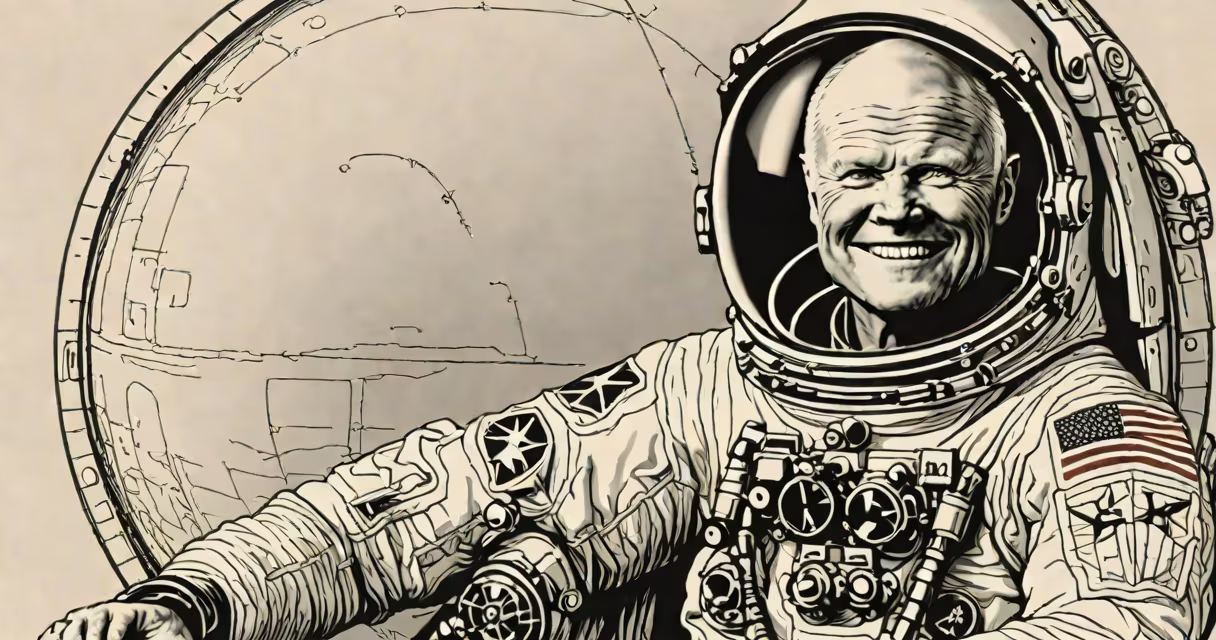
John Glenn astronaut was the first American to orbit Earth, completing three orbits aboard the Friendship 7 spacecraft during the Mercury-Atlas 6 mission on February 20, 1962. His flight lasted four hours and 56 minutes and solidified the United States' growing presence in human spaceflight during the Cold War.
Glenn's process began as part of NASA's Project Mercury, the agency's first human spaceflight program. Designed to prove that humans could survive in space, Mercury focused on single-pilot missions using small, capsule-shaped spacecraft. Glenn was selected from a group of 110 military test pilots who applied to join the astronaut corps. He was one of seven original Mercury astronauts chosen in 1959, known collectively as the "Mercury Seven."
His flight was not without risk. During re-entry, a warning light indicated that the heat shield might have come loose. Mission control instructed Glenn to keep the retrorocket pack attached during descent to prevent the shield from detaching. Glenn later confirmed he manually held the pack in place during re-entry, a decision that contributed to his safe return. This moment became one of the most scrutinized parts of the mission, highlighted in NASA's official mission report and detailed in the book *The Right Stuff* by Tom Wolfe.
The Mercury-Atlas 6 launch used a modified Atlas rocket, originally designed as an intercontinental ballistic missile. The vehicle lifted the Friendship 7 capsule into low Earth orbit at an altitude of approximately 160 kilometers. Once in orbit, Glenn conducted visual observations of Earth, tested manual controls, and reported on the effects of weightlessness. He described the view of Earth as "beautiful" and noted the absence of sound in space.
After completing three orbits, the capsule fired its retro rockets to begin re-entry. The spacecraft experienced extreme heating-up to 1,200 degrees Celsius-during atmospheric re-entry. A fault in the automatic attitude control system forced Glenn to manually stabilize the capsule. He used a hand-held control stick to maintain orientation, demonstrating that human pilot intervention remained critical even in automated systems.
Friendship 7 splashed down in the Atlantic Ocean near the Bahamas. The recovery team, including a Navy helicopter and a destroyer, retrieved Glenn from the capsule within 30 minutes of splashdown. He was then flown to a hospital for medical checks. Post-flight analysis confirmed that Glenn had experienced minimal physical stress, validating the safety of human spaceflight for longer durations.
Astronauts are categorized by their training and mission roles. The primary types include:
| Type | Description | Example |
|---|---|---|
| Test Pilot | Flies experimental aircraft to evaluate performance and safety. | John Glenn, prior to selection. |
| Commander | Leads crewed missions, responsible for success and safety. | John Glenn, Mercury-Atlas 6. |
| Specialist | Focuses on science, engineering, or equipment operation. | Scientists on Space Shuttle missions. |
| Flight Engineer | Monitors systems and supports operations during flight. | Used on ISS missions. |
Glenn served as a commander in the Mercury program, a role that required both technical skill and public visibility. Unlike later astronauts who trained extensively for spacewalks or complex experiments, Mercury astronauts were primarily responsible for piloting the capsule and reporting on environmental conditions. Glenn's ability to remain calm under pressure-evident during the heat shield scare-was essential to mission success.
John Glenn astronaut status was achieved through rigorous physical, psychological, and academic screening. NASA's standards included a minimum height of 5 feet 11 inches, excellent vision, and a bachelor's degree in engineering or a related field. Glenn met all requirements and passed the Navy's aviation physical, which included tests for spatial awareness and motion sickness.
His mission was used to counter Soviet achievements in space. After Yuri Gagarin became the first human in space in April 1961, the U.S. faced intense pressure to respond. Glenn's successful orbit demonstrated that American technology and human endurance could match those of the USSR. The mission was broadcast live on television, drawing an estimated 45 million viewers in the U.S. alone. President John F. Kennedy praised Glenn's achievement, calling it "a triumph for all mankind."
Glenn's flight also advanced understanding of human physiology in microgravity. Data collected during the mission informed future long-duration spaceflight planning. NASA's Human Research Program notes that Glenn's heart rate and blood pressure remained stable throughout the flight, confirming that short-term orbital missions were feasible for healthy individuals.
One widespread error is claiming that Glenn was the first American in space. That honor belongs to Alan Shepard, who flew a suborbital flight on May 5, 1961, reaching an altitude of 187 kilometers. Glenn's flight was the first American orbital mission, not the first American spaceflight.
Another misconception is that Glenn's spacecraft was powered by a nuclear engine. The Friendship 7 used chemical propulsion for its retrorockets and thrusters. The main engine was a liquid-fueled rocket motor developed by the Air Force, not a nuclear reactor. Nuclear-powered spacecraft were not deployed until decades later, such as the Voyager probes, which used radioisotope thermoelectric generators (RTGs).
A lesser-known fact: Glenn returned to space at age 77. In 1998, he flew aboard the Space Shuttle Discovery (STS-95) as a payload specialist. This made him the oldest person to fly in space at the time. His mission studied the effects of aging on the human body in microgravity, contributing to research on cardiovascular health and muscle atrophy. The results were published in the journal *Aviation, Space, and Environmental Medicine*.
Friendship 7 remains on display at the National Air and Space Museum in Washington, D.C. The capsule measures 2.4 meters in diameter and weighs 1,360 kilograms. Inside, the interior was lined with insulation and covered in reflective material to manage temperature. Glenn sat in a custom seat designed to distribute g-forces evenly across his body during launch and re-entry.
After the mission, Glenn received the Presidential Medal of Freedom in 1962. He later served as a U.S. Senator from Ohio from 1974 to 1999. His political career included advocating for science education and space policy reform. In 2016, NASA honored him by naming a Mars rover prototype the "Glenn Mars Rover" in recognition of his contributions to aerospace innovation.
During a visit to the museum in 2018, I watched Glenn's personal logbook, which contained handwritten notes from the flight. One entry read: "Everything looks good. I feel fine. The Earth is beautiful." The simplicity of the words contrasted with the magnitude of the event. It underscored that behind every technological leap is a human being making decisions under pressure.
John Glenn astronaut remains a defining figure in American space history. His 1962 flight proved that humans could safely operate in space for extended periods. His later return to space at age 77 challenged assumptions about age and physical capability. These milestones continue to inform modern spaceflight, including NASA's Artemis program and commercial crew missions.