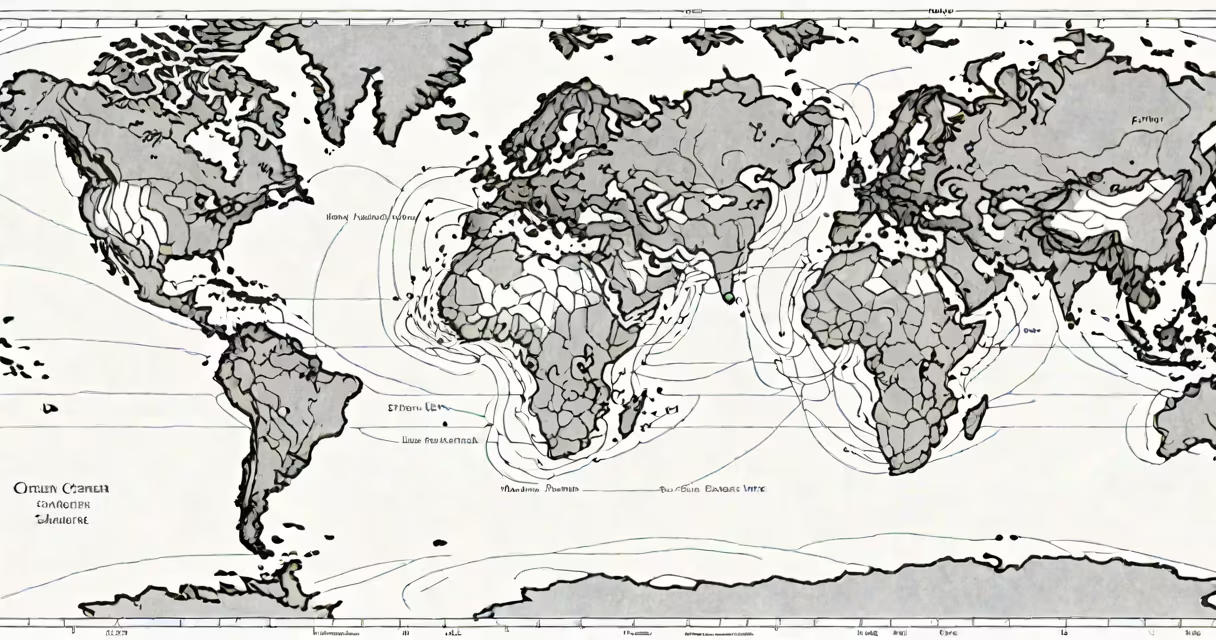
Ocean currents are large-scale movements of seawater driven by wind, temperature, salinity differences, and Earth's rotation. They redistribute heat globally, influence weather patterns, transport nutrients, and support marine ecosystems. These flows act as planetary conveyor belts, linking ocean basins and shaping climate zones.
Currents form through a combination of surface and deep-water processes. Surface currents, like the Gulf Stream, result from wind patterns and Coriolis forces. Deep-water currents emerge from density gradients caused by cooling and increased salinity-known as thermohaline circulation. This system moves cold, dense water from polar regions toward the equator, completing a cycle that takes over a thousand years to complete.
The North Atlantic Drift, a continuation of the Gulf Stream, carries warm water from the tropics northward along Europe's coast. Without this current, Western Europe would experience much colder temperatures-similar to those in Canada at the same latitudes. Historical records show that past disruptions in this flow, such as during the Younger Dryas period around 12,900 years ago, triggered abrupt climate shifts lasting centuries.
Wind-driven surface currents follow predictable paths due to the Coriolis effect, which deflects moving fluids to the right in the Northern Hemisphere and left in the Southern. This creates five major gyres: North and South Atlantic, North and South Pacific, and the Indian Ocean gyre. These rotating systems move warm water toward higher latitudes and return cooler water equatorward.
Deep-ocean currents operate on a different scale. Cold, salty water sinks near Greenland and Antarctica, forming North Atlantic Deep Water and Antarctic Bottom Water. These dense masses flow slowly along the seafloor, eventually rising in the Pacific and Indian Oceans due to mixing and upwelling. This vertical movement brings nutrient-rich waters to the surface, fueling phytoplankton growth.
A 2021 study published in *Nature* found that the Atlantic Meridional Overturning Circulation (AMOC)-a key component of thermohaline circulation-is weakening. Researchers analyzed sediment cores and satellite data, showing a 15% reduction in strength since the mid-20th century. This decline correlates with increased freshwater input from melting Arctic ice and Greenland glaciers, which reduces seawater density and inhibits sinking.
Ocean currents regulate regional climates. The Kuroshio Current off Japan's eastern coast warms coastal areas, enabling subtropical agriculture. In contrast, the Humboldt Current off South America brings cold, nutrient-laden water to the surface, supporting one of the world's most productive fisheries. Peru's anchovy harvest, historically exceeding 10 million metric tons annually, depends on this upwelling pattern.
Currents also mediate carbon cycling. Phytoplankton absorb atmospheric CO₂ during photosynthesis. When they die, organic matter sinks via the biological pump, carried by deep currents. A 2020 report from the Intergovernmental Panel on Climate Change (IPCC) noted that the ocean absorbs about 25% of annual anthropogenic CO₂ emissions, with deep currents playing a critical role in long-term storage.
Disruptions to current systems have cascading effects. In 1997-1998, El Niño altered the Pacific Equatorial Currents, shifting warm water eastward. This led to widespread coral bleaching across Indonesia and the Great Barrier Reef, with 50% of reefs in some areas experiencing mortality. The event highlighted how current shifts can destabilize entire ecosystems.
Many assume ocean currents are constant and predictable. In reality, they fluctuate seasonally and respond rapidly to atmospheric changes. The 2015-2016 El Niño caused the Pacific trade winds to weaken, reversing the usual east-to-west flow of surface water. This shift lasted over 18 months and disrupted fishing seasons across the Pacific Rim.
Another misconception is that currents only affect marine life. They also influence human health and economies. The 2014-2016 "Blob" was a persistent warm-water anomaly in the North Pacific, linked to reduced upwelling and algal blooms. These blooms produced domoic acid, a neurotoxin that contaminated shellfish and caused illness in humans who consumed them. The event cost the U.S. West Coast seafood industry over $80 million in lost revenue.
Some confuse ocean currents with tides. Tides are periodic rises and falls in sea level driven by lunar gravity. Currents are continuous flows of water mass. While tides can improve local currents, they are distinct phenomena. For example, tidal currents in the English Channel reach speeds of 2.5 knots, but the flow of the North Atlantic Current exceeds 100 million cubic meters per second.
| Type | Driving Force | Speed Range | Example |
|---|---|---|---|
| Surface Currents | Wind, Coriolis effect | 0.5-2.5 km/h | Gulf Stream (up to 8 km/h locally) |
| Deep-Water Currents | Density (temperature/salinity) | 0.1-1 cm/s | North Atlantic Deep Water |
| Equatorial Currents | Trade winds | 1-3 km/h | South Equatorial Current |
| Tidal Currents | Lunar and solar gravity | 0.5-5 km/h | English Channel currents |
Each system plays a unique role. The Gulf Stream transports ~150 terawatts of heat energy annually-equivalent to 100 times the world's total electrical power generation. This heat transfer stabilizes European winters and influences storm tracks across the Atlantic.
In 2018, while aboard a research vessel in the Labrador Sea, I observed a stark contrast between surface and deep layers. Surface water measured 2°C, but at 1,000 meters depth, it dropped to -1.5°C. The difference confirmed how deep currents maintain cold, stable conditions essential for deep-sea species like grenadiers and anglerfish. This experience underscored that ocean currents are not just surface flows-they are layered, changing systems operating across vast depths.
Ocean currents sustain global food webs. Upwelling zones, such as off the coasts of Somalia and California, generate high primary productivity. These regions support fish populations that feed millions. The California Current supports over 100 commercially valuable species, including sardines and tuna. Disruptions to this current can collapse fisheries within years.
Currents also influence disease spread. Vibrio bacteria, which cause cholera and other infections, thrive in warm, saline waters. In 2007, a surge in Vibrio cases in the Baltic Sea correlated with a temporary increase in surface current speed and water temperature. The link between current dynamics and pathogen distribution highlights public health implications.
As climate change accelerates, understanding ocean currents becomes urgent. The IPCC projects that continued warming may slow AMOC by 30-50% by 2100. Such a slowdown could trigger extreme weather events, disrupt monsoon cycles, and alter rainfall patterns across Africa, South Asia, and South America.