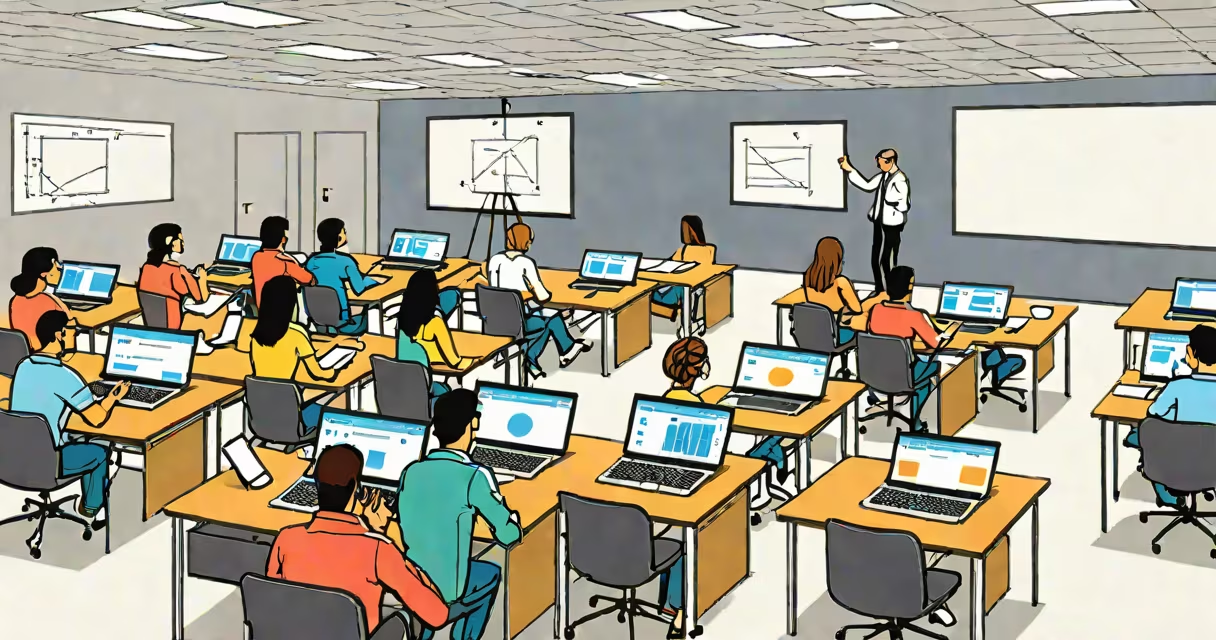
A hybrid learning classroom integrates face-to-face instruction with digital tools and remote participation, enabling students to engage with lessons either physically in the room or virtually from another location. This setup supports flexible attendance, accommodates diverse schedules, and maintains continuity during disruptions.
Classrooms using this model operate under a structured blend of synchronous and asynchronous activities. Instructors deliver live lectures in person while simultaneously streaming sessions via video platforms. Students join remotely through webcams, microphones, and internet-connected devices. Assignments, discussions, and assessments occur through learning management systems such as Google Classroom or Canvas.
Research from the U.S. Department of Education (2020) shows that hybrid models produce learning outcomes equal to or better than traditional in-person instruction when designed effectively. The study analyzed over 500 experiments and found that combining modalities increases student retention by 15-20% compared to purely online or in-person formats.
Each session follows a coordinated schedule. A teacher begins class in the physical space, projecting slides and facilitating discussion. Simultaneously, remote students access the same content through a livestream. The instructor uses a microphone and camera to ensure visibility and audio clarity for both groups.
Interactive elements include real-time polling, shared digital whiteboards, and breakout rooms for small-group work. Tools like Zoom, Microsoft Teams, or Google Meet manage connections. Students can ask questions via chat or raise hands digitally. The teacher monitors both in-room and online participation to maintain balance.
Assignments are posted in a central platform. Deadlines are synchronized across locations. Grading occurs through rubrics applied consistently to all submissions, whether submitted online or handed in physically. Teachers often record lectures for later review, supporting students who miss sessions due to illness or travel.
Hybrid classrooms rely on four foundational elements: reliable internet, accessible devices, consistent communication channels, and trained educators. Schools must provide devices-laptops or tablets-to students lacking them. Wi-Fi coverage must extend beyond classrooms into hallways and common areas.
Three standard configurations exist:
| Model | Structure | Best For |
|---|---|---|
| Rotating Schedules | Students alternate between in-person and remote days weekly. | Large schools with limited classroom space. |
| Flexible Attendance | Same class meets both in person and online daily; students choose. | Students with medical needs or family obligations. |
| Blended Rotation | Fixed time blocks: 60% in-person, 40% online; content delivered via recorded videos and live Q&A. | Advanced courses requiring lab work or project-based learning. |
Some institutions use a "hub-and-spoke" model, where a lead teacher delivers content from a central classroom while satellite classrooms in different buildings join via video. This reduces staffing costs and allows expert instructors to reach multiple schools.
Hybrid learning is not simply "online school with occasional in-person meetings." It requires intentional design to avoid inequity. A student joining remotely should not receive less attention or lower-quality feedback. Research from Stanford University's Center for Teaching and Learning (2021) confirms that perceived fairness in participation impacts academic performance.
Another myth is that hybrid models reduce teacher workload. In reality, they increase planning demands. Instructors must create materials usable in both settings, track two groups separately, and troubleshoot technical issues. A 2022 survey by the National Education Association found that 68% of teachers reported higher stress levels when managing hybrid instruction.
Hybrid does not mean equal time spent online and offline. The ratio varies by subject, grade level, and institutional policy. A high school physics class may spend 70% of time in labs and 30% online for theory, while a middle school literature course might reverse that balance.
In 2023, Lincoln High School in Portland, Oregon, launched a hybrid math curriculum for Algebra II. The school had 120 students, 25% of whom lived more than 15 miles from campus. To address transportation barriers, the district adopted a rotating hybrid model.
Classes met five days a week. On Mondays and Wednesdays, students attended in person. Fridays were remote-only. During in-person sessions, the teacher taught concepts using interactive software. Remote students joined via Zoom, with their cameras on and microphones muted unless speaking.
After each lesson, students completed practice problems in a shared Google Doc. The teacher reviewed responses in real time, highlighting errors and offering corrections. Weekly quizzes were administered online, with results auto-graded. Students who scored below 70% received personalized video feedback.
Over one semester, average test scores rose from 72% to 84%. Student satisfaction surveys showed 89% felt engaged, and 93% reported improved understanding of complex topics. The program was later cited by the Oregon Department of Education as a model for rural districts.
Hybrid learning differs from fully online or fully in-person models in its dual delivery system. It is not synonymous with remote learning, which implies absence of physical presence. Nor is it equivalent to flipped classrooms, where students watch lectures at home and do problem-solving in class-though hybrid models can incorporate flipping.
Effective hybrid classrooms prioritize equity. This includes ensuring all students have devices and stable internet access. Schools must also train teachers in digital pedagogy. The International Society for Technology in Education (ISTE) recommends that educators complete at least 40 hours of professional development focused on inclusive tech integration.
One non-obvious requirement is spatial design. Classrooms must have multiple camera angles and directional microphones so remote students see the teacher and hear every word. Some schools install ceiling-mounted cameras with pan-tilt-zoom features to follow movement and focus on whiteboards.
When designing a hybrid classroom, consider the cognitive load on students. Too many platforms (e.g., one for announcements, another for assignments, a third for video calls) leads to confusion. Consolidate tools into a single learning management system. Use consistent naming conventions for files and folders.
For example, a teacher might label assignment folders as "Unit_3_Algebra_2_Hybrid_Lesson_1.pdf." This clarity prevents lost work and simplifies grading. A 2023 study in the Journal of Educational Technology Systems found that students in well-organized hybrid environments completed tasks 23% faster than those in disorganized ones.
As a former high school science teacher, I observed that students in hybrid settings often form peer support networks across locations. Online participants frequently collaborate on group projects using shared documents and scheduled video calls. These relationships improve motivation and accountability.
Hybrid learning classrooms represent a shift toward adaptable, student-centered education. They combine the immediacy of live interaction with the flexibility of digital access. When implemented with intentionality, they serve diverse learners and prepare students for a connected world.