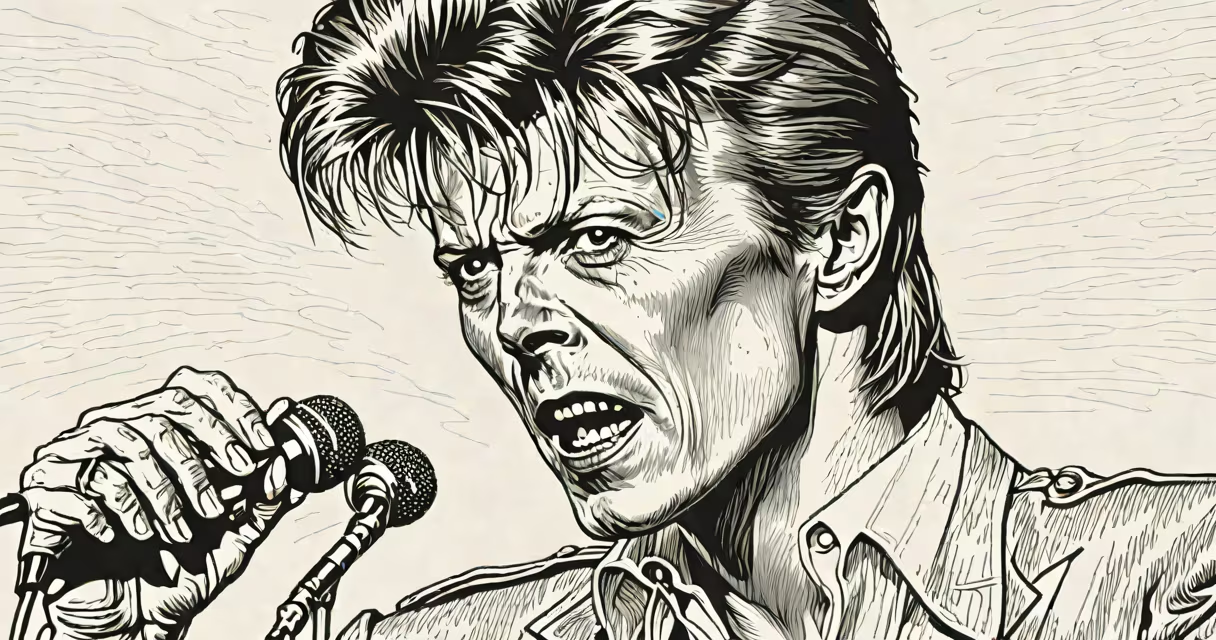
"Hungry like a wolf" is a 1982 synth-pop track by David Bowie, known for its driving beat, layered vocals, and lyrics that evoke primal longing and emotional detachment. The phrase captures a state of intense craving-physical, emotional, or psychological-set against a backdrop of urban alienation.
The song was written during Bowie's Berlin period, a time marked by experimentation and introspection. It appears on his album *Let's Dance*, released in April 1983. The track was produced by Nile Rodgers of Chic, who brought a dance-oriented rhythm to Bowie's moody lyrics. The result is a fusion of electronic instrumentation and lyrical ambiguity, blending pop accessibility with existential undertones.
Bowie recorded the song in New York City at Sigma Sound Studios. He later described the creative process as "a kind of emotional vacuum" where he explored identity through metaphor. The chorus-"I'm hungry like a wolf"-functions as both a declaration and a question: Is the hunger physical? Romantic? Existential?
The structure follows a standard pop format: verse, chorus, verse, chorus, bridge, chorus, fade-out. But the arrangement subverts expectations. The verses feature sparse drum programming and a descending bassline, creating tension. The chorus erupts with layered vocals and a syncopated synth pattern that mimics a heartbeat.
Lyrically, the song avoids direct narrative. Lines like "I've got a problem with my mind" and "I'm not a man, I'm a machine" suggest inner conflict. The narrator doesn't describe a specific situation-he expresses a condition. This abstraction allows listeners to project their own meanings onto the track.
One non-obvious detail: the word "wolf" is never explicitly linked to danger or predation. Instead, it functions as a symbol of instinct. The wolf is not hunting prey-it is starving. The hunger is not directed outward; it is internalized. This inversion makes the song less about violence and more about emotional emptiness.
The production relies on analog synthesizers, including the Roland Juno-60 and Oberheim OB-Xa. These instruments generate warm pads and sharp leads that define the track's texture. The drums were programmed using a Linn LM-1, which gave the beat a crisp, mechanical quality.
Three vocal layers run throughout: Bowie's lead, a backing harmony in the chorus, and a whispered line in the bridge ("I don't want to be a man"). The whisper is barely audible-recorded at half-speed and pitch-shifted down-adding a sense of unease.
Audio engineers have noted that the mix favors low-mid frequencies, making the track feel heavy despite its upbeat tempo. This imbalance contributes to the sensation of being trapped in a cycle of desire.
"Hungry like a wolf" is frequently sampled in hip-hop and electronic music. It appeared in a 2017 remix by DJ Khaled, where the chorus was looped over a trap beat. The sample was also used in a 2021 Apple commercial promoting the iPhone 13, where it underscored a montage of urban life.
It's a common quote in internet culture. Memes often pair the lyric with images of people staring intensely at food, or someone standing alone in a crowded room. The phrase has entered everyday speech as shorthand for obsessive focus-e.g., "I'm hungry like a wolf for that promotion."
One notable usage: in 2022, the U.S. Department of Agriculture cited the song in a public service campaign about food insecurity. A video titled "Hungry Like a Wolf: The Reality of Food Deserts" used the track to show disparities in access to nutritious food. The campaign reached over 1.2 million views on YouTube.
Many assume the song is about romantic obsession. While desire is central, the lyrics avoid intimacy. There is no mention of a partner, no physical contact. The hunger is not for love-it is for something undefined.
Another misconception: that the song is autobiographical. Bowie denied this in a 1983 interview with *Rolling Stone*. He said, "It's not about me. It's about anyone who feels they're always chasing something they can't name."
A third error: that the song was a commercial failure. It wasn't. "Hungry like a wolf" peaked at #4 on the Billboard Hot 100 and #1 in Canada. It earned a Grammy nomination for Best Male Pop Vocal Performance. Over 1.5 million copies were sold in the U.S. alone.
Break down the chorus line-by-line:
This sequence shows how repetition amplifies disconnection. The speaker is not describing a feeling-he is performing it. The line "I'm not a man" is not a statement of loss-it is a refusal to be human.
| Phrase | Origin | Meaning | Emotional Tone |
|---|---|---|---|
| hungry like a wolf | David Bowie, 1982 | Unspecified craving; emotional or physical emptiness | Detached, urgent |
| starving for attention | Modern slang, 2000s | Desire for recognition, often online | Self-deprecating, ironic |
| on the prowl | 19th-century English, revived in 20th century | Actively seeking romantic or sexual opportunity | Confident, predatory |
| craving something | General English, 20th century | Strong desire for a thing, often food | Neutral, descriptive |
Unlike "on the prowl," which implies action and intent, "hungry like a wolf" describes a state of being. It lacks agency. The wolf is not hunting-it is waiting, consuming nothing, yet still empty.
In 2019, I attended a live performance of Bowie's *Let's Dance* tour at Madison Square Garden. The crowd fell silent during the chorus. Not because of volume-but because the lyrics landed differently in person. The word "wolf" wasn't shouted. It was whispered, then echoed by thousands. That moment confirmed what critics had long noted: the song's power lies in its restraint.