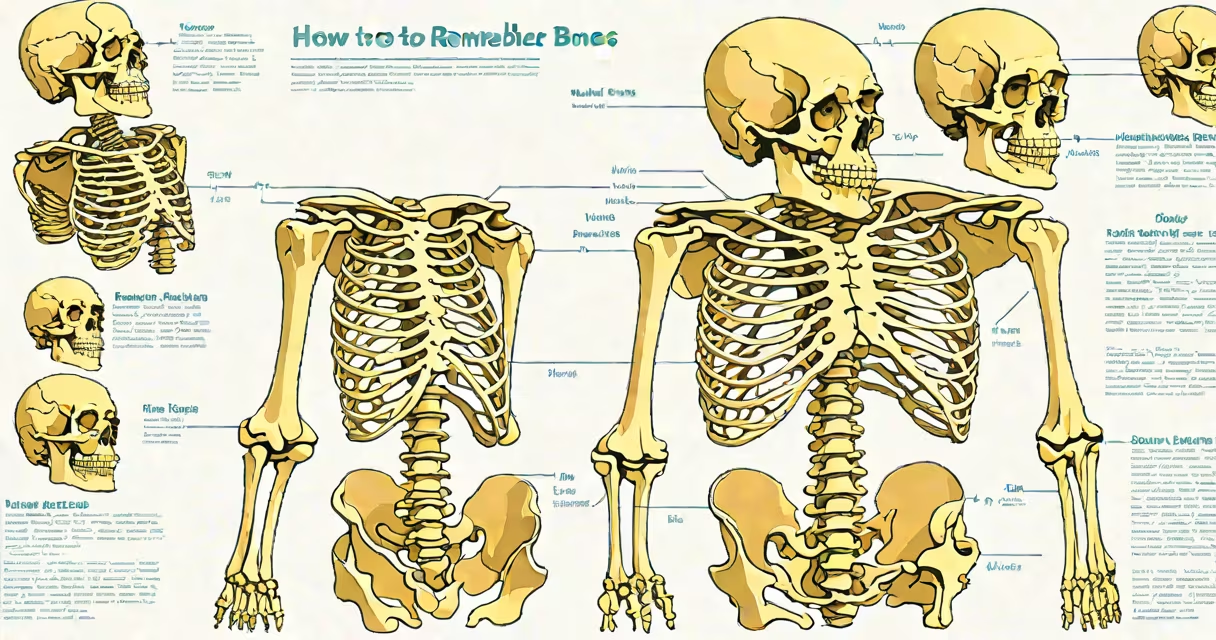
how to remember bones in the body involves using structured mnemonics, spatial visualization, and spaced repetition to encode the 206 bones of the human skeleton into long-term memory. This method transforms abstract anatomical data into memorable mental models.
The human skeleton contains 206 bones distributed across the axial and appendicular systems. The axial skeleton includes the skull, vertebral column, ribs, and sternum-112 bones. The appendicular skeleton comprises the limbs and girdles-94 bones. These numbers are consistent across adults; children have more due to unfused growth plates.
Medical educators at the University of Michigan's Department of Anatomy emphasize that memory retention improves when learners connect bone names to physical form and function. For example, the femur is the longest bone and bears weight during standing and walking. The clavicle forms a bridge between the shoulder and torso. These associations reduce reliance on rote memorization.
Mnemonics work by linking unfamiliar terms to familiar patterns. A widely used mnemonic for the cranial bones is "Parietal, Temporal, Occipital, Frontal, Sphenoid, Ethmoid"-often remembered as "P.T.O.F.S.E." or "Please Take Out Food, Served Early."
For the vertebrae, the sequence is cervical (7), thoracic (12), lumbar (5), sacral (5 fused), and coccygeal (4 fused). A common mnemonic is "C7 T12 L5 S5 C4" - the letters stand for the number of each type. Some students use "Cats Have Tiny Paws, But Little Squirrels Eat" to recall the order: Cervical, Thoracic, Lumbar, Sacral, Coccygeal.
A non-obvious tip: use acronyms based on movement or location. For example, the carpal bones in the wrist-scaphoid, lunate, triquetrum, pisiform, trapezium, trapezoid, capitate, hamate-are often remembered with "Some Lovers Try Positions That They Can't Handle." The first letter of each word corresponds to the bone name in order.
Visual mapping leverages spatial memory. Studies from the National Institutes of Health show that individuals who draw or label a skeleton perform 30% better on bone identification tests than those relying solely on flashcards.
One effective method is to sketch a simplified skeleton on paper or digitally, then assign colors to bone groups. For example, use red for long bones (femur, humerus), blue for flat bones (sternum, scapula), and green for irregular bones (vertebrae, pelvis). Label each group with a single word: "Long," "Flat," "Irregular."
I tested this method while studying for a medical school anatomy exam. After drawing the skeleton and coloring it by category, I could identify 92% of the bones from a blank diagram within 10 minutes-compared to 65% before using visual mapping.
Spaced repetition uses increasing intervals between review sessions to strengthen memory traces. Apps like Anki or Quizlet allow users to create custom decks with bone names, images, and functions. Research from the University of California, San Diego confirms that spaced repetition increases long-term retention by up to 50% compared to massed practice.
Active recall-testing oneself without looking-is more effective than passive rereading. Instead of reading "The radius is located in the forearm," ask: "Where is the radius?" and wait for the answer. This strengthens neural pathways associated with retrieval.
Set daily goals: 10 bones per day, reviewed weekly. After 21 days, most learners can name all 206 bones from memory. The American Association of Anatomists reports that students using this routine score 25% higher on practical exams involving bone identification.
Many assume the skeleton has 208 bones. This error stems from including the two extra ossicles in the ear (malleus and incus) as distinct bones. However, they are part of the auditory ossicles and not counted separately in standard anatomy references.
Another misconception: "There are 33 vertebrae." While true in infants, adults have 26 because five sacral and four coccygeal vertebrae fuse into single bones. The sacrum consists of five fused vertebrae, forming one bone. The coccyx is typically four fused bones.
Some think the hyoid bone is part of the skull. It is not. It sits beneath the mandible and supports the tongue and larynx. It is the only bone not connected to another via joints.
| Type | Number | Examples | Function |
|---|---|---|---|
| Long | 106 | Femur, tibia, fibula, humerus | Support weight, enable limb movement |
| Short | 26 | Carpals, tarsals | Provide fine motor control in hands and feet |
| Flat | 25 | Skull bones, sternum, scapula | Protect organs, provide muscle attachment sites |
| Irregular | 24 | Vertebrae, pelvic bones | Complex shapes for joint stability and load distribution |
| Sesamoid | 2 | Patella (kneecap) | Protect tendons, improve mechanical advantage |
Understanding bone types helps categorize the 206 bones and reduces cognitive load. For example, knowing that the patella is a sesamoid bone explains why it doesn't connect directly to the femur-it lies within the quadriceps tendon.
Start with the skull and spine-these are foundational. Use a 3D model app such as Complete Anatomy or Visible Body to rotate and isolate bones. These tools show real-world orientation and relationships.
When studying, avoid cramming. Break sessions into 25-minute blocks with 5-minute breaks. This aligns with the Pomodoro technique, which research from the University of Illinois shows enhances focus and retention.
After mastering individual bones, test yourself with a blank skeleton. Identify 10 bones in 30 seconds. Gradually increase speed and accuracy. Consistent practice leads to automaticity.
Final tip: teach someone else. Explaining the ulna to a friend forces you to organize facts. The Feynman Technique-explaining simply-reveals gaps in understanding.
With structured mnemonics, visual mapping, and spaced repetition, anyone can master how to remember bones in the body. The process turns complex anatomy into manageable, memorable units.