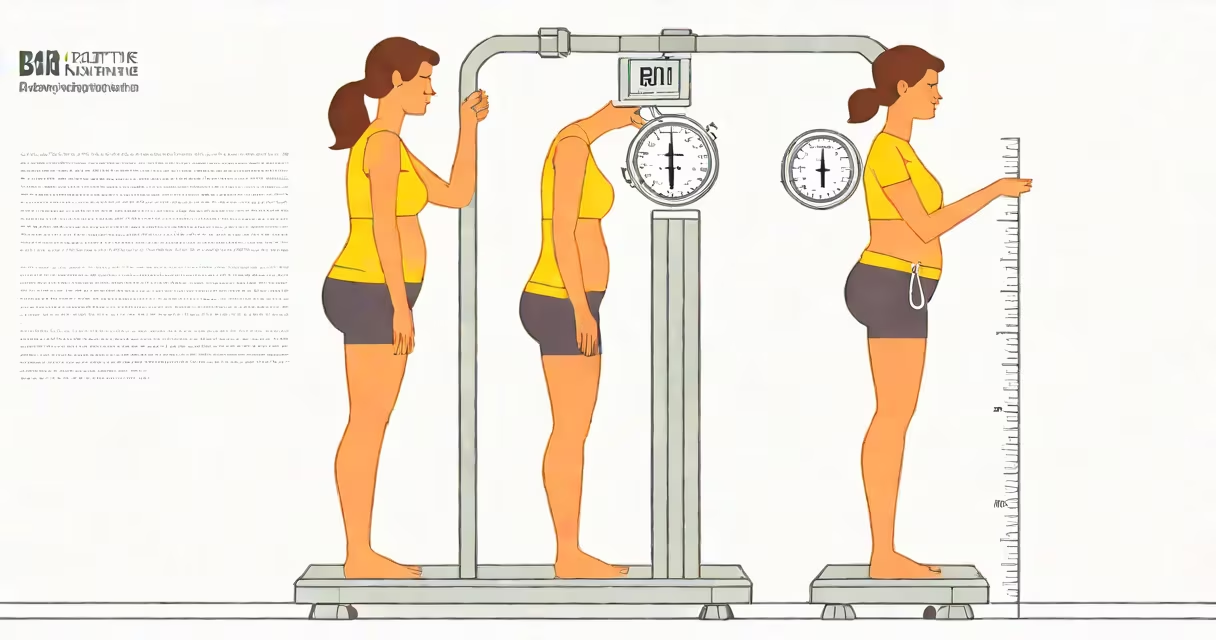
Body mass index (BMI) is a numerical value derived from your weight and height that estimates body fat levels and categorizes individuals into weight status groups such as underweight, normal weight, overweight, or obese. It's calculated using a standardized formula and widely used in clinical and public health settings.
BMI serves as a screening tool, not a diagnostic measure. It provides a quick way to assess whether a person's weight falls within a healthy range relative to their height. The World Health Organization (WHO) uses BMI to classify global populations, and the U.S. Centers for Disease Control and Prevention (CDC) relies on it for tracking obesity trends in adults and children.
To calculate your BMI, divide your weight in kilograms by the square of your height in meters. For example, if you weigh 70 kg and are 1.75 meters tall, your BMI is 70 ÷ (1.75 × 1.75) = 22.86. This falls within the "normal weight" category according to WHO standards.
The BMI formula is consistent worldwide: BMI = weight (kg) / height² (m²). This equation converts raw physical measurements into a single number that reflects relative body size. The result is dimensionless and expressed in units of kg/m².
For those using pounds and inches, the formula adjusts to: BMI = (weight in pounds × 703) / (height in inches)². Using the same 70 kg and 1.75 m example, converting to imperial gives 154.3 pounds and 68.9 inches. Plugging in: (154.3 × 703) / (68.9)² ≈ 22.86. The result matches the metric version.
Many online calculators automate this process. However, accuracy depends on precise inputs. Measuring height without shoes and weight without clothing improves reliability. A 2021 study published in *The Lancet* found that self-reported height and weight often lead to underestimation of BMI by 0.5-1.5 points, which can misclassify individuals near cutoff thresholds.
WHO defines four main BMI categories for adults:
| BMI Range | Category | Health Risk Level |
|---|---|---|
| <18.5 | Underweight | Increased risk of malnutrition and osteoporosis |
| 18.5-24.9 | Normal weight | Lower risk of chronic disease |
| 25.0-29.9 | Overweight | Moderate risk of heart disease and type 2 diabetes |
| ≥30.0 | Obese | High risk of metabolic syndrome and cardiovascular events |
These ranges apply to adults aged 18 and older. Children and adolescents use age- and sex-specific percentiles because body composition changes rapidly during growth. The CDC provides growth charts for pediatric BMI, which are used in school health screenings and pediatric clinics.
A common misconception is that BMI reflects muscle mass. In reality, it cannot distinguish between fat and lean tissue. A muscular athlete may have a high BMI yet low body fat percentage. For instance, a 6-foot-tall football player weighing 230 pounds (104.3 kg) with 10% body fat has a BMI of 28.9-classified as overweight-but is metabolically healthy.
BMI fails to account for body distribution. Abdominal fat correlates more strongly with insulin resistance and heart disease than BMI. A 2018 study in *JAMA Internal Medicine* showed that people with normal BMI but high waist circumference had higher mortality rates than those with elevated BMI and lower waist size.
Another limitation is racial and ethnic variation. Research from the National Institutes of Health indicates that Asian populations tend to develop health risks at lower BMI thresholds. The WHO recommends a BMI cutoff of 23 for Asians due to increased diabetes risk at lower values compared to Western populations.
Despite these flaws, BMI remains a practical tool for population-level assessments. Its simplicity allows rapid screening in large-scale studies and public health campaigns. The CDC reports that over 70% of U.S. adults have a BMI above 25, highlighting the prevalence of overweight and obesity in the country.
Start by measuring your height accurately. Stand barefoot against a wall with heels together, shoulders relaxed, and eyes level with the horizon. Use a flat object like a book to mark the highest point of your head. Record the distance from the floor in centimeters or inches.
Weigh yourself on a calibrated scale. Step on at the same time each day, ideally in the morning after using the restroom and before eating. Wear minimal clothing for consistency. Enter both values into a BMI calculator.
I once measured my own BMI during a routine check-up. I stood at 178 cm (5'10") and weighed 82 kg (181 lbs). My calculation was 82 ÷ (1.78 × 1.78) = 25.7. This placed me in the overweight category. I later learned that my waist-to-height ratio was 0.51-above the recommended 0.5 threshold-indicating abdominal fat accumulation. This prompted lifestyle changes that improved my metabolic markers.
Understanding how to get your body mass index begins with accurate measurement and correct application of the formula. While it doesn't capture everything about your health, it offers a clear baseline for further evaluation and action.