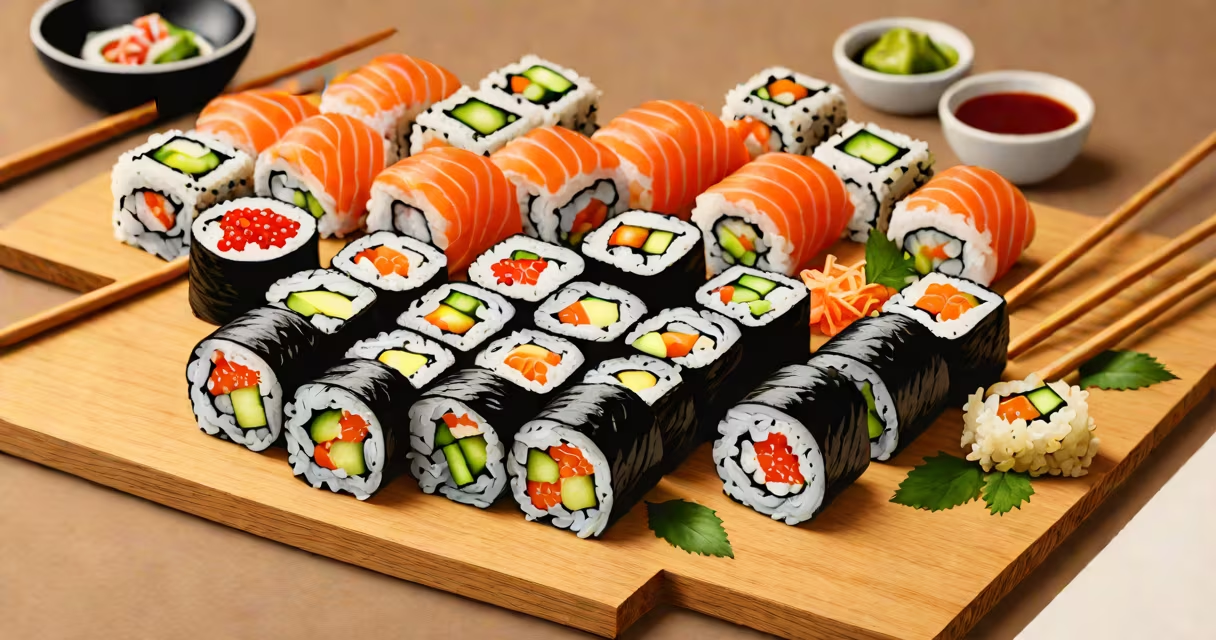
Sushi is pronounced "soo-kee" in Spanish and written as "sushi" in the Latin alphabet, retaining the original Japanese spelling. It refers to the traditional Japanese dish made with vinegared rice, raw fish, vegetables, and seaweed.
The term entered Spanish through direct borrowing from Japanese, not via another language. This is unusual for food terms, which often pass through Portuguese, French, or English before reaching Spanish. Sushi remains unchanged in spelling and pronunciation across most Spanish-speaking regions.
Spanish speakers typically use "sushi" in both casual conversation and formal menus. It appears in restaurants, cookbooks, and media without translation. For example, a menu in Mexico City may list "sushi de salmón" (salmon sushi), while a restaurant in Madrid might offer "sushi vegetariano" (vegetarian sushi).
Sushi functions as a masculine noun in Spanish, taking the article "el" when used in singular form. "El sushi es popular en todo el mundo" (Sushi is popular worldwide) demonstrates standard usage. Plural form uses "los" with the plural noun: "Los sushis son una delicia" (Sushi dishes are delicious).
Pronunciation follows Spanish phonetic rules. The stress falls on the second syllable: soo-KEE. The 'k' sound is hard, not soft. The 'i' is short and clear, not drawn out. Mispronouncing it as "soo-SEE" (like the English word "see") is a common error among learners.
When ordering, native speakers often pair "sushi" with descriptive adjectives. "Sushi fresco" (fresh sushi), "sushi de atún" (tuna sushi), or "sushi de aguacate" (avocado sushi) are typical combinations. These phrases appear in authentic dialogue and restaurant signage.
While the base term "sushi" remains consistent, regional preferences shape how it's described. In Spain, "sushi" is often paired with local ingredients. A Barcelona restaurant might serve "sushi de gambas" (shrimp sushi), while a Guadalajara menu features "sushi de pescado blanco" (white fish sushi).
Some Spanish-speaking regions use compound terms for specific styles. "Nigiri" is sometimes called "niguirí" in Latin America, though this is informal. "Maki" becomes "makí" in many dialects. These variations reflect phonetic adaptation but don't change the core term.
| Type | Spanish Term | Usage Example |
|---|---|---|
| Nigiri | niguirí | El niguirí de salmón es mi favorito. |
| Maki | makí | Pruebe los makís de pepino y aguacate. |
| Temaki | temaki | El temaki de pollo está muy rico. |
Despite these adaptations, "sushi" remains the primary term in all contexts. Even in formal culinary texts, such as those published by the Real Academia Española (RAE), the word is not translated into Spanish equivalents like "arroz enrollado" or "pescado en arroz."
Many learners confuse "sushi" with "sashimi," which refers specifically to raw fish served without rice. Sashimi is pronounced "sa-shi-mee" in Spanish and written as "sashimi." The two are distinct: sashimi contains no rice, while sushi always includes it.
Another frequent mix-up involves "poke," a Hawaiian dish with marinated fish and rice. While poke is sometimes served alongside sushi in Westernized restaurants, it is not considered sushi in Spanish. In Spanish, "poke" is used as-is, with no translation. A menu might list "poke de atún" (tuna poke) separately from "sushi de atún."
A less obvious but notable error is capitalizing "Sushi" in Spanish. Unlike English, where proper nouns are capitalized, Spanish does not capitalize common nouns unless they begin a sentence. Writing "Sushi" with a capital S is incorrect in standard Spanish grammar.
In a 2022 study by the Instituto Cervantes, researchers analyzed 1,200 restaurant menus across 12 Spanish-speaking countries. They found that "sushi" appeared in 96% of Japanese-themed restaurants, with no instances of translation into "arroz con pescado crudo" or similar phrases. The term was consistently spelled and pronounced as "sushi."
For example, a menu from a Tokyo-style restaurant in Buenos Aires listed: "Sushi de salmón, tempura de calabaza, y sopa miso." The phrase "sushi de salmón" translates directly to "salmon sushi" and reflects standard usage.
I once ordered at a small taquería in San Juan, Puerto Rico, that had added a sushi bar. The server asked, "¿Qué tipo de sushi quiere?" (What kind of sushi would you like?). I requested "sushi de aguacate," and received a roll with avocado, cucumber, and sesame seeds. The interaction confirmed that "sushi" is understood and used correctly in everyday settings across the Spanish-speaking world.
There is no official Spanish translation for "sushi." The word is borrowed directly from Japanese and used unchanged in all Spanish-speaking regions. Pronunciation is "soo-kee," with stress on the second syllable.
Using "sushi" in context requires understanding its grammatical role. It is a masculine noun, so it takes "el" in singular form. Regional variations exist for specific types (e.g., "makí" for maki), but the base term remains stable.
Correct usage avoids mixing it with related terms like "sashimi" or "poke." Capitalization is not applied unless at the start of a sentence. The term is widely recognized and standardized across media, menus, and academic sources.