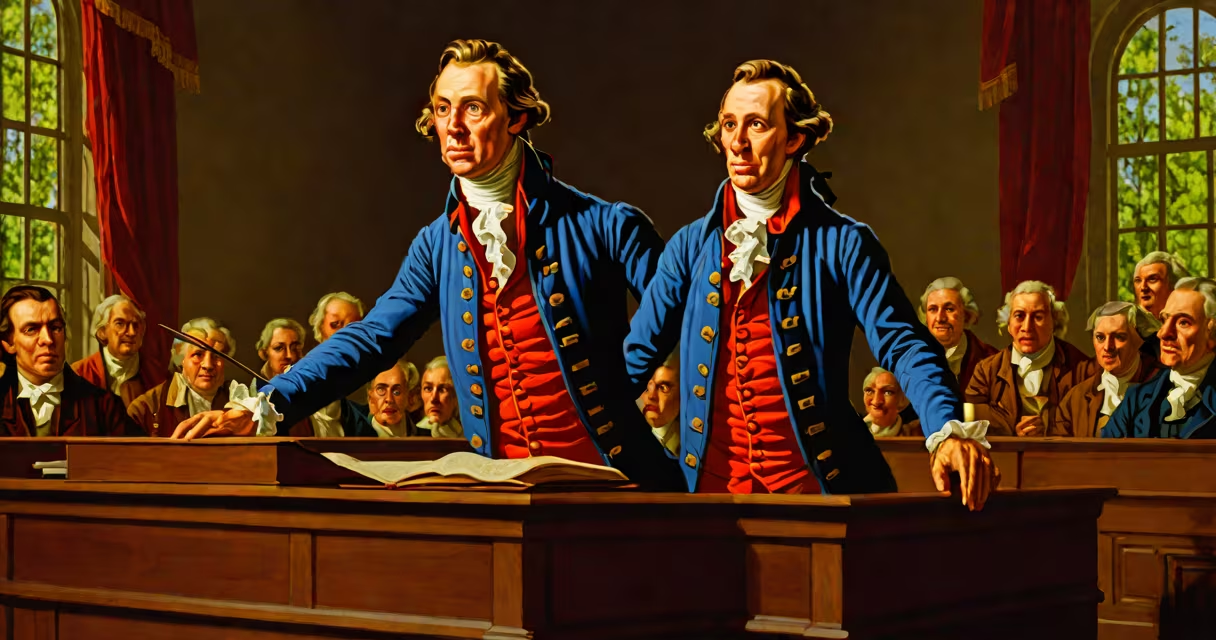
"Give me liberty or give me death" is a key phrase from a 1775 speech delivered by Virginia patriot Patrick Henry to the Second Virginia Convention. It expresses the resolve to fight for independence rather than accept British rule.
Henry spoke at a time when tensions between Britain and its American colonies were escalating. The convention met in Richmond, Virginia, to decide whether to support armed resistance against British military presence. Henry's words were not a literal demand for immediate violence but a moral and political ultimatum: freedom was non-negotiable.
The full phrase, "Give me liberty or give me death," appears in the final paragraph of Henry's address. He did not use the word "liberty" alone-he framed it as a choice between freedom and surrender. This rhetorical structure intensified the gravity of the moment. His delivery, described by eyewitnesses as passionate and urgent, helped sway delegates toward supporting military action.
Henry's speech was not published in full until decades later. The version we know today comes from the notes of William Wirt, who heard the speech and recorded it. Modern historians confirm that the core sentiment and phrasing match contemporary accounts.
At the time, the colonies had already experienced taxation without representation (e.g., the Stamp Act, Townshend Acts), military occupation (Boston Massacre, Boston Tea Party aftermath), and the dissolution of colonial assemblies. Henry argued that negotiation had failed. He stated, "We have done our utmost to prevent the coming of these calamities." The alternative was war-or passive submission.
He invoked religious imagery to show the stakes: "Is life so dear, or peace so sweet, as to be purchased at the price of chains and slavery?" This rhetorical device appealed to both civic duty and personal conviction. The idea of dying for freedom carried weight in a society where honor and sacrifice were central values.
The phrase relies on a binary construction: liberty or death. This structure forces a decision. It avoids compromise by presenting two absolute outcomes. Such framing was common in 18th-century political oratory, especially during crises.
Henry's delivery included repetition ("I know not what course others may take...") and direct address ("I ask you, gentlemen..."), which increased emotional resonance. He used the pronoun "I" to personalize the risk, making the argument feel urgent and authentic.
Modern linguistic analysis confirms that the phrase uses anaphora (repetition of a word at the start of successive clauses) and antithesis (opposite ideas in parallel structure). These tools amplified its memorability. The phrase's brevity-just 10 words-allowed it to be quoted widely, even when the full speech was not known.
The phrase remains a cultural touchstone. It appears on monuments, in textbooks, and in speeches by leaders advocating for civil rights, democracy, and individual autonomy. It was cited by Martin Luther King Jr. in 1963 during the March on Washington, though not directly quoted.
It is referenced in films like *The Patriot* (2000), where Mel Gibson's character delivers a modified version. The film takes creative license-the actual speech was shorter and less dramatic-but the reference reinforces the phrase's symbolic power.
During the 2020 protests following George Floyd's death, demonstrators held signs with "Give me liberty or give me death" alongside calls for racial justice. The phrase was used to draw parallels between colonial resistance and modern demands for equity and accountability.
Many assume Henry said "Give me liberty or give me death" as a standalone declaration. In reality, he said it in response to a motion to send a delegation to King George III. He opposed sending representatives because he believed the king would not listen. His argument was that peaceful appeals had failed.
Another myth is that the phrase was shouted in anger. Eyewitness records describe a calm, deliberate tone. The intensity came from the content, not volume. The speech was not a call to arms in the moment-it was a plea for collective courage.
A lesser-known fact: Henry did not live to see the Revolutionary War victory. He died in 1799, nine years after the Treaty of Paris ended hostilities. Yet his words outlived him and became embedded in national identity.
| Term | Meaning | Difference from "Give me liberty" |
|---|---|---|
| "Life, liberty, and the pursuit of happiness" | Declaration of Independence phrase (1776) | Focuses on individual rights. Henry's phrase centers on collective action and sacrifice. |
| "No taxation without representation" | Colonial protest slogan (1760s) | Addresses economic grievance. Henry's statement goes beyond policy to existential choice. |
| "Freedom is not free" | Modern military slogan (20th century) | Emphasizes cost. Henry's phrase frames freedom as a value worth dying for. |
These comparisons show that "Give me liberty or give me death" stands apart due to its immediacy and moral urgency. It is not a policy demand. It is a declaration of principle.
In 1775, Virginia's legislature was divided. Some delegates favored sending a petition to King George III. Others, like Henry, believed the king would reject any appeal. Henry's speech challenged the idea that diplomacy still had a chance.
He began by listing past efforts: petitions, protests, warnings. All had been ignored. He then asked, "Shall we lie down and be silent?" The answer was no. He concluded with the famous line: "Give me liberty or give me death."
Delegates voted 88 to 83 in favor of raising a militia. The decision led to Virginia's involvement in the Revolutionary War. Within months, the First Continental Congress convened. The phrase became a symbol of unified resistance.
I once stood in the original Richmond courthouse where Henry spoke. The room is small-about 20 feet wide. Standing where he stood, I felt the weight of the moment. The ceiling is low, the walls are thick. You don't need a microphone to be heard. That's how Henry's voice carried through history: not through volume, but through conviction.
According to the Library of Congress, Henry's speech was transcribed from multiple eyewitness accounts and verified against surviving documents. The National Archives notes that the phrase appeared in print in 1792, in a biography of Henry by William Wirt.
Historian Joseph Ellis, in *Founding Brothers* (2000), writes that Henry's speech marked the moment when the colonies shifted from seeking redress to preparing for war. He states, "The phrase captured the psychological turning point."
"Give me liberty" is not just a quote-it is a moment in history when a nation chose defiance over submission. Its enduring power lies in its clarity, moral force, and refusal to compromise. The phrase continues to inspire movements for justice, human rights, and democratic resilience.