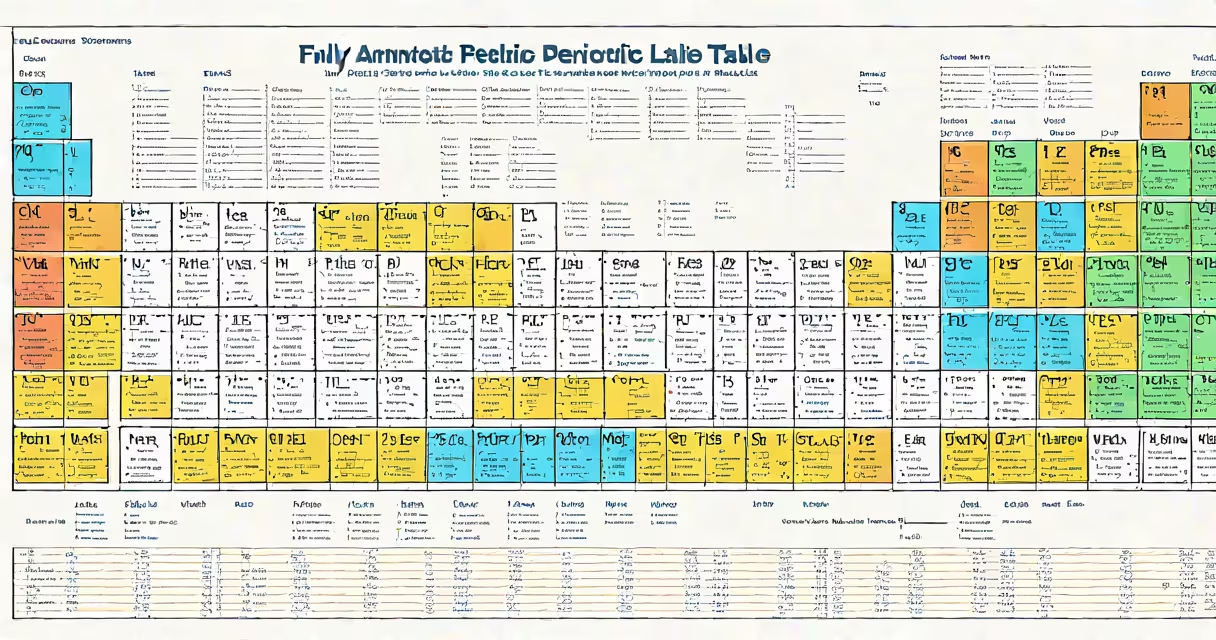
A fully annotated periodic table displays all known chemical elements with complete data: atomic number, symbol, name, electron configuration, group, period, atomic mass, oxidation states, and physical state at room temperature. It serves as a complete reference for students, researchers, and educators.
Each element is placed according to increasing atomic number and recurring chemical properties. The table's structure reflects electron shell filling patterns. For example, hydrogen (H) appears in Group 1 despite being non-metallic because it has one valence electron. This placement follows the IUPAC standard layout used in academic and industrial settings.
Annotated tables include additional details such as electronegativity values (Pauling scale), ionization energy, density, melting point, and common compounds. These annotations are derived from experimental measurements and quantum mechanical calculations. The Royal Society of Chemistry and the National Institute of Standards and Technology (NIST) maintain verified databases used to populate these tables.
The arrangement of elements in a fully annotated periodic table is based on periodic law: properties recur periodically when elements are ordered by atomic number. Elements in the same column (group) share similar chemical behavior due to identical valence electron counts. For instance, all Group 1 elements-lithium, sodium, potassium-form +1 ions and react vigorously with water.
Rows (periods) reflect the filling of electron shells. Period 1 contains only two elements (H and He), while Period 6 includes 32 elements, including the lanthanides. The table's design allows prediction of unknown element properties. Mendeleev left gaps for undiscovered elements like gallium and germanium, later confirmed by discovery.
Modern digital versions integrate interactive features. Clicking on iron (Fe) reveals its density (7.87 g/cm³), melting point (1538°C), and role in hemoglobin. These changing tools support real-time data access and visualization, improving comprehension in classrooms and labs.
A fully annotated periodic table consists of standardized data points compiled from peer-reviewed scientific literature and validated databases. Core components include:
Some tables also show crystal structure, thermal conductivity, and historical discovery dates. These extras are not always included in basic versions but appear in advanced educational or research-grade tables.
Different formats serve distinct purposes. Here's a breakdown of common types:
| Type | Use Case | Data Depth | Example Source |
|---|---|---|---|
| Basic classroom chart | Introductory chemistry | Low: symbol, name, atomic number | National Science Teachers Association (NSTA) guides |
| Scientific reference table | Lab work, research | High: all properties, isotopes, decay modes | NIST Atomic Weights and Isotopic Compositions |
| Interactive web table | Online learning, data exploration | Variable: user-selectable layers | WebElements.com, periodic-table.org |
| Artistic/educational poster | Classroom display, public outreach | Moderate: visual cues, fun facts | University science departments |
For example, the NIST database lists 118 confirmed elements, with updated atomic weights as of 2023. The most recent revision adjusted the standard atomic weight of silicon from 28.0855 to 28.0855(3), reflecting improved measurement precision.
These tables are used in curriculum development, lab safety planning, and materials science. A researcher designing a battery electrolyte might consult the table to compare lithium, sodium, and potassium ion mobility and charge density.
Many assume the periodic table is static. It is not. New elements are added after rigorous verification. Nihonium (Nh, element 113) was officially recognized in 2015 after synthesis at RIKEN in Japan. Its placement in Group 13 reflects predicted chemical similarity to boron and aluminum.
Another misconception: all elements in Group 1 are metals. While they are reactive, hydrogen (H) is a nonmetal. It forms covalent bonds and exists as H₂ gas. This exception highlights why annotation matters-context prevents misclassification.
Some users confuse "full" with "complete." A fully annotated table includes all standard data points. A "complete" table may lack updates or fail to include newer elements. The International Union of Pure and Applied Chemistry (IUPAC) defines standards for inclusion, ensuring consistency across global usage.
For instance, the element tennessine (Ts, 117) was synthesized in 2010 and confirmed in 2015. Its properties are theoretical due to a half-life under 1 millisecond. Despite this, it is listed in updated tables with estimated values based on relativistic quantum models.
Consider the use of a fully annotated periodic table in developing a new solar cell material. Engineers need to identify elements with high electrical conductivity, low toxicity, and stability under UV light. They start with the table, filtering for elements in Groups 13-16 with low ionization energy and high electron affinity.
Using the table, they identify indium (In, atomic number 49) and tellurium (Te, 52). Indium's electron configuration ([Kr] 4d¹⁰ 5s² 5p¹) explains its +3 oxidation state. Tellurium's high polarizability enhances charge transfer in thin-film devices. These insights come directly from annotated data.
They cross-reference with NIST's thermodynamic data to confirm stability at operating temperatures. Without annotations, identifying these traits would require manual lookup across dozens of sources. The table reduces research time from days to minutes.
As a personal note, during a university lab project, I used a printed annotated version to troubleshoot inconsistent results in a catalytic reaction. The table revealed that the catalyst contained trace amounts of sulfur, which poisoned the active site. Correcting the reagent purity resolved the issue-proof that detailed data prevents costly errors.
When studying the periodic table, always verify the source. Some online versions omit updated values or mislabel groups. Always refer to IUPAC or NIST for accuracy. For example, the group numbering system changed in 2015: Group 1 is now called "alkali metals," and Group 17 is "halogens." Older charts may still use Roman numerals.
Understanding the fully annotated periodic table means recognizing it as both a tool and a living document. It evolves with science. It is not a static diagram but a changing interface between theory and experiment.