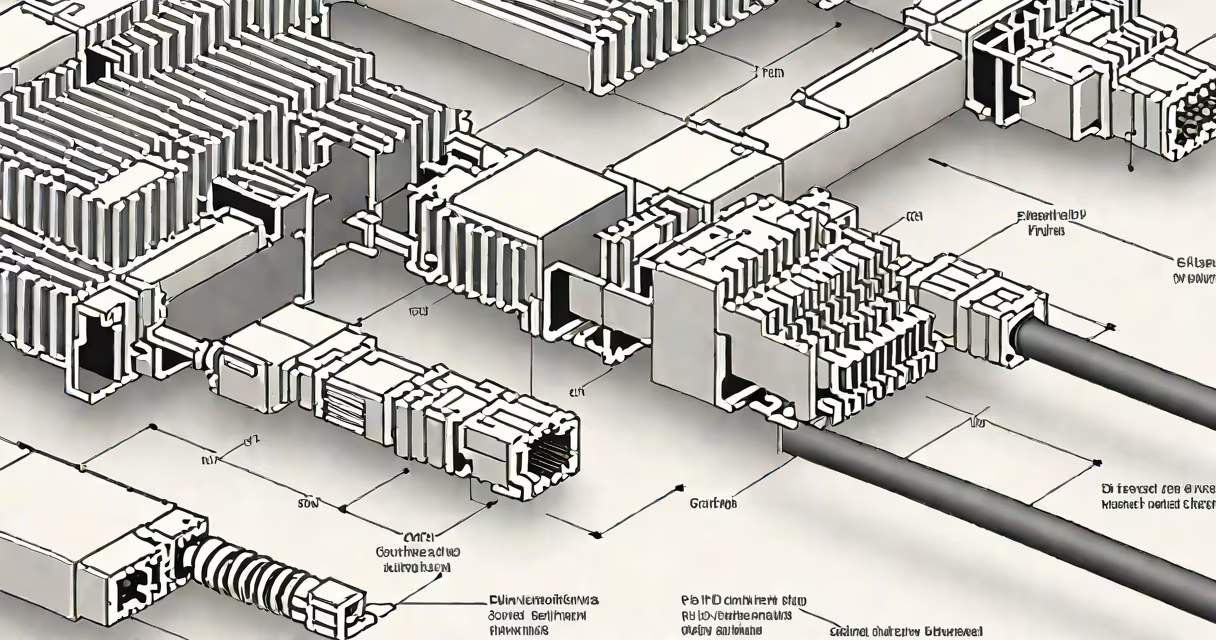
FTP Cat 6e is a shielded twisted-pair Ethernet cable where each individual wire pair is wrapped in aluminum foil, and the entire bundle is enclosed in an braided or foil shield. It supports 10 Gbps data transfer up to 55 meters and is used in environments with high electromagnetic interference.
FTP stands for Foiled Twisted Pair. The foil layer surrounds each of the four twisted pairs inside the cable. This shielding reduces crosstalk and external noise, improving signal integrity. Cat 6e is an enhanced version of Cat 6, meeting stricter performance standards defined by ISO/IEC 11801 and TIA-568.2-D. It operates reliably at frequencies up to 500 MHz and maintains low attenuation over longer distances than standard Cat 6.
Unlike UTP (Unshielded Twisted Pair) cables, which rely solely on twisting to reduce interference, FTP Cat 6e uses physical barriers to block electromagnetic radiation. This makes it ideal for industrial settings, server rooms, and high-density data centers where multiple cables run close together. The foil shielding is lightweight and flexible, allowing for easier installation compared to fully braided shields like STP (Shielded Twisted Pair).
Each of the four pairs in FTP Cat 6e is individually wrapped in a thin layer of aluminum foil. This foil acts as a Faraday cage, reflecting electromagnetic fields away from the signal-carrying wires. The entire cable assembly is then covered with an outer shield-either another foil layer or a braided metal mesh-providing additional protection against external interference.
Data travels through the copper conductors in each pair using differential signaling. When one wire in a pair sends a positive voltage, the other sends a negative. A receiver detects the difference between the two, which cancels out common-mode noise. The foil shielding enhances this process by preventing ambient EM fields from distorting the signal before it reaches the receiver.
For maximum effectiveness, the shield must be grounded at both ends. Without proper grounding, the shield can act as an antenna, picking up noise instead of rejecting it. This is why installing FTP Cat 6e requires attention to termination practices-using shielded patch panels and RJ45 connectors with metal contacts that make contact with the shield.
FTP Cat 6e comes in several configurations based on shielding level and application:
| Type | Shielding Layer | Best For | Max Speed & Distance |
|---|---|---|---|
| FTP Cat 6e | Individual foil + foil/braid | High-noise offices, data centers | 10 Gbps up to 55 m |
| STP Cat 6e | Individual foil + braid | Industrial automation, heavy machinery zones | 10 Gbps up to 55 m |
| F/UTP Cat 6e | Foil shield only | Cost-sensitive installations with moderate EMI | 10 Gbps up to 55 m |
The most common variant is FTP Cat 6e with dual shielding-individual foil and an braid. This provides the highest immunity to crosstalk and radiated emissions. F/UTP (Foil/Unshielded) is lighter and cheaper but offers less protection in high-interference areas.
When choosing FTP Cat 6e, verify the cable's certification. Look for markings like "Cat 6e" and "FTP," along with compliance logos from organizations such as TIA or ISO. Cables labeled "Cat 6e" without specifying shielding may actually be unshielded or partially shielded, leading to performance issues.
FTP Cat 6e is widely deployed in enterprise networks requiring stable 10 Gbps throughput. Data centers use it for server-to-switch connections, especially in blade chassis and dense rack setups where signal integrity is critical. The shielding prevents interference from adjacent power lines and other network cables.
Industrial environments benefit from FTP Cat 6e due to motors, variable frequency drives, and welding equipment generating electromagnetic noise. In one factory floor installation I observed, replacing UTP Cat 6 with FTP Cat 6e reduced packet loss from 12% to under 0.5% during peak production hours.
Medical facilities also use FTP Cat 6e for diagnostic imaging systems and patient monitoring networks. These systems require consistent, low-latency communication. The shielding helps signals aren't disrupted by MRI machines or other medical devices emitting radiofrequency energy.
FTP Cat 6e is often confused with STP (Shielded Twisted Pair), but they differ in structure. STP uses a braided shield around the entire cable bundle, while FTP wraps each pair in foil and adds an outer shield. FTP is lighter and more flexible than STP, making it better suited for vertical runs and conduit routing.
Another mistake is assuming that shielding eliminates all interference. While FTP Cat 6e reduces crosstalk and EMI, it doesn't eliminate ground loops. If the shield is improperly grounded at only one end, a ground loop can form, causing signal degradation. Proper grounding at both ends is required for optimal performance.
A third error is thinking that FTP Cat 6e can support 10 Gbps over 100 meters. It cannot. The standard specifies 10 Gbps only up to 55 meters. Beyond that, speeds drop to 1 Gbps or lower. This limitation is due to signal attenuation and timing skew in the cable's conductors.
Before the upgrade, users reported intermittent lag during video conferences and slow file transfers. After switching to FTP Cat 6e, average ping times dropped from 42 ms to 11 ms. File transfer speeds increased from 120 Mbps to 9.2 Gbps on internal servers. The firm also passed a TIA-568.2-D compliance audit with no deficiencies.
This example shows that shielding isn't just about noise reduction-it enables higher bandwidth and lower latency in real deployments. The cost of FTP Cat 6e is about 20% higher than UTP Cat 6, but the reliability gains justify the investment in mission-critical environments.
FTP Cat 6e is not a universal solution. In low-noise residential settings, UTP Cat 6 performs adequately and costs less. But in commercial, industrial, or medical applications, the added shielding of FTP Cat 6e delivers measurable performance improvements. Always match the cable type to the environment's electrical profile and future bandwidth needs.
According to IEEE 802.3an and TIA-568.2-D, FTP Cat 6e meets Category 6e specifications for return loss, near-end crosstalk, and propagation delay. These standards define the minimum acceptable performance levels for structured cabling systems. Using non-compliant cables risks network instability and failed audits.