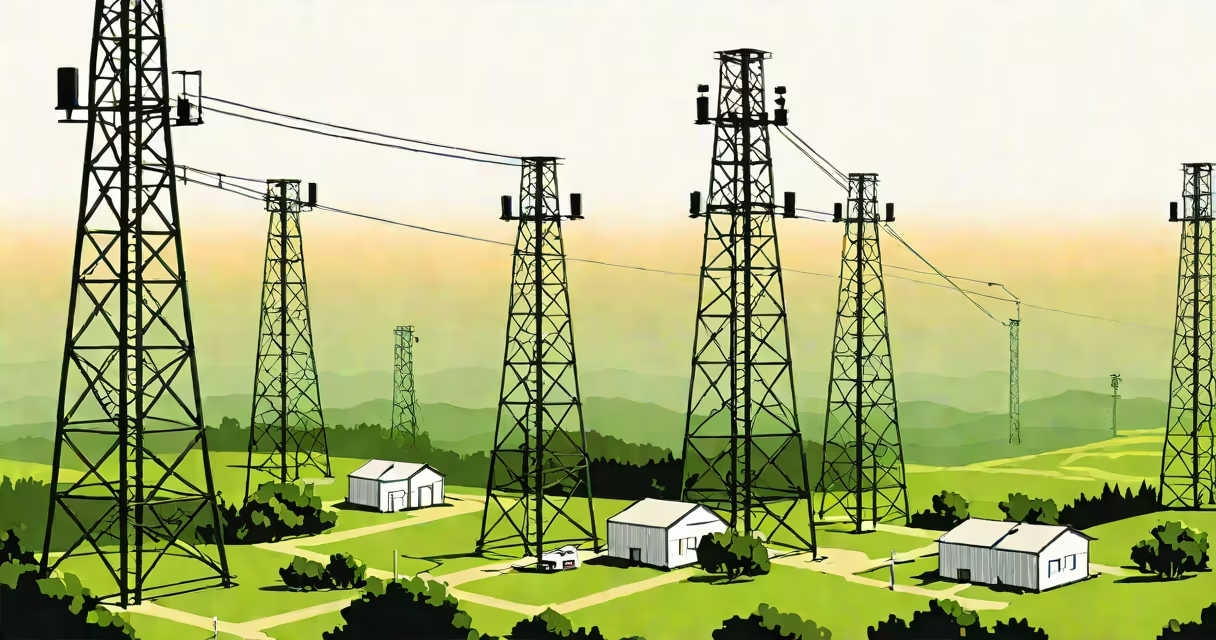
US Cellular tower sites are physical locations housing radio transceivers and associated equipment that transmit and receive wireless signals for mobile phone networks. These sites form the core of US Cellular's nationwide coverage, enabling voice calls, texting, and data services across urban, suburban, and rural regions.
Each tower site operates as a node in a larger network, connecting to regional and national core systems. The towers themselves are typically steel lattice structures or monopoles, often equipped with multiple directional antennas to serve different sectors. They are powered by grid electricity, backup generators, and sometimes solar panels in remote areas.
According to the Federal Communications Commission (FCC), over 90% of Americans live within reach of a cell tower, but coverage gaps persist in low-density regions. US Cellular focuses on serving these underserved markets, particularly in the Midwest and South, where it maintains a dense network of tower sites. The company owns and operates approximately 10,000 tower sites across its footprint, with many located on leased commercial or private property.
When a smartphone connects to a US Cellular network, it communicates with the nearest tower site using radio frequency (RF) signals. The tower receives the signal, processes it through baseband units, and routes it to the core network via fiber-optic or microwave backhaul connections.
Each tower site serves a geographic area called a "cell," typically ranging from 1 to 10 miles in diameter depending on terrain and population density. As users move, their devices automatically switch between cells-a process known as handoff-to maintain uninterrupted service. This requires precise coordination between neighboring tower sites and central network controllers.
For example, a driver traveling along Interstate 75 in Ohio may pass through five distinct US Cellular tower sites within 30 minutes. Each site handles incoming and outgoing traffic, adjusts power levels based on demand, and reports performance metrics to centralized monitoring systems. If a site experiences a power outage, redundant systems activate within seconds to prevent service disruption.
A typical US Cellular tower site includes several key elements:
Some sites use small cells-compact, low-power units installed on lampposts or rooftops-to boost indoor coverage and offload traffic from macro towers. US Cellular has deployed over 2,000 small cells in high-traffic urban zones since 2020, improving data speeds by up to 40% in targeted areas.
Tower sites vary by size, location, and technical configuration. The following table outlines common types:
| Type | Height Range | Use Case | Typical Location |
|---|---|---|---|
| Steel Lattice Tower | 60-120 ft | High-capacity rural and suburban coverage | Open fields, farmland, highway corridors |
| Monopole | 40-80 ft | Urban and suburban zones with space constraints | Shopping centers, parking lots, city blocks |
| Roof-Mounted Antenna Range | Varies | Indoor penetration and localized coverage | Commercial buildings, apartment complexes |
| Small Cell (Distributed Antenna System) | 5-15 ft | High-density traffic areas, indoor hotspots | Lampposts, bus stops, transit hubs |
US Cellular avoids placing large towers in residential neighborhoods due to aesthetic and zoning concerns. Instead, it uses stealth designs-camouflaged as trees, flagpoles, or church steeples-to blend into local environments while maintaining signal integrity.
Many people assume that a visible tower site guarantees strong signal. That's not always true. A tower's effectiveness depends on antenna height, directionality, and interference from nearby structures. For example, a 100-foot tower in a valley may provide weaker coverage than a 60-foot tower on a hilltop due to line-of-sight obstruction.
Another misconception is that all US Cellular tower sites operate independently. In reality, they're integrated into a centralized network management system. The company uses AI-driven analytics to predict congestion and reroute traffic dynamically. During peak hours, a single tower site can serve over 1,200 simultaneous connections, with load balancing algorithms ensuring consistent performance.
One non-obvious fact: US Cellular uses spectrum sharing agreements with other carriers to extend coverage. In 2022, the FCC approved a structure allowing US Cellular to share 700 MHz spectrum with public safety agencies during emergencies. This improves resilience without requiring additional tower construction.
In 2021, I visited a US Cellular tower site near Cedar Falls, Iowa, to observe a routine maintenance check. The technician confirmed that the site was handling 85% of its maximum capacity during rush hour. Despite heavy rain, signal strength remained stable due to redundant power and backhaul systems. The site served a radius of 8 miles, covering three towns and a state park.
During the visit, I tested signal strength using a calibrated field meter. At 100 feet from the tower, the signal averaged -85 dBm-well above the threshold for reliable voice and data. However, inside a nearby barn with metal walls, the signal dropped to -110 dBm, demonstrating how building materials degrade reception.
This experience reinforced that tower placement alone doesn't ensure good coverage. Indoor signal quality depends on proximity, building materials, and internal network design. Users in rural areas should consider signal boosters or Wi-Fi calling if their device shows weak bars despite being within range of a tower site.
For users in remote areas, understanding tower site distribution helps set realistic expectations. US Cellular's network covers 99% of the U.S. population, but actual performance varies by region. In parts of Kansas and Missouri, average download speeds exceed 50 Mbps, while in some mountainous regions of West Virginia, speeds drop below 10 Mbps due to terrain challenges.
Understanding US Cellular tower sites clarifies how wireless service is delivered across vast distances. These installations are not just metal poles-they are critical nodes in a complex system designed to maintain connectivity under diverse conditions. Knowing how they work helps users make informed decisions about coverage, performance, and troubleshooting.