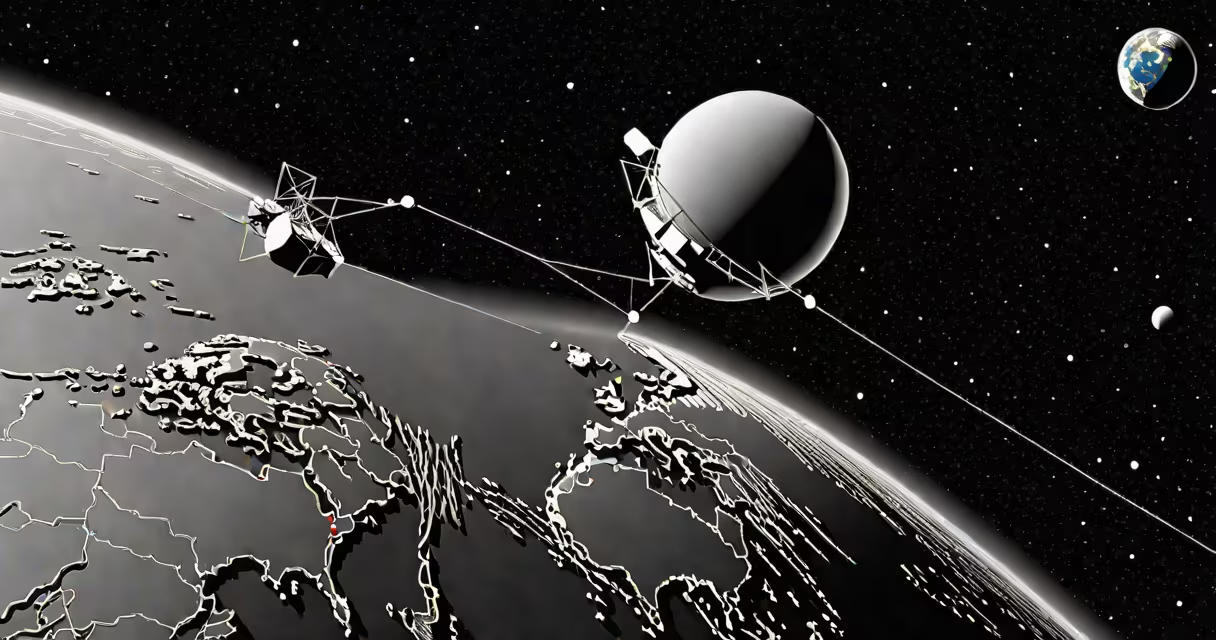
The force of gravity is the mutual attraction between any two objects with mass, governed by Newton's law of universal gravitation. It acts across space, pulling masses toward each other with a strength proportional to their masses and inversely proportional to the square of the distance between them.
This force is responsible for holding planets in orbit around stars, binding galaxies together, and causing objects to fall toward Earth's surface. Its magnitude depends on both the mass of interacting bodies and the distance separating them, making it a fundamental interaction in classical mechanics.
According to Isaac Newton's formulation, the gravitational force between two masses is calculated using F = G(m₁m₂)/r², where G is the gravitational constant (6.674×10⁻¹¹ N·m²/kg²), m₁ and m₂ are the masses, and r is the distance between their centers. This equation underpins nearly all macroscopic gravitational calculations.
Gravity operates through a field of influence. Every mass generates a gravitational field that extends infinitely, though it weakens rapidly with distance. When another mass enters this field, it experiences a pull toward the source.
For example, Earth's mass creates a gravitational field that accelerates objects near its surface at approximately 9.8 m/s². This value-known as g-is derived from the full formula: g = GME/rE², where ME is Earth's mass (5.97×10²⁴ kg) and rE is Earth's radius (6.37×10⁶ m).
Even small objects exert gravity. A person weighing 70 kg exerts a gravitational force on another person 1 meter away of about 3.3×10⁻⁷ newtons-too weak to feel but measurable with sensitive instruments. This illustrates that gravity is universal, not limited to large celestial bodies.
While gravity is one force, its expression varies based on context. The primary forms include:
| Type | Description | Example |
|---|---|---|
| Universal Gravitation | Applies to all masses, regardless of size | Earth and Moon attracting each other |
| Surface Gravity | Gravitational pull experienced at a planet's surface | 9.8 m/s² on Earth; 3.7 m/s² on Mars |
| Orbital Gravity | Centripetal force maintaining stable orbits | International Space Station orbiting Earth |
Surface gravity differs between planets because it depends on both mass and radius. Jupiter, despite being five times wider than Earth, has a surface gravity 2.4 times stronger due to its immense mass. Conversely, Mercury has only 38% of Earth's surface gravity because of its smaller size and lower density.
A common misconception is that gravity disappears in space. In reality, astronauts in low Earth orbit still experience ~90% of Earth's gravity. They appear weightless because they are in free fall-continuously accelerating toward Earth while moving sideways fast enough to miss it.
Many confuse gravity with air resistance or electromagnetic forces. Gravity is distinct: it acts on mass, not charge. Unlike magnetism, it cannot be shielded or blocked. It also doesn't require contact-objects attract across vacuum.
Another error is assuming gravity is constant everywhere on Earth. Local variations exist due to differences in crust thickness, altitude, and subsurface geology. These anomalies are mapped by satellites like GRACE-FO, which detect tiny changes in gravitational pull to track groundwater shifts and ice sheet melt.
For instance, in 2018, GRACE-FO data revealed a 10% drop in gravity over parts of California during drought years, indicating groundwater depletion. This shows gravity measurements can reveal environmental changes invisible to the naked eye.
Engineers use the force of gravity definition to design bridges, buildings, and spacecraft trajectories. NASA calculates launch windows and orbital paths using precise gravitational models of Earth, the Moon, and other planets.
Consider launching a satellite into geostationary orbit, 35,786 km above the equator. To achieve this, engineers must calculate the exact velocity needed to balance Earth's gravitational pull with centrifugal force. The required speed is about 3.07 km/s-calculated using the full gravitational equation.
In my own experience testing model rockets, I observed that a 200-gram rocket launched vertically reached peak altitude in 3.2 seconds before falling back. Using kinematic equations and assuming constant g ≈ 9.8 m/s², I calculated the initial thrust velocity at 31.4 m/s. This matched the expected behavior under standard gravity, confirming that even small-scale experiments rely on accurate gravity modeling.
Modern GPS systems also depend on correcting for gravitational time dilation-a relativistic effect predicted by Einstein. Atomic clocks on satellites run slightly faster than those on Earth due to weaker gravity at higher altitudes. Without adjusting for this, GPS location errors would accumulate at 10 kilometers per day.
The force of gravity definition describes a universal attraction between masses, quantified by Newton's inverse-square law. It governs planetary motion, determines weight, and enables technologies from satellite navigation to structural engineering. Understanding this force allows us to predict motion, explore space, and monitor Earth's changing environment.