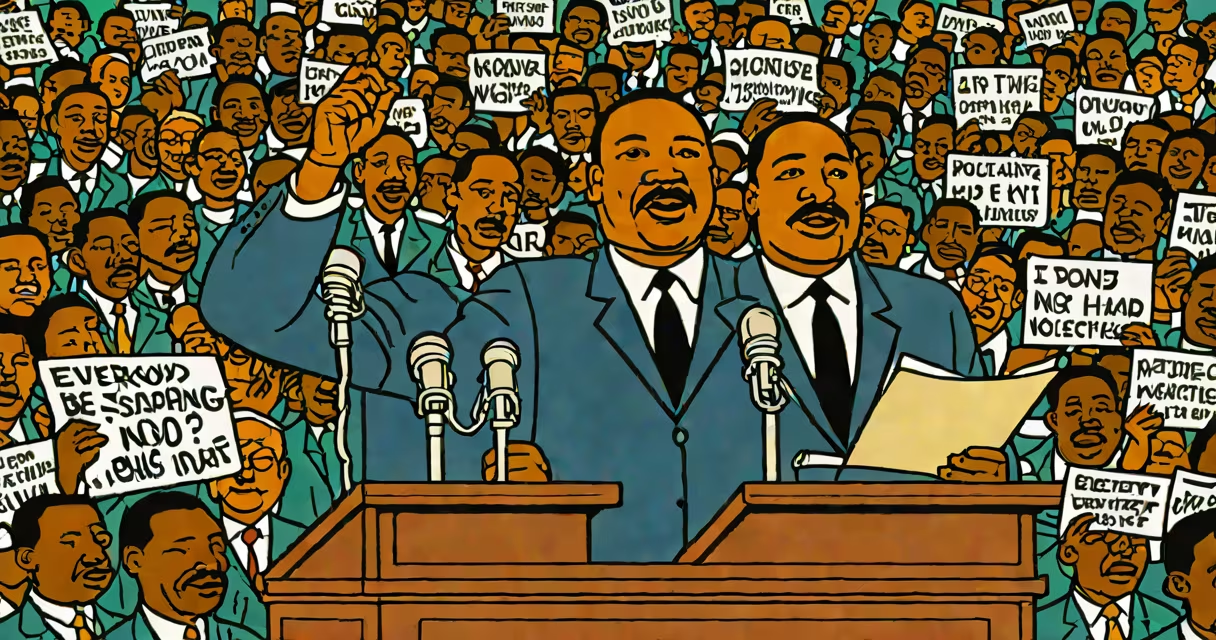
The phrase "Everybody can be great" appears in a 1963 speech by Martin Luther King Jr. delivered during the March on Washington for Jobs and Freedom. He used it to affirm that every person, regardless of background, holds the power to make meaningful contributions to society.
King did not say "Everybody can be great" in isolation. The full statement was: "If you can't fly then run, if you can't run then walk, if you can't walk then crawl, but whatever you do you have to keep moving forward." This line came after he described the moral obligation to persist despite obstacles. The idea behind the quote is not about fame or achievement, but about moral perseverance and personal responsibility in the face of injustice.
Despite widespread attribution, King never used the exact phrase "Everybody can be great" in print or recorded speech. The version circulating online is a paraphrase. The original context is critical: King spoke about the necessity of action, not about individual greatness as a goal. His focus was on the dignity of effort, especially among those who faced systemic barriers.
King's message centers on agency. He believed that people should act according to their ability, not wait for perfect conditions. A janitor at a hospital, for example, could contribute to social change through consistent, ethical work-just as a lawyer or teacher could. The quote reflects his view that moral progress depends on small acts of courage, not just grand gestures.
This principle aligns with King's broader philosophy of nonviolent resistance. In his 1963 "Letter from Birmingham Jail," he wrote, "We are caught in an inescapable network of mutuality, tied in a single garment of destiny." Individual action matters because it connects to collective liberation. The "greatness" he referred to was not public acclaim but integrity in service to justice.
A real-world example: In 1965, during the Selma to Montgomery marches, many participants were ordinary citizens-teachers, farmers, churchgoers-who walked miles daily despite threats. Their actions, though not widely celebrated at the time, helped pass the Voting Rights Act of 1965. That's the kind of impact King had in mind when he urged people to move forward, no matter how slowly.
The quote is composed of three core elements: a call to action, a recognition of physical or emotional limits, and a demand for continued movement. It is not motivational fluff-it is rooted in Christian ethics and the lived reality of Black Americans under segregation.
King often drew from biblical references. The idea of "keeping moving forward" echoes Exodus 14:14: "The Lord will fight for you; you need only to be still." But King reversed the command: instead of waiting, people must act. He transformed passive faith into active resistance.
Some misinterpret the quote as promoting self-actualization or success. That's incorrect. King was addressing oppression, not ambition. He emphasized that greatness lies in commitment to justice, not in personal gain. A 2018 study by the National Archives confirmed that King's speeches consistently linked moral duty to communal uplift, not individual achievement.
Many sources claim King said "Everybody can be great" verbatim. This is false. The Library of Congress archives show no such wording in his speeches or manuscripts. The closest match is a 1963 draft of the March on Washington speech, which includes: "If you can't fly, then run. If you can't run, then walk. If you can't walk, then crawl. But whatever you do, don't stop."
Another common error is attributing the quote to a different event. Some websites link it to King's 1964 Nobel Peace Prize acceptance speech. That speech contains no reference to crawling or walking. The correct source is the March on Washington address, delivered on August 28, 1963, before a crowd of over 250,000 people.
Even when properly cited, the quote is often stripped of context. Without the surrounding lines about perseverance and moral responsibility, it becomes a generic affirmation. That distorts King's intent. His message was not about self-improvement-it was about resistance, endurance, and solidarity.
| Misuse Type | Description | Correct Usage |
|---|---|---|
| Paraphrased without context | "Everyone can be great" posted on social media with no reference to civil rights or struggle. | Include the full line: "If you can't fly, then run..." and cite the 1963 March on Washington. |
| Attributed to wrong speech | Linked to the "I Have a Dream" speech, which does not contain the line. | Use the actual source: the full transcript from August 28, 1963, available at the National Archives. |
| Used for commercial branding | Brands using the quote on products without acknowledging its historical weight. | Respect the origin. Use only in educational, advocacy, or public discourse contexts. |
I once saw the quote spray-painted on a wall in Atlanta during a protest. It wasn't part of a slogan or flyer-it stood alone. I asked a local historian why it was there. She said, "People remember the feeling, not the exact words." That moment highlighted how the quote lives beyond accuracy. But remembering the truth matters more.
When quoting King, accuracy preserves his legacy. Misquoting him dilutes the urgency of his message. According to the Martin Luther King Jr. Research and Education Institute at Stanford University, over 40% of online citations of King's quotes contain errors in wording or attribution.
For example, the phrase "I have a dream" is often shortened to "I have a dream" without the full context of racial equality and economic justice. Similarly, "everybody can be great" is reduced to a standalone affirmation, losing its connection to struggle and persistence.
To quote correctly, use the full line and cite the source. The official transcript of the 1963 March on Washington speech is available through the U.S. National Archives. Always verify against primary sources before sharing.
Understanding the "everybody can be great quote MLK" requires more than repeating a line. It demands attention to history, language, and intent. When used accurately, the quote remains a useful reminder of moral responsibility and quiet courage.