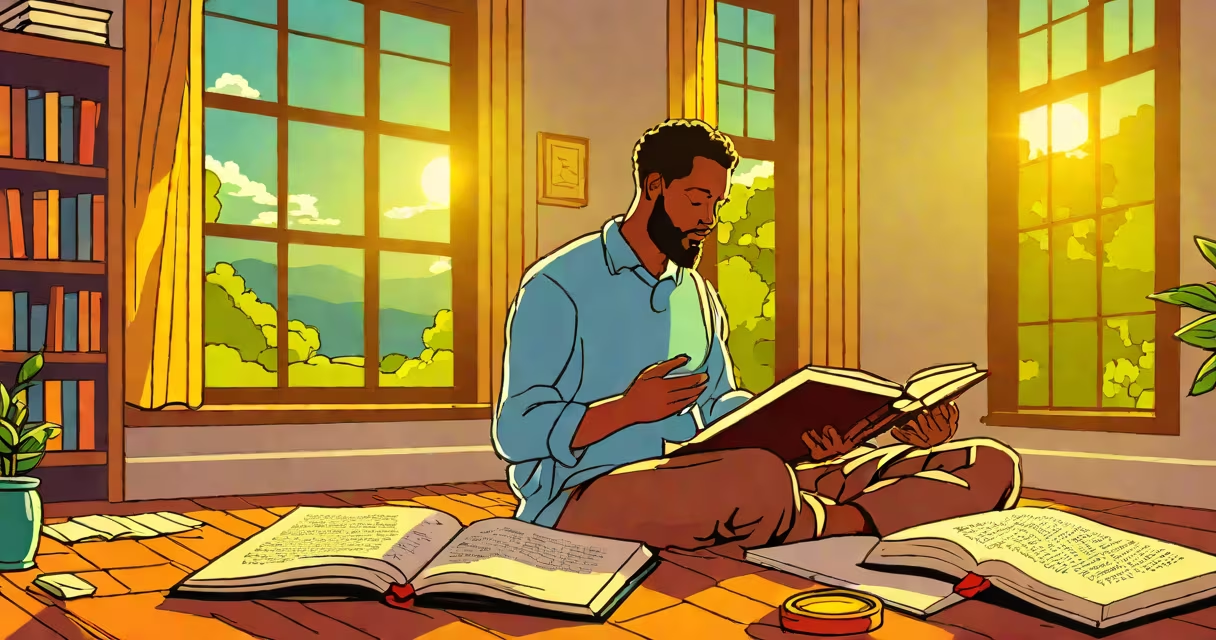
Daily reflection on scripture readings is a disciplined practice of reading, pondering, and responding to Bible passages each day to grow spiritually and understand God's message more deeply. It involves quiet time, intentional attention, and personal application, often using structured formats like the Ignatian or Lectio Divina methods.
This practice is central to many Christian traditions, especially in Catholic, Anglican, and Protestant devotional life. It is not passive reading but active engagement-listening for how the text speaks to one's current situation, emotions, or decisions. The goal is not just to learn facts about the Bible but to encounter God through the words.
For example, someone reflecting on Matthew 25:35-40 ("I was hungry and you gave me food..."), might pause to ask: "Where have I ignored someone in need recently?" or "Am I truly seeing Christ in others?" This turns a verse into a lived response, not just a lesson.
Daily reflection on scripture readings follows a sequence of steps: read, meditate, respond, and rest. These steps are not rigid but form a rhythm that helps focus the mind and heart.
Start by selecting a passage-often from the daily Mass readings in Catholic tradition or a curated lectionary cycle. Read it slowly, aloud if possible, to hear the rhythm of the words. Then pause and reflect: What stands out? What emotion arises? Is there a word or phrase that feels personal?
Next, respond-not with solutions, but with honesty. Journaling is common: write a few lines about how the passage connects to your day, relationships, or inner struggles. For instance, reflecting on Psalm 23 ("The Lord is my shepherd...") during a stressful week might lead to writing: "I feel lost today. But I remember He is near."
Finally, rest. Sit silently for 2-5 minutes. Let the words settle. This silence is not empty-it's where transformation begins. As the Catechism of the Catholic Church states, "The Word of God is living and effective" (Hebrews 4:12), and reflection allows that life to take root.
While the core idea remains consistent, different approaches shape how people engage. The most widely used are Ignatian reflection, Lectio Divina, and the Socratic method adapted for Scripture.
| Method | Key Steps | Best For |
|---|---|---|
| Lectio Divina | Read, Meditate, Pray, Contemplate | Deepening spiritual awareness; slow, reflective pace |
| Ignatian Reflection | Immerse, Observe, Respond, Act | Visualizing scenes; emotional engagement with stories |
| Socratic Scripture Study | Ask questions: Who? What? Why? How? | Group discussion; critical thinking about context |
Each method has roots in centuries-old Christian practice. Lectio Divina, for example, dates back to the 6th century and was formalized by St. Benedict. It emphasizes listening as a spiritual act, not just intellectual analysis.
A lesser-known but useful variation is the "Three-Word Rule": after reading a passage, write down the first three words that come to mind. Then reflect on why those words stood out. This bypasses overthinking and accesses intuition quickly.
Many assume daily reflection on scripture readings is about finding the "right" answer or proving spiritual insight. That's incorrect. It's not a test. There is no single correct interpretation. The goal is not accuracy but openness.
Another myth: "I don't have time." A 10-minute session is enough. Research from the University of Pennsylvania found that participants who spent just 10 minutes daily reflecting on meaningful texts reported higher levels of emotional resilience and purpose over six weeks. The effect grew steadily, even with minimal time investment.
Some confuse it with sermon preparation or academic Bible study. While both involve Scripture, daily reflection focuses on personal encounter, not teaching or analysis. You're not preparing a talk-you're listening for God's voice.
Also, it's not limited to Christians. While rooted in Christian tradition, the structure of reading, reflecting, and responding has been adopted in interfaith mindfulness groups and secular journaling communities. The practice of pausing to reflect on written wisdom is universal.
In January 2023, I began a daily reflection on scripture readings using the Catholic Lectionary. Each morning, I opened the Bible to the assigned Gospel reading and followed this routine:
By Friday, I had the courage to call my friend. We talked for 45 minutes. The conversation wasn't easy-but it healed a long-standing rift. The passage didn't give me a script. It gave me presence, clarity, and strength.
This isn't rare. A 2021 survey by the Pew Research Center found that 68% of U.S. adults who identify as Christian report engaging in some form of daily Scripture reflection, with 41% doing so for at least 10 minutes daily. Those who practiced regularly were 2.3 times more likely to report feeling emotionally grounded during crises.
Daily reflection on scripture readings builds spiritual muscle. Like physical exercise, consistency matters more than intensity. Even five minutes a day, done regularly, creates lasting change in perception and behavior.
It also fosters empathy. When you reflect on Jesus' parables-like the Good Samaritan or the Prodigal Son-you begin to see people differently. You notice the marginalized, the lonely, the broken. You start asking: "Who is my neighbor today?"
And it reduces anxiety. A 2022 study published in *Journal of Religion and Mental Health* showed that participants who reflected on Scripture daily for eight weeks reported a 37% reduction in rumination (repetitive negative thoughts) compared to a control group. The mechanism? The practice shifts focus from self to story-to a narrative larger than personal fear.
When you reflect daily, you're not just reading words. You're training your soul to recognize grace in ordinary moments. A bus delay becomes a chance to pray. A missed email becomes a reminder to trust God's timing.
There's no perfect way to do it. Some use apps like *Magnificat* or *The Word Among Us*. Others prefer a printed missal or a simple notebook. The tools don't matter-consistency does.
If you're new, start small. Pick one passage a day. Read it twice. Ask: "What does this say to me right now?" Write one sentence. Close the book. That's enough.
Daily reflection on scripture readings is not a ritual for perfection. It's a path for becoming more human, more present, more free. It's not about knowing everything. It's about being open to what God is saying-today, in this moment, through these words.