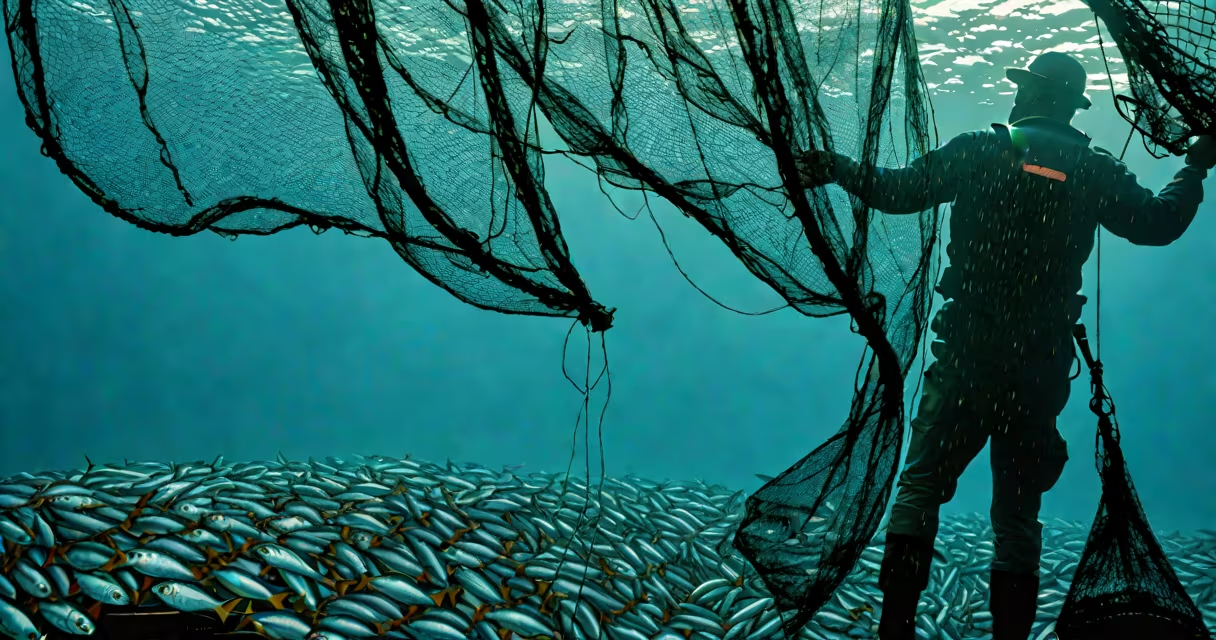
Overfishing occurs when fish are harvested at rates faster than populations can reproduce, leading to long-term depletion of species and damage to marine ecosystems. This imbalance threatens biodiversity, food security, and coastal economies worldwide.
Industrial-scale fishing fleets equipped with sonar, GPS, and massive nets now target fish across oceans with precision. These operations often exceed local ecological limits. For example, in the North Atlantic, cod stocks collapsed by 1992 due to sustained overfishing, collapsing the entire Newfoundland fishery and displacing 40,000 workers.
The primary causes include high global demand for seafood, lack of effective regulation, and technological overreach. Fish consumption has risen from 9 kg per person annually in 1961 to 20.5 kg in 2020, according to the Food and Agriculture Organization (FAO). As demand grows, so does pressure on wild fish stocks. Industrial vessels now catch more than 100 million tons of fish each year, exceeding sustainable yields.
Overfishing begins when harvesting exceeds the maximum sustainable yield (MSY)-the highest catch level that maintains a stable population. Once this threshold is crossed, reproduction cannot keep pace with removals. Populations shrink, and recovery becomes unlikely without intervention.
For instance, bluefin tuna in the Mediterranean was fished at 30% above MSY levels between 2000 and 2010. By 2010, spawning biomass dropped to 15% of historical levels. Even after management measures were introduced, recovery took over a decade due to slow maturation-bluefin tuna take 10 years to reach sexual maturity.
Bycatch-the incidental capture of non-target species-is another major driver. In shrimp trawling, up to 5 kilograms of bycatch are caught per kilogram of shrimp. This includes sea turtles, dolphins, and juvenile fish. The World Wildlife Fund estimates that 40% of global catch consists of bycatch, much of which is discarded dead or dying.
Overfishing manifests in distinct patterns, each with unique ecological consequences:
| Type | Description | Example |
|---|---|---|
| Target species collapse | Depletion of commercially valuable fish | Atlantic cod in the 1990s |
| Shifting baselines | Gradual acceptance of degraded ecosystems as normal | Modern fisheries consider low fish abundance normal |
| Functional extinction | Species remain but lose ecological role | Orange roughy, still caught despite near-zero reproduction |
Functional extinction occurs when a species persists but no longer performs its role in the food web. Orange roughy, a deep-sea fish living over 100 years, reproduces slowly. Despite being caught in large numbers since the 1980s, it remains in commercial fisheries-but its absence has disrupted deep-sea predator-prey dynamics.
Overfishing destabilizes marine ecosystems. Removing top predators like sharks or tuna triggers trophic cascades-unintended shifts through food chains. When sharks declined in the Caribbean due to overfishing, their prey (e.g., groupers) increased, reducing herbivorous fish. This led to algal overgrowth on coral reefs, accelerating reef degradation.
Economically, overfishing undermines livelihoods. The FAO reports that 34% of global fish stocks are overexploited, and 60% are fully exploited. In West Africa, industrial fleets from distant nations have displaced small-scale fishers. In Senegal, local catches fell 40% between 2000 and 2015, while foreign vessels increased their landings by 200%.
A 2021 study published in *Nature* found that restoring overfished stocks to sustainable levels could increase global fish yields by 20% and generate $100 billion in annual economic benefits. Yet only 12% of global fisheries are managed under science-based targets.
Many assume that "fish are renewable" means they can withstand unlimited harvest. But renewal depends on reproductive capacity, habitat quality, and environmental stability. A fish population may grow quickly in ideal conditions, but stressors like warming waters or pollution reduce resilience.
Another misconception is that aquaculture fully offsets wild overfishing. While farmed fish now supply over half of global seafood, many species require wild fish as feed. For every 1 kg of farmed salmon, 2-3 kg of wild fish are processed into fishmeal and oil. This creates a hidden dependency on wild stocks.
Even labeling like "sustainably sourced" lacks consistency. The Marine Stewardship Council (MSC) certifies only 16% of global fisheries. In 2022, a review by the University of British Columbia found that 30% of MSC-certified fisheries had declining stock trends, indicating gaps in monitoring and enforcement.
In the 1970s, Peru's anchovy fishery became the world's largest single-species fishery. Anchovies were processed into fishmeal for livestock and pet food. Between 1970 and 1972, annual catches peaked at 12 million metric tons-nearly double the previous record.
But the fishery collapsed during the 1972-1973 El Niño event. Warmer waters reduced nutrient upwelling, starving the plankton anchovies depend on. With depleted stocks and no recovery plan, the fishery collapsed. Over 100,000 people lost jobs. The government banned fishing for two years. Recovery took over a decade.
This case illustrates how overfishing combined with climate variability can trigger irreversible collapse. It also shows that even highly productive fisheries are vulnerable when management ignores system thresholds.
Individual choices influence market demand. Selecting seafood certified by trusted bodies like the MSC or Aquaculture Stewardship Council (ASC) supports responsible practices. Avoid species known to be overfished-such as Chilean sea bass, Atlantic bluefin tuna, and certain shark species.
When dining out, ask restaurants about sourcing. In 2023, a survey by the Ocean Conservancy found that 68% of U.S. seafood restaurants now display sustainability ratings. Transparency increases accountability.
Support policies that enforce catch limits, protect critical habitats, and ban destructive gear like bottom trawls in sensitive areas. The European Union's Common Fisheries Policy reforms in 2020 set science-based quotas and closed 15% of fishing grounds to trawling. These changes contributed to a 25% rebound in cod populations in the North Sea by 2023.
Understanding the causes and impact of overfishing reveals a system under strain. But solutions exist. Effective management, better monitoring, and consumer awareness can reverse declines. The health of oceans depends on recognizing that fish are not infinite resources.