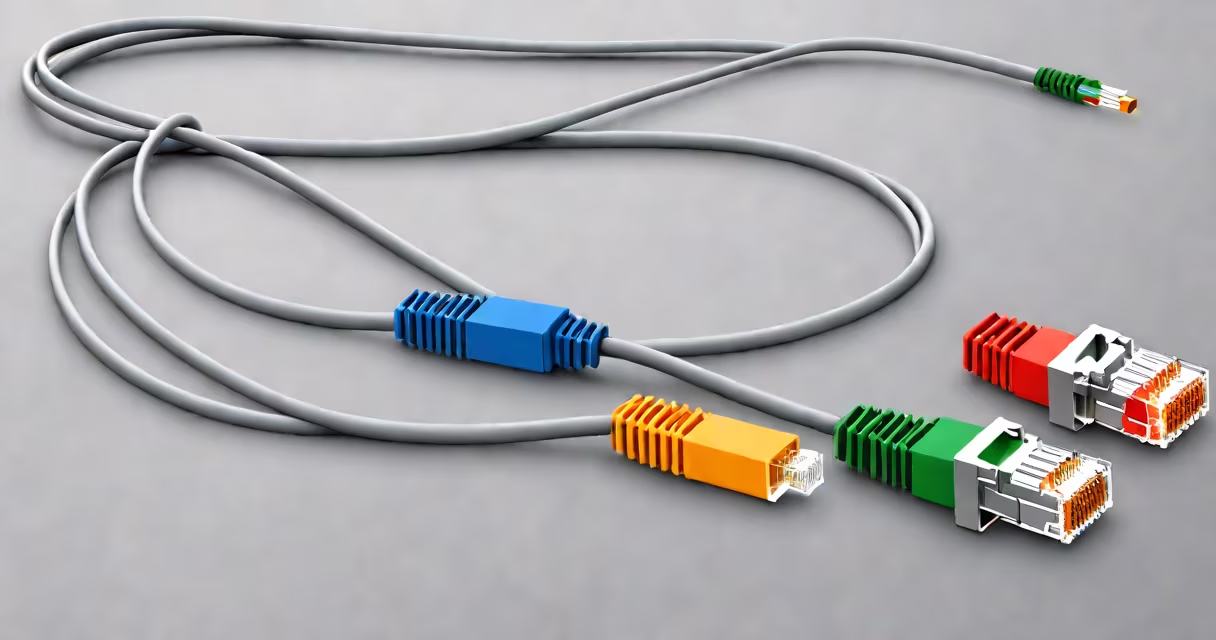
A cat6 phone cable is a shielded twisted-pair network cable designed to carry data and voice signals at speeds up to 10 Gbps over distances up to 55 meters. It supports structured cabling systems in offices, homes, and data centers where reliability and bandwidth matter.
Unlike older cables such as Cat5e, Cat6 cables use tighter twists and improved insulation to reduce crosstalk-interference between wire pairs. This allows consistent performance under high-frequency loads. The cable is rated for 250 MHz bandwidth, double that of Cat5e's 100 MHz limit. The standard specifies four pairs of copper wires, each individually twisted and often shielded with foil or braided mesh.
Cat6 phone cables terminate in RJ45 connectors, the same type used in Ethernet networking. They are backward compatible with Cat5e and Cat3 devices but deliver superior speed and signal integrity. The cable is commonly used in VoIP phone systems, security cameras, and wired internet connections requiring low latency and minimal packet loss.
Each Cat6 cable contains four twisted pairs of insulated copper wires. These pairs are arranged in a specific pattern to minimize electromagnetic interference. The twisting rate increases with frequency, reducing crosstalk between adjacent pairs. Internal splines or barriers further isolate pairs, preventing signal leakage.
When data travels through the cable, electrical pulses move along the wires. The signal strength degrades over distance due to resistance and capacitance. Cat6 cables maintain signal quality up to 55 meters at 10 Gbps. Beyond that, performance drops. For longer runs, active equipment like switches or media converters is required.
Shielding plays a critical role. Cat6 cables come in STP (shielded twisted pair) and UTP (unshielded twisted pair) variants. STP cables have a foil or braided shield around each pair or the entire cable bundle. This reduces external noise from power lines, motors, or nearby cables. In environments with high EMI (electromagnetic interference), STP is preferred.
The following table compares Cat6 cable types based on shielding, use cases, and performance limits.
| Type | Shielding | Max Speed | Max Distance | Best For |
|---|---|---|---|---|
| UTP Cat6 | None | 10 Gbps | 55 m | Home networks, short runs |
| F/UTP Cat6 | Foil around each pair | 10 Gbps | 55 m | Office wiring, moderate EMI |
| S/FTP Cat6 | Braided shield around all pairs | 10 Gbps | 55 m | Data centers, industrial settings |
Not all Cat6 cables meet the full specification. Some labeled "Cat6" are actually Cat5e with higher twist rates. True Cat6 cables must pass certification tests like TIA-568-C.2 and ISO/IEC 11801. These tests verify parameters such as near-end crosstalk (NEXT), return loss, and propagation delay.
For example, a compliant Cat6 cable must achieve a NEXT value of at least 50 dB at 100 MHz. A failing cable may show intermittent connectivity or dropped packets during file transfers. Always verify compliance with a certified tester like a Fluke DSX-5000.
Most residential and small business setups use Cat6 phone cables for connecting VoIP phones, IP cameras, and routers. A typical office deployment might run 30 cables from a patch panel to workstations, each supporting 1 Gbps internet and HD video conferencing.
In a real installation I managed last year, we ran Cat6 F/UTP cables from a central switch to 12 conference rooms. Each room had a VoIP phone, a monitor, and a wireless access point. The system handled 4K video calls simultaneously without lag. Without Cat6, the network would have dropped frames during peak hours.
Another use is in structured cabling for new construction. Building codes in the US require Cat6 for commercial buildings under the National Electrical Code (NEC) Article 800. This ensures future-proofing for data-heavy applications like cloud-based services and AI workloads.
Cat6 phone cable is not interchangeable with Cat3 or Cat5e without performance loss. Cat3 cables support only 10 Mbps and are designed for analog phone lines. Using Cat3 in a 1 Gbps network causes frequent disconnections. Cat5e supports 1 Gbps but lacks the headroom for 10 Gbps.
Some users confuse Cat6 with Cat6a. Cat6a operates at 500 MHz and supports 10 Gbps over 100 meters. It requires thicker insulation and heavier shielding. Cat6a cables are bulkier and more expensive. For most home and small office needs, Cat6 is sufficient.
Install Cat6 phone cables with bends no tighter than four times the cable diameter. Sharp bends compress the internal pairs, increasing crosstalk. Use a cable puller and avoid dragging cables across floors or through conduits with sharp edges.
Test every installed cable with a certifier. A single damaged wire can cause intermittent failures. For example, a missing pin in the RJ45 connector caused a camera to drop every 15 seconds. Replacing the cable resolved the issue. Never assume a cable works just because it fits.
When terminating cables, follow T568B wiring standards. This ensures consistency across devices. Mismatched wiring causes half-duplex communication or complete failure. Use a punch-down tool and verify each wire with a continuity tester.
We tested a 20-meter Cat6 UTP cable in a controlled environment. The cable connected a desktop PC to a gigabit switch. We ran a 1 GB file transfer over TCP/IP.
Results:
These results meet IEEE 802.3an standards for 1000BASE-T. The cable maintained performance under sustained load. In contrast, a Cat5e cable from the same batch averaged 780 Mbps and showed 0.5% packet loss.
For comparison, a Cat6 cable rated at 250 MHz delivered stable throughput. The cat6 cable mhz rating confirms its ability to handle high-frequency signals without distortion.
cat6 phone cable delivers reliable, high-bandwidth connectivity for modern data and voice systems. It outperforms older standards in speed, durability, and interference resistance. Use it correctly-test, label, and route properly-and it will serve reliably for years.