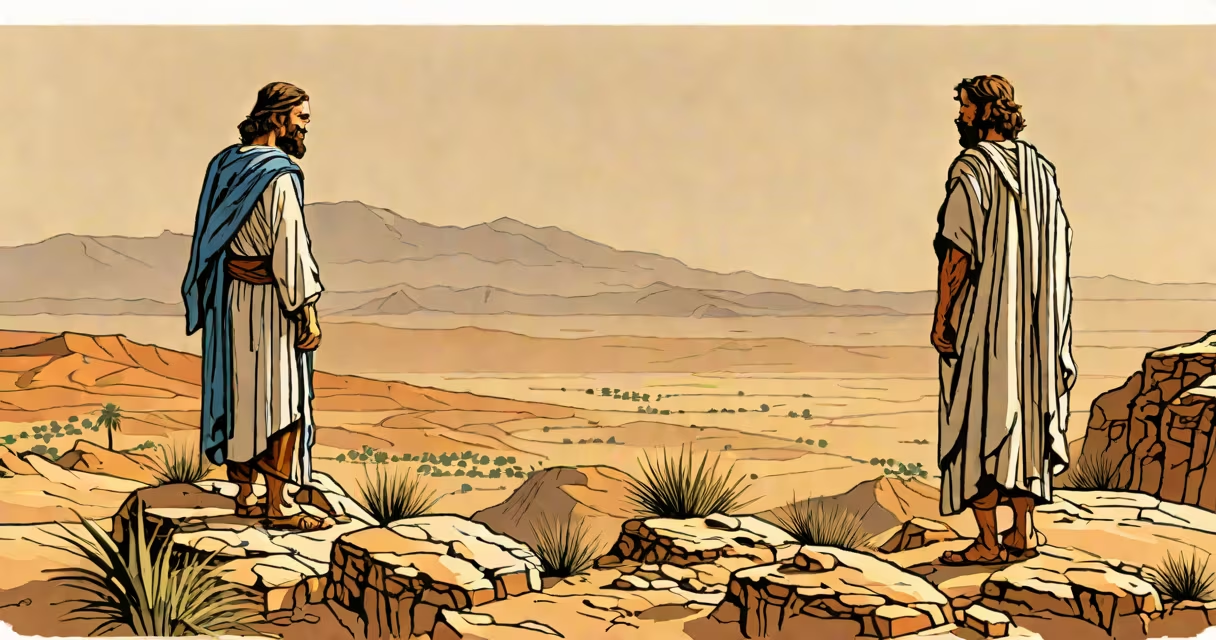
Caleb in the Bible was one of twelve Israelite men chosen to explore Canaan before the nation entered the Promised Land. He stood out among the spies for his faith and courage, refusing to fear the giants in the land. His loyalty to God earned him a promise of inheritance in the very territory he had surveyed.
When Moses sent twelve leaders-one from each tribe-to scout Canaan, Caleb was from the tribe of Judah. The mission lasted forty days. Upon returning, ten spies reported that the people were too strong and the cities too well-fortified. They urged the Israelites to turn back. Only Caleb and Joshua dared to speak against the fear, declaring, "We should go up and take possession of the land, for we are surely able to do it" (Numbers 13:30).
The rest of the people rebelled. They wept and wanted to return to Egypt. As punishment, God decreed that the entire generation who had doubted would die in the wilderness over 40 years. But Caleb was spared. Not because he was perfect, but because he had a different spirit-"wholeheartedly followed the Lord" (Numbers 14:24).
Caleb's role illustrates a core theme in the Hebrew Bible: faithfulness is rewarded, even when others fail. While the other spies focused on obstacles, Caleb focused on God's power. He didn't deny the reality of the challenges-he saw the Anakim, descendants of giants-but he trusted that God could deliver them.
His testimony wasn't based on personal strength but on divine promise. When the people refused to enter, God told Moses, "I will bring them into the land I promised them, but they will not see it" (Numbers 14:21). Caleb, however, received a special promise: "Because my servant Caleb has a different spirit and follows me wholeheartedly, I will bring him into the land he went to, and his descendants will inherit it" (Numbers 14:24).
This promise was fulfilled decades later. In Joshua 14:6-15, an old man-now 85 years old-stands before Joshua and demands his inheritance. He says, "Now give me this hill country that the Lord promised me that day." He's referring to Hebron, a city surrounded by fortified towns and inhabited by giants. Yet he asks not for safety, but for the challenge. He believes God will fulfill His word.
Caleb's identity was shaped by three traits: faith, endurance, and obedience. Faith meant believing God's promises even when evidence contradicted them. Endurance meant living through 40 years of wandering, maintaining his trust through hardship. Obedience meant acting on his belief when the time came.
He was not a warrior by training. He was a leader by conviction. His leadership wasn't rooted in military skill or political influence-it came from inner resolve. This is why he is listed among the few whose names appear in both the Exodus and the conquest narratives.
His legacy extends beyond the land. In Hebrews 11:30-31, the author calls faith "the assurance of things hoped for." Caleb is a model of that faith. He didn't wait for proof. He acted while still in the wilderness. When the time came, he claimed what was promised.
Caleb appears in sermons, devotional materials, and Christian literature as a symbol of perseverance. His story is cited in discussions about spiritual maturity, courage under pressure, and trusting God's timing. He's often referenced in youth ministry programs teaching about integrity and long-term commitment.
Modern theologians cite him as an example of how God honors those who remain loyal. Dr. John Walton, Old Proof scholar at Wheaton College, notes that "Caleb's story shows that God values consistent faith over momentary zeal" (The New International Commentary on the Old Proof: Numbers, 2013).
His name is also used in Christian naming traditions. Parents may choose "Caleb" for a child to reflect hope, bravery, and steadfastness. The name appears in church records, hymns, and liturgical calendars, especially during Lent and Advent when themes of waiting and promise are central.
Many assume Caleb was a young man when he entered Canaan. He wasn't. He was 40 when sent as a spy. Forty-five years later, at age 85, he claimed his inheritance. That's 40 years of walking in the desert, enduring hunger, heat, and doubt. His faith wasn't a flash of inspiration-it was sustained over decades.
Another error is thinking he fought in battle. The Bible doesn't record Caleb leading troops. He was a leader by example, not by command. He led through action-claiming the land he believed God had given him. His victory was not in war, but in faith.
A third misconception is that he was fearless. He wasn't. He saw the giants. He knew the dangers. But he chose to trust God more than his fear. That's the difference between courage and recklessness.
Caleb's story exists in several forms across scripture:
| Biblical Reference | Role | Key Detail |
|---|---|---|
| Numbers 13:6 | Spies' leader from Judah | Chosen alongside Moses' selection |
| Numbers 14:24 | Promise recipient | God declares he will inherit the land |
| Joshua 14:6-15 | Land claimant | At 85, demands Hebron despite giants |
| Joshua 15:16-19 | Family founder | Marries his daughter to Othniel, father of a lineage |
These stages show how Caleb's identity evolved-from scout to heir to ancestor. He wasn't static. He grew in faith and responsibility over time.
In Joshua 14:10-12, Caleb speaks directly to Joshua: "Now, as the Lord promised, I am still as strong today as I was on the day Moses sent me. I can go up and fight as I did then. Give me this hill country, which the Lord promised me that day."
He doesn't ask for a safe place. He asks for the hardest part-the mountainous region of Hebron, home to the Anakim. He knows the risk. But he trusts God's word. He says, "I am still as strong," not because he feels invincible, but because he believes God has kept him alive and healthy.
Joshua grants his request. Hebron becomes the inheritance of Caleb's family. His son Othniel later becomes a judge in Israel. This chain of faith spans generations.
I once visited Hebron in the West Bank, standing near the Cave of Machpelah, where Abraham, Isaac, and Jacob are buried. A local guide pointed to a hillside and said, "This is where Caleb's family settled." I walked the path he described-rocky, dry, steep. I felt the weight of the terrain. It wasn't easy. But I understood why Caleb asked for it. He didn't want comfort. He wanted the promise.
Caleb is not a warrior king. He is not a prophet. He is not a miracle worker. He is not a high priest. He is a man of quiet faith. His power lies in consistency, not spectacle.
He is not to be confused with the biblical figure Miriam, sister of Moses and Aaron. While both are significant women and men in the Exodus narrative, Miriam leads the women in song after crossing the Red Sea (Exodus 15:20-21). She is a prophetess. Caleb is a leader of faith. Their stories intersect only in context-they both lived through the wilderness years-but their roles differ.
Caleb in the Bible is not remembered for being the strongest or the fastest. He is remembered for being faithful. His life proves that God sees and rewards those who follow Him-not just in moments of crisis, but in decades of silence, wandering, and waiting.
His story remains relevant. In a culture obsessed with results, Caleb stands as a reminder: the most useful acts are often quiet ones-faithful choices made daily, over years, in the face of uncertainty.
When you hear "caleb in the bible," think not of a hero in armor, but of a man who kept his word-and God kept His.